
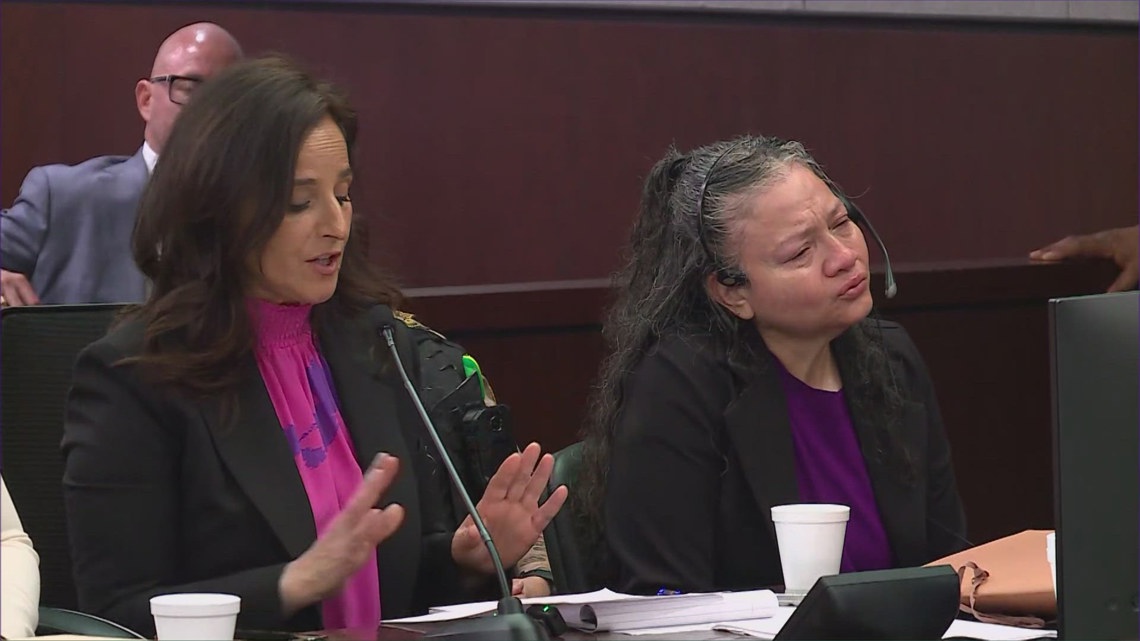
On Tuesday afternoon, the Honduras native remained behind bars, with about 24 hours remaining to see whether she’ll be taken into ICE custody or released.
AUSTIN, Texas — An Austin mother exonerated after a decades-long legal battle is still behind bars, even after a judge declared her innocent.
On Monday, a Travis County judge officially cleared Carmen Mejia of murder in the 2003 death of a baby in her care. But moments after the ruling, Mejia was taken back into custody because of a federal immigration detainer. The detainer gives federal authorities up to 48 hours to decide whether to take Mejia into custody or release her.
The dramatic turn came after an emotional court hearing where Mejia reunited with her daughters for the first time in more than two decades.
A reunion more than 20 years in the making
After the judge signed the order declaring her innocent, Mejia hugged her daughters – all of whom were under 8 years old when she was convicted and later adopted by other families.
“The only thing I knew about her was her name,” one daughter told the court. “I knew that she was in prison, but I didn’t know where or even if she was still in Texas.”
The case against Mejia began in 2003 when a baby in her care died. But new evidence and testimony reviewed in recent years convinced prosecutors and the state’s highest criminal appeals court that the child’s death was an accident.
On Monday, David Wahlberg, judge of the 167th District Court, formally declared Mejia innocent and dismissed the charges.
“Miss Mejia, I wish that signing this order here this afternoon would be the end of this tragedy,” Wahlberg said in court. “Unfortunately, I don’t believe it will be.”
Immigration hold complicates release
Shortly after the ruling, Mejia was escorted out of the courtroom and back into the custody of the Travis County Sheriff’s Office due to an immigration detainer filed by U.S. Immigration and Customs Enforcement.
Her attorneys with The Innocence Project said the agency has full discretion to decide whether to take her into federal custody or allow her to go free.
Mejia originally came to the U.S. from Honduras in 1995 and was living in the country legally under Temporary Protected Status when she was charged. Her legal team said she lost that status because of the conviction that has now been overturned.
Immigration attorney Vi Nanthaveth, who is not representing Mejia, told KVUE on Tuesday cases like this are extremely rare.
“It’s heartbreaking,” Nanthaveth said. “There’s no automatic mechanism that would just restore her immigration status.”
Former district judge Charlie Baird told KVUE he reached out to The Innocence Project about Mejia’s case after his bailiff, Art Guerrero, insisted it deserved a second look.
“Hopefully the immigration authorities will recognize that she was previously here with a legal status, that she has family here, that she probably has very little or no family in her country or origin, and that they might have think that the best thing for her to do under the circumstances – very unique circumstances – is to allow her to stay in the United States,” said Baird during an interview with KVUE on Tuesday.
Starting over after exoneration
Because her previous legal status was tied to a conviction that has now been erased, Mejia may have to rebuild her immigration case from the beginning.
Nanthaveth said possible options could include reregistering for Temporary Protected Status, seeking humanitarian parole or requesting cancellation of removal.
“As rare as this is, you have a person that has been fully exonerated, but yet there’s no automatic mechanism from the immigration side that would then just restore her immigration status,” Nanthaveth said.
For Mejia’s daughters, the hope is simple: that their mother can finally come home.
“I want us to spend holidays together, birthdays and even small moments like cooking dinner,” one daughter told the court.
Mejia’s attorneys said they are now working urgently to persuade federal authorities to release her so she can begin rebuilding her life with her family.
Federal officials have not yet offered details about what will happen next in Mejia’s case.