
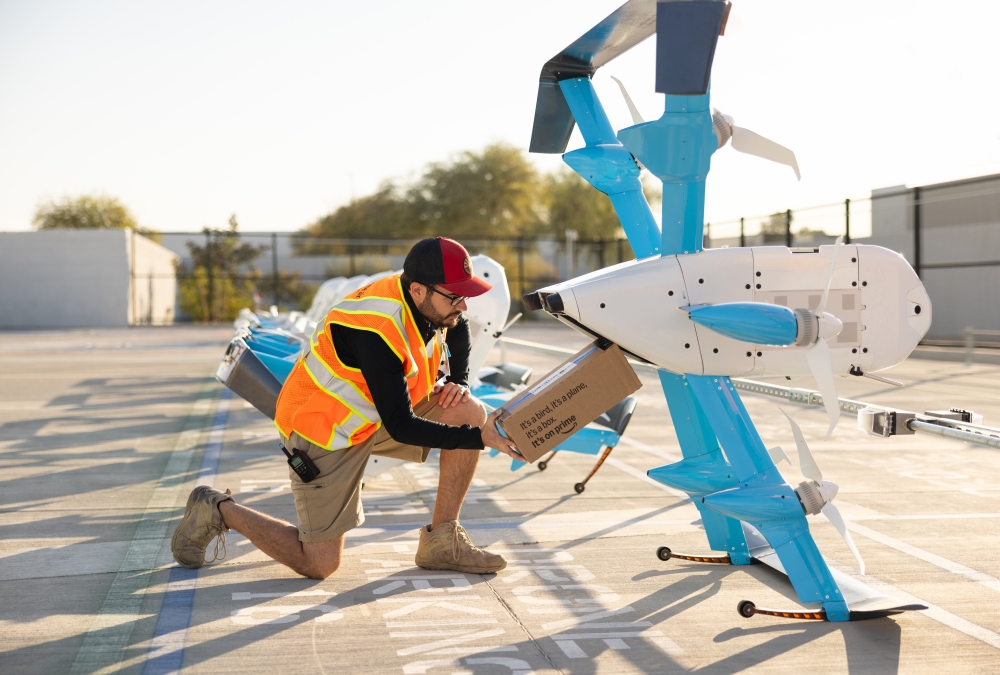
Amazon has introduced adjustments to its Prime Air drone delivery program in Richardson after residents voiced concerns about the noise and frequency of the drones.
Sam Bailey, senior manager of economic development policy at Amazon, explained Amazon’s initial adjustments at the March 9 City Council meeting, although he said there is “more work to do.”
The big picture
Council approved a zoning change in June in a 4-3 vote to allow Amazon to offer drone deliveries within a 7.5-mile radius of its Richardson facility on Research Drive.
The drone program launched in early December, delivering over 13,000 customer orders so far, Bailey said. Since the launch, residents who live near the Amazon facility have shared concerns about the noise, frequency and height of the drones that fly over their houses every day.
“While we understand progress, that progress needs to be balanced with quality of life,” resident Nancy Crow said. “Lately while in my yard, on my patio, gardening or walking in Crowley Park, I consistently hear the buzz of drones overhead, and it is very irritating and not very peaceful.”
Richardson does not have the ability to regulate most of the issues brought up in the complaints, as the drones are largely regulated by the Federal Aviation Administration, City Manager Don Magner said, but the city has worked with Amazon to address some of the concerns.
What’s new
Bailey said the following changes were implemented in February:
Increased minimum altitude for outbound flights to average of 225 feetRedirected select outbound flights to route eastward over the commercial area before entering the Creek Hollow Estates neighborhoodReduced overflight of greenway east of Woodcreek ChurchDecreasing the actual noise from the drone would require a hardware change, which will not be in development soon, Bailey said. Therefore, the primary method to decrease drone noise is by increasing their altitude.
In addition to raising the average altitude to 225 feet, the eastward route redirection aims to ensure the drones reach maximum height prior to crossing over residential areas.
“My goal is to make sure that anytime they are crossing a commercial line into a residential line, they’re at that 225 [feet],” Magner said.
Some context
There is a no-fly zone around the Methodist Richardson Medical Center, also located near the Amazon facility, that was instituted by the FAA due to emergency helicopter use at the hospital. The no-fly zone limits the routes that drones can take out of the Amazon facility, and Bailey said the new adjustments aim to ensure continued safe navigation around the center.
Many residents requested that the drone paths be rerouted to major roads rather than over neighborhoods. Bailey said this change could create safety concerns with other drone operators and their flight paths, cut into a drone’s “safe reserve” of energy and affect how many customers the drones are able to reach.
“We are taking the most direct flight to the customer, taking into account the standing no-fly zone that is currently in place,” Bailey said. “Routing over roads, I think it creates an additional safety issue, and it would consume drastically more energy.”
Also of note
Bailey addressed a Feb. 4 incident in which a drone struck a gutter on the side of a Richardson apartment building. He said the drone experienced interference to its GPS system due to the size of the building, and so Amazon removed larger multifamily buildings from the drone delivery program while engineers work to determine the cause of the issue.
Another thing
In addition to noise and frequency, some residents also expressed privacy concerns about the data that the drones may collect.
Bailey said the drones are equipped with a forward-facing camera, a Light Detection and Ranging system to scan for obstacles in the air and a perception system to scan for obstacles in the downward delivery path.
“There are no cameras facing downwards collecting data of individuals, cars [or] license plates,” Bailey said. “We aren’t collecting imagery of people’s backyards.”
Sensory data stays on the individual drone and is not viewed by flight monitors at Amazon, Bailey said.
Residents are also able to blur their homes in imagery of available delivery areas by contacting Amazon directly.
What they’re saying
Several council members and residents requested a noise assessment to determine the impact of the drone noise.
“I would like to know real data, and I feel like at this point in time, we don’t have that,” Mayor Pro Tem Ken Hutchenrider said.
Council member Jennifer Justice said Amazon should determine a “better way” to route the drones rather than consistently flying over the same neighborhood.
“It’s an economic impact for Amazon to not fly over Telecom or to fly over a road for a certain period of time,” Justice said. “To get north, there have to be other ways that Amazon can fly, and it may be that you can’t reach 5,000 houses. That’s not a problem for me.”
Mayor Amir Omar proposed that Amazon could adjust routes by small degrees based on where flights had already occurred in a day in order to decrease the number of flights over a given home.
“You’re spreading the wealth, sadly to the same neighborhood, but at least not over the same house,” Omar said.
Omar also suggested that Amazon adjust the drone operating hours by shaving an hour off at the beginning or end of the day.
“This technology is inevitable,” council member Curtis Dorian said. “What we need to do with all new technology and all new formats of technology is to find ways to work with it and make changes along the way.”
Going forward
Bailey said that feedback following the altitude increase instituted in February showed that Amazon is moving in the right direction, but there is “more work to do.”
“[Amazon is] going to make the changes, and then they’re going to refine. And then we’re going to study it again to see if the improvements occur,” Magner said.
Bailey hosted an open house at Richardson’s IQHQ on March 10 to answer further questions from residents.
“We do see this as a service that people are demanding,” Bailey said. “We will identify what other changes we can make to hopefully reduce the impact and the feedback from the community regarding some of the concerns.”