
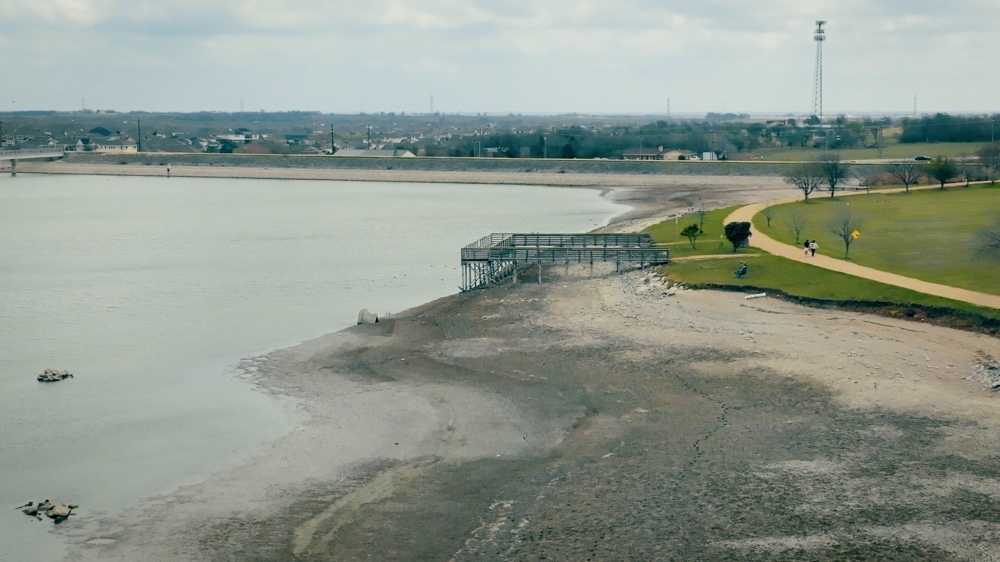
Pflugerville officials said a series of pipeline failures over the past several months disrupted the city’s ability to pump water into Lake Pflugerville, ultimately forcing the city to implement Stage 3 emergency water restrictions March 4.
City staff outlined the situation during a March 10 City Council presentation, explaining how the failures affected the city’s water supply system and what steps are underway to restore normal operations.
The overview
City officials said multiple breaks in the 30-inch raw water pipeline that carries water from the Colorado River to Lake Pflugerville limited the city’s ability to replenish its primary drinking water source.
“The current restrictions that are in place are not the result of one event,” Public Utility and Engineering Director Matt Rector told council members. “It is actually several distinct events that have happened.”
Lake Pflugerville functions as a storage reservoir rather than a natural lake, meaning it must be continuously filled with water pumped through the city’s raw water pipeline.
“This is a man-made lake with no natural filling potential,” Rector said. “If we can’t use the pump station, there’s no water coming into it.”
Diving in deeper
According to city staff, the first pipeline break occurred in September 2025, during construction of a new secondary pipeline designed to improve system reliability.
Contractors encountered a buried metal plate during excavation. When the plate was lifted, the rigging failed and the plate struck the existing pipeline.
The initial repair took about 12 days, but additional breaks occurred in November 2025 and this January, each requiring extended shutdowns for repairs.
“When you drop something heavy on one end, there’s a vibration effect that’s going to happen,” he said.
A fourth break in February 2026 occurred shortly after the pump station was restarted.
“Unfortunately, the pump station was activated prematurely, creating this fourth break,” Rector said.
That failure required crews to excavate more than 20 feet below ground near Boggy Creek to locate and repair the damaged section of pipeline.
“We had to excavate down 20-plus feet on each side of the creek just to figure out where the leak was,” Rector said.
Why it matters
Without the pipeline operating, the city could not pump water into Lake Pflugerville, causing lake levels to decline as customer demand continued.
City staff said demand also began increasing as temperatures warmed and residents prepared for spring outdoor watering.
“It was warm in February,” Rector said. “Spring’s right around the corner. People are starting to anticipate lawn work and that kind of thing.”
The situation prompted city leaders to implement water restrictions under Pflugerville’s drought contingency plan to reduce demand and stabilize the system.
What’s next
City crews are installing a temporary 24-inch bypass pipeline around the damaged section to restore water flow while repairs continue.
Meanwhile, the city is continuing construction on a second raw water pipeline designed to prevent similar disruptions in the future.
Also on the agenda
City Council also voted to extend the local disaster declaration for 60 days, through May 4.
Weiss said maintaining the declaration allows the city to respond more quickly and coordinate with state agencies assisting with the situation, including the Texas Division of Emergency Management, the Texas Commission on Environmental Quality and others.
Council members also addressed confusion among residents about how the declaration affects water restrictions. Some neighborhoods in Pflugerville receive water from other providers and are not subject to the city’s drought restrictions.
Weiss clarified that the disaster declaration itself does not create watering limits.
“The declaration is not the authorizing mechanism for Stage 3 restrictions,” he said, noting that outdoor watering limits are governed by the city’s drought contingency plan.
Council members said clearer communication may be needed to help residents understand which areas fall within the city’s water service territory, including the possibility of publishing a map showing affected neighborhoods.