
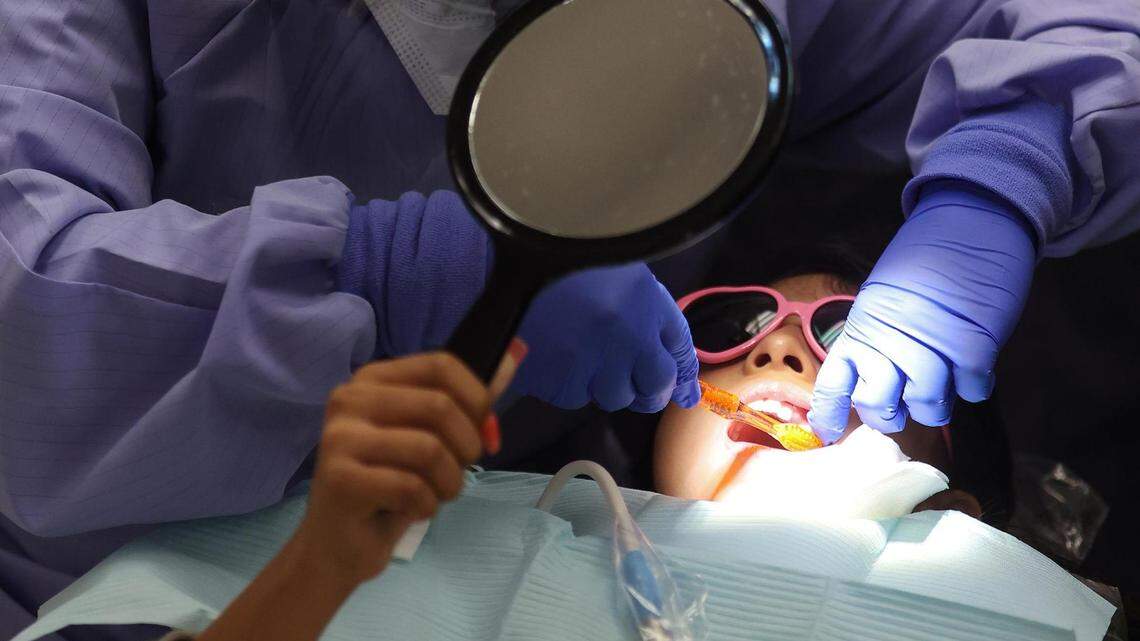
Clara Solorzano, a second year dental hygiene student at Tarrant Community College, cleans 10-year-old Dayana Salazar’s teeth on Friday, November 12, 2021. An associate professor at UNT Health Fort Worth is researching how dental health providers can talk with patients about preventing HPV-related cancers.
Amanda McCoy
amccoy@star-telegram.com
At your average dentist’s appointment, you get reminded to brush your teeth and floss regularly.
Stacey Griner, an associate professor with UNT Health Fort Worth, wants to add one more thing to that list: conversations about how to prevent HPV-related cancers.
Griner wants more dental health providers to talk to patients about how the HPV vaccine can prevent throat and neck cancers, 70% of which are associated with the human papillomavirus. HPV is a virus that infects most people at some point in their lifetimes, and can cause cervical, anal, oropharyngeal, vaginal, vulvar and penile cancers. But only about half of all Texas teens are up-to-date on the HPV vaccine: just 52.4% of Texas teens were up-to-date on the HPV vaccine in 2024, the latest year for which data is available.
⭐ Our editors also recommend:
“We need some different approaches to prevent oropharyngeal cancer,” Griner said.
Griner is leading a two-year study that will interview dental health providers from throughout the U.S. about how they feel about recommending the HPV vaccine to their patients. The study, which began in January, recently received $100,000 in funding from the Prevent Cancer Foundation. Ultimately, Griner and her team plan to produce an implementation guide that can be used by dental health providers to help them talk about the HPV vaccine.
Increasingly, dental providers have screened patients for eating disorders, cancers, high blood pressure, diabetes and more, Griner said. But there’s been limited research on how comfortable dental health providers feel discussing the HPV vaccine.
Griner, a dental hygienist herself, said dental hygienists are in a unique position to talk to patients about HPV and its related cancers because they spend more time with a patient than a regular doctor would, and they typically see patients at least twice a year.
HPV is primarily spread through sexual contact, and it is the most common sexually transmitted infection in the U.S., a fact that might make some dental health providers uncomfortable talking about the vaccine. But Griner wants dental health providers to focus on the vaccine’s role as a cancer prevention tool. Both the American Dental Association and the American Academy of Pediatric Dentists encourage dental providers to recommend the HPV vaccine to their patients.
“That opens up a whole new group of health care providers that can interact and recommend the HPV vaccine,” Griner said.
This story was originally published March 10, 2026 at 2:17 PM.
Related Stories from Fort Worth Star-Telegram

Fort Worth Star-Telegram
Ciara McCarthy covers health and wellness as part of the Star-Telegram’s Crossroads Lab. She came to Fort Worth after three years in Victoria, Texas, where she worked at the Victoria Advocate. Ciara is focused on equipping people and communities with information they need to make decisions about their lives and well-being. Please reach out with your questions about public health or the health care system. Email cmccarthy@star-telegram.com or call or text 817-203-4391.