
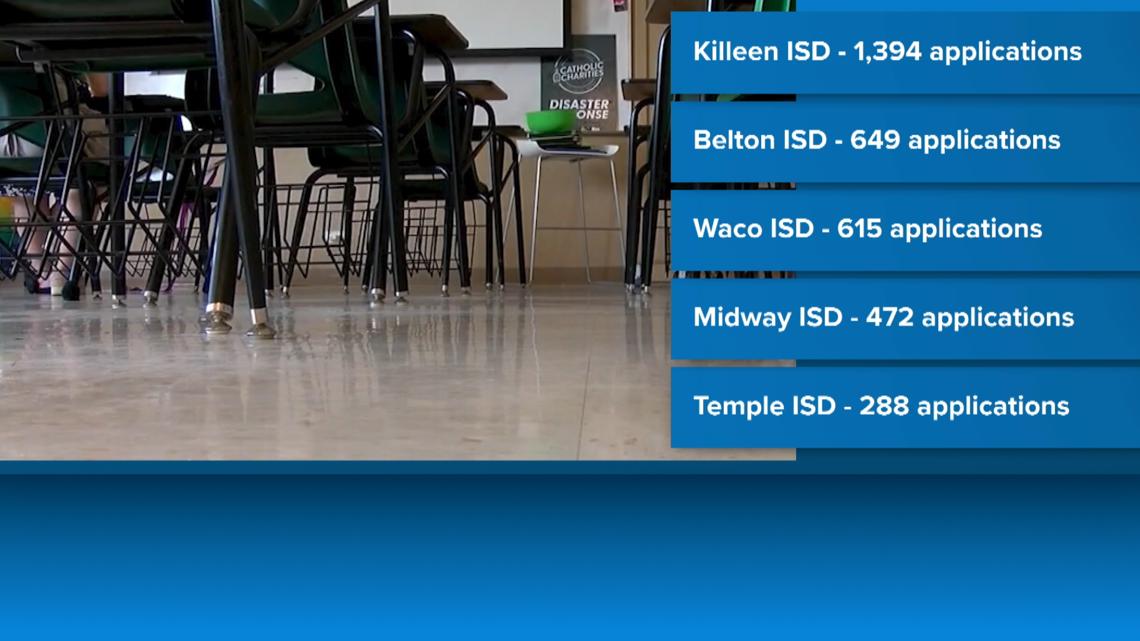
Families are signing up in significant numbers. Killeen ISD leads locally with 1,394 applications, followed by Waco and Belton ISD.
TEMPLE, Texas — More than 160,000 Texas families have applied for the state’s new school voucher program.
Here in Central Texas, thousands are among them. But as the March 17th deadline approaches, new data is painting a more complicated picture of who is actually signing up.
Local numbers show significant interest across Central Texas districts:
Killeen ISD: 1,394 applicationsBelton ISD: 649 applicationsWaco ISD: 615 applicationsMidway ISD: 472 applicationsTemple ISD: 288 applications
Who Is Applying — And Who Isn’t
According to data obtained through public information requests by the Texas-based nonprofit Our Schools Our Democracy, 76 percent of voucher applicants are not currently enrolled in Texas public schools. That means the vast majority of those applying are already in private school, homeschooled, or entering school for the very first time.
Only about one in four applicants comes from public schools.
The youngest students make up the largest group applying. Statewide, more than 20,000 pre-K applications have been submitted — the single biggest grade-level group — followed by kindergarten and first grade. Applications drop off steadily through high school, with just over 5,300 applications from 12th graders.
The income breakdown of applicants is where the debate gets sharpest.
State Representative Hillary Hickland of House District 55 — a supporter of the program — points to data showing strong participation from lower-income families.
“Over 71% of the families who have applied are those of low socioeconomic means, and that is exactly what this was all about,” Hickland said. “It was helping people, families access options for their kids that wouldn’t have opportunities without it.”
But Our Schools Our Democracy founder and executive director Carrie Griffith says a closer look at the numbers tells a different story.
According to the group’s analysis, 35 percent of applicants come from households at or below 200 percent of the federal poverty level — roughly $66,000 or less annually for a family of four. Another 36 percent come from middle-income households earning between $66,000 and $165,000. And 29 percent come from households earning $165,000 or more per year.
“65% as of current data are above 200% poverty level — and a third are actually above 500% poverty level,” Griffith said.
That means roughly two-thirds of applicants are above the income threshold that most government programs use to define economic vulnerability. For context, free lunch is provided to families at 130 percent above the federal poverty level, and reduced-price lunch is available at 185 percent.
One of the most striking findings in the data involves students with disabilities — who are supposed to be first in line for funding if the program is oversubscribed.
Just 11 percent of applicants are students with disabilities. Griffith says that may not be a coincidence.
Under Texas law, private schools accepting voucher funds are not required to provide special education services — and they are legally allowed to decline to enroll any student, for any reason.
“Private schools are statutorily allowed to discriminate against any student for any reason — including students with special needs — even if they’re taking a $30,000 voucher,” Griffith said. “I think families understand this.”
The data also reveals a geographic gap. Nearly 150 Texas counties do not have a single brick-and-mortar private school — elementary, middle, or high school — participating in the voucher program. That means families in those areas are helping fund a program they may never be able to access.
Representative Hickland, a mother of four who says her own family has navigated public school, private school, and a hybrid homeschool model, says the program is not meant to pull students away from public schools — it is simply meant to open a door for families who need something different.
“This has always been about families being able to access the best education for their kids,” Hickland said. “We know that for 95% of families, public school is always going to be the best choice. No one is giving up on our public schools. This is just an open doorway for those who need something different.”
She also encouraged any family still on the fence not to wait.
“It’s not going to hurt to go ahead and apply if that’s something you’re considering — because the door closes for families on March 17th,” Hickland said.
Applying does not guarantee funding. The application is free and takes less than 10 minutes to complete. If demand exceeds available funds — which officials expect it will — students with special needs and families with lower incomes will be prioritized.
Families must also show proof of enrollment in a participating private school before any voucher funds are released. Accounts are expected to be funded in July.
Griffith warns that the number of families who ultimately receive and use those funds could look very different from the number who applied — because private schools are not required to accept every student who applies.
“Private schools don’t have to accept all students,” Griffith said. “They don’t have to accept anyone unless the student fits the profile and the desired demographic of the campus.”
Our Schools Our Democracy says it will continue tracking the program through its Texas Center for Voucher Transparency — the only watchdog center of its kind in the country — and plans to report on how final enrollment numbers compare to the application data once funding is distributed.