
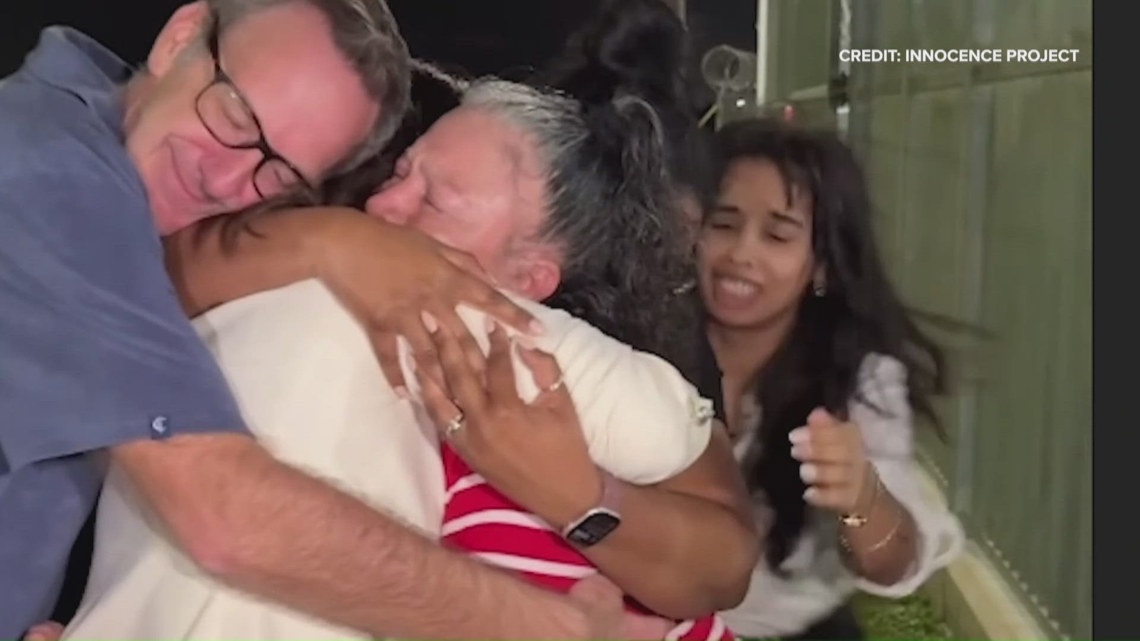
The Austin mother, who was wrongfully convicted of murder in 2005, remained in custody after her exoneration until ICE released an immigration detainer late Tuesday.
AUSTIN, Texas — An Austin woman who spent more than two decades behind bars for a murder conviction that was later overturned is finally home with her family.
Carmen Mejia was released early Wednesday morning after federal immigration officials lifted a detainer that had kept her in custody even after a judge dismissed the criminal charges against her.
Mejia had been wrongfully convicted of murder in 2005 in connection with the death of a baby in her care in 2003. In January, Texas’ highest criminal appeals court found her innocent, ruling the child’s death was the result of an accident rather than a crime.
Earlier this week, a Travis County judge formally dismissed the charges and ordered Mejia released. However, an immigration detainer meant federal officials had 48 hours to either take her into custody or allow her to go free.
According to the Department of Homeland Security, that detainer was lifted because of Mejia’s exoneration.
Emotional reunion after decades apart
As Mejia walked out of custody early Wednesday, supporters and attorneys who fought for her release with the Innocence Project were waiting to greet her.
Her release marks the first time she has been free in more than 20 years.
At the time of her arrest, Mejia’s three daughters were all younger than 8 years old. They were later adopted in a closed adoption.
During Monday’s exoneration hearing, Mejia’s youngest daughter addressed the court.
“After more than 20 years of separation, all we are asking for now is the chance to be a family.”
Case revived by a courthouse insider
The push to revisit Mejia’s case began years ago with a former courthouse bailiff, Art Guerrero.
Guerrero said doubts about the case continued to weigh on him.
“It was really, really bothering me mentally,” Guerrero said.
He brought his concerns to the late Judge Charlie Baird, who then contacted the Innocence Project to review the case.
Baird later described Guerrero as the driving force behind the effort.
“Art is the unsung hero in this.”
Immigration status remains uncertain
Even after her exoneration, Mejia faced uncertainty because her wrongful conviction cost her her legal status in the U.S.
Immigration attorney Kate Lincoln-Goldfinch said Mejia had been protected under Temporary Protected Status (TPS), a designation granted to many Hondurans living in the U.S. after infrastructure in Honduras collapsed following Hurricane Mitch in 1998.
But TPS protections for several countries, including Honduras, have faced cancellations in recent years.
“Anyone who’s in TPS status, including Hondurans like Ms. Mejia, are facing the revocation of their TPS status, and they’re going to need to pursue alternate protected status,” Lincoln-Goldfinch said.
For now, DHS says Mejia can remain in the U.S. until her current immigration status expires.
Focusing on the present
Despite the uncertainty about what comes next, Mejia and her supporters are focused on her long-awaited freedom.
Family members embraced her outside the facility as she cried and hugged those who fought for her release.
Attorneys say Mejia plans to speak publicly at a later date. For now, she is spending time with her family – something they have waited more than two decades to do.