
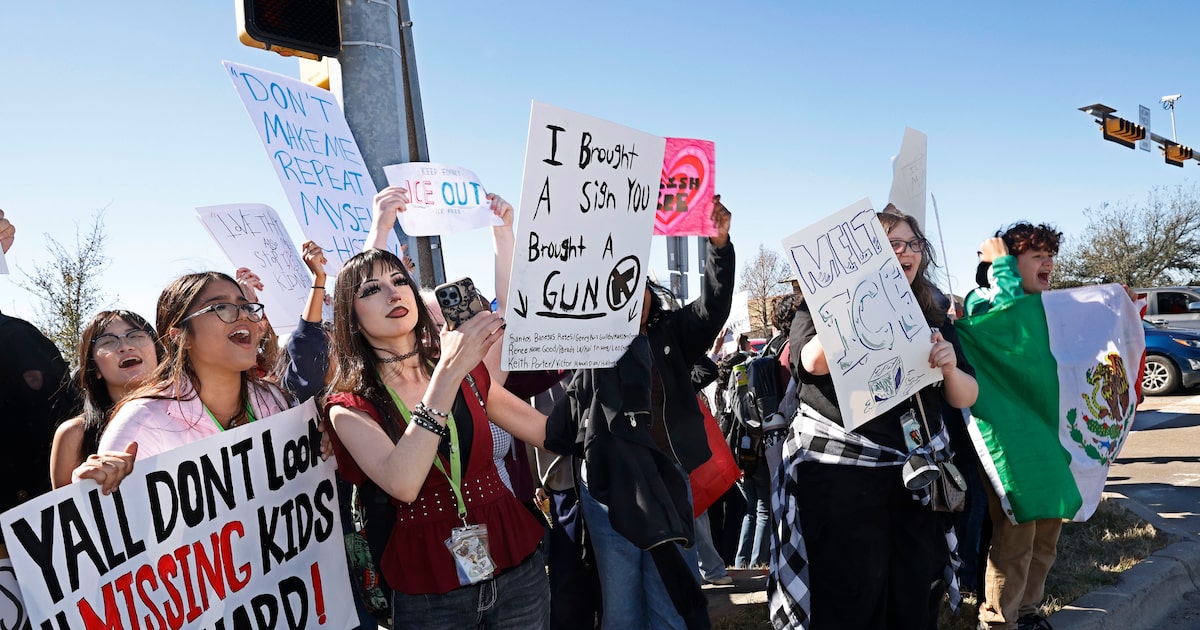
Consequences for walkouts
Assume these student protesters were adults with jobs. If they walked out during their work day when they were supposed to be performing their job duties, there would be consequences. The consequence of leaving the job without permission would be that they no longer worked there.
In my opinion, school walkouts should be treated similarly. Our public schools have performance standards for staff and rules for students. I would favor the consequences to be an unexcused absence for the whole day, one day in-school suspension, zero grade for the day in missed classes with no makeup or extra-credit chances.
The school should lose that day’s money if any employee facilitated the walkout. I’m sure none of that will happen because it would hurt feelings, be unfair, be racist or some other excuse for accepting unacceptable behavior.
Let the kids protest with their parents on weekends.
Lisa Hays, Mesquite
My power is my vote
Life was simple when I played football at Texas Christian University back in the Southwest Conference days. Life was right or wrong, black or white. My studies taught me that we had progressed as a society since colonial times.
Opinion
Then I went to law school and learned black and white were at opposite ends of a spectrum with many shades of gray in between. Even right and wrong had nuances.
With each year, I felt my humanity growing as well. My brother came out, and my loathing toward gays turned to enlightened acceptance — my brother was a good guy.
Near the end of my working days, my political party was usurped by MAGA minions, and my world turned upside down. Truth became fake news, lying became acceptable, and my brothers on the football team were tossed aside by my government in an attempt to whitewash our history.
It seems each week now, something new occurs with drastic results. Everything is deemed an emergency giving the president unprecedented powers, which eventually are ruled unconstitutional. Why won’t the damn Congress assert itself? They represent us, and yet they ignore our plight.
Guess what? Come November, my vote is not going to one incumbent. Not one. My helplessness is now power. This ain’t my America.
Jeffrey L. Breithaupt, Santa Rosa, Calif.
It’s hard to keep up
Re: “We Don’t Know Why Dallas Elected Givens,” March 6 Editorials.
Underlying your opinion piece is an assumption that our populace generally favors those with more experience and more qualifications. I would argue that qualifications are just one of myriad reasons why any particular candidate comes out ahead.
Other factors may include, but are not limited to: money, race, class, whether the candidate is a perceived underdog, the candidate’s ability to exert change from outside the system, personality and physical appearance.
Also keep in mind that the recent primary ballot was long, with more than 100 items across 19 pages. It is simply hard and exhausting to keep up.
Politics is among the oldest and most elusive professions in human history. Despite thousands of years of institutional knowledge, I find it amazing that our political polling often fails to accurately predict human behavior.
Jimmy J. Tran, Dallas
Reining in compensation
Re: “From nil, to NIL,” Sunday business story.
The many problems that are present today are directly tied to the many fumbles of the NCAA and its hard-headed approach to the new world of athletes’ compensation. To make matters worse is the White House meeting to discuss how to shore up support for the Student Compensation and Opportunity Through Rights and Endorsements Act. The visuals were of a low order, as a group of older, mostly white, millionaires discussed the ways to rein in compensation for the mostly Black college football and basketball players.
Here is the root of the problem: The people who were represented in the White House and in your NIL story do not want to focus on increasing revenue but on how to level the compensation for the athletes, regardless of the revenue that the athlete or school generates.
We’ve heard the same thing about the men’s and women’s World Cup, the WNBA and the NBA.
Here is an idea for the guidelines going forward. Create new divisions for schools, one for big-revenue schools and one for small-revenue schools. Give schools in each division an annual or tri-annual opportunity to move up or down, depending on guidelines based on revenue. The kids could have one or two transfer opportunities within five years. Leave 15% for the nonrevenue sports.
Thomas R. Youngblood, Dallas
Success masks big issues
Re: “Here’s why Texas’ economy keeps outpacing the rest of the nation,” Monday Business story.
This story on the roaring Texas economy leaves out important context: the human toll of that boom. Specifically, what we’ve done to the people of our state to get here.
Texas routinely ranks near the bottom in health care access and graduation rates, and at 49th or 50th for supporting individuals with intellectual or developmental disabilities. While our overall poverty rates have declined, 76 of our 254 counties experienced an uptick in poverty rates from 2018 to 2022, mostly in rural areas. In fact, Texas has the largest rural poverty population in the country.
Gross domestic product is only one measure of a state’s health. Texans pride themselves on family values, but do our state policies reflect them? Our abysmal maternal mortality rates suggest not.
We can and should be proud of our economic progress, but we should watch how we treat our neighbors, or it will come back to haunt us. Our fellow Texans must be educated, healthy, well-fed and employed if they’re going to continue to power this economic engine.
Anne Marie Power, Dallas
We welcome your thoughts in a letter to the editor. See the guidelines and submit your letter here.
If you have problems with the form, you can submit via email at letters@dallasnews.com