
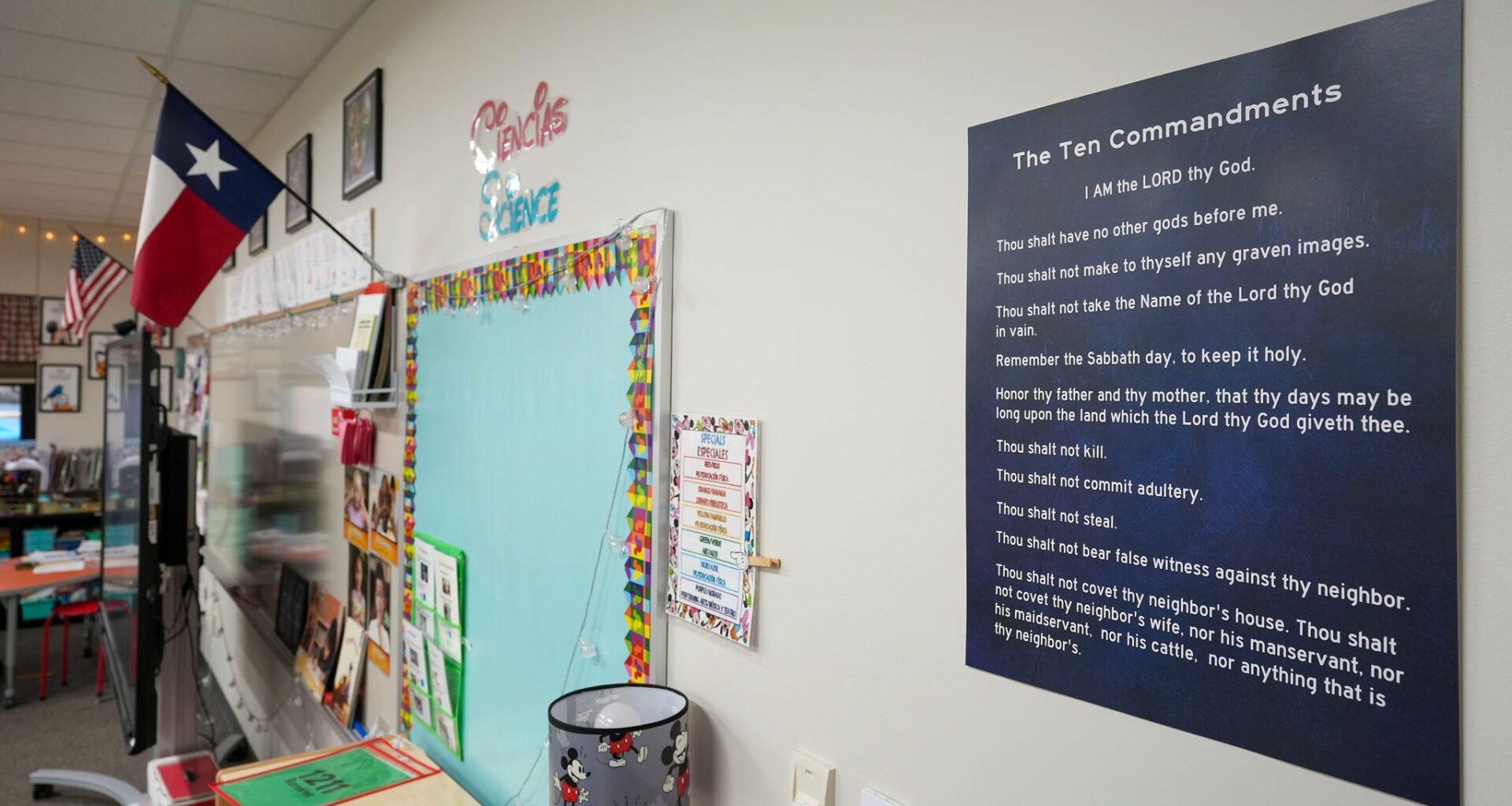
As a non-Christian attending a Texas high school (whose board has fortunately voted against such a policy), I am alarmed by what feels like a growing push to bring more state-sanctioned religion into public education, including the Bible-infused Bluebonnet Curriculum approved last year and SB 10’s mandate for Ten Commandments posters in classrooms.
Article continues below this ad
SB 11, like those measures, raises serious constitutional concerns and threatens religious diversity in public schools — though in this case, districts had a choice.
While the bill allows districts to opt out, it arguably should not exist in the first place. The First Amendment prohibits making a “law respecting an establishment of religion,” and the 14th Amendment requires states to comply with that protection. Public schools are government institutions and therefore must be careful not to endorse religious activities.
SB 11 attempts to address that concern by requiring prayer periods to be conducted outside instructional hours. But this does not resolve the central issue: When the state designates time for religious observance, it risks crossing a constitutional line. In Abington School District v. Schempp (1963), the Supreme Court concluded that Bible readings in public schools are unconstitutional, even if students have the choice to opt out.
This isn’t just a technical question of who nominally holds the title of “prayer period leader.” Even if students were to lead sessions, state institutions wield immense legal and social influence.
Article continues below this ad
ALSO READ: New curriculum provides wrong lessons on religious freedom
If religious activity is formally sanctioned by a school, it can socially alienate students who do not participate. SB 11 may allow students to read texts other than the Bible, but the political context surrounding the bill still promotes one religion to some degree. At the very least, it overlooks the 26% of Texans who are religiously unaffiliated, as well as the 6% who practice non-Christian religions, according to the Pew Research Center.
Considering that roughly one-third of the state population falls into these groups, religion can be more divisive than unifying in a school setting. I’ve personally witnessed antisemitism in the classroom, which was deeply hurtful to many students. Policies that elevate religious observance risk intensifying that sense of exclusion.
Some argue that spirituality — particularly Christianity — is an essential part of national identity and deserves greater visibility in schools. However, this country’s foundational principles consistently emphasize that Americans’ faith, or lack thereof, should remain free from government influence.
Article continues below this ad
Secularism in public education does not bar religious expression altogether. Students already have the right to individual religious expression at school without SB 11. My school accommodates Fellowship of Christian Athletes, as well as Catholic, Islamic Culture and Jewish student clubs. As long as activities are student-led, even in groups, they are legally protected.
Beyond legal precedent, separation of church and state is not merely an abstract constitutional doctrine. As state Rep. James Talarico, a Presbyterian seminarian, has argued, a church affiliated too closely with political power can dilute its own “prophetic voice” and its ability to speak truth on spiritual matters. Maintaining institutional separation protects not only the state, but also religious communities.
Regardless of how individual districts voted on SB 11, the underlying question remains: What role should religion play in public education? SB 11 does not expand religious freedom; students already possess that right. Instead, it risks inserting government into matters of faith in ways that can divide rather than unite.
Rejecting a campus prayer-period policy, as my school district did, is both legally and morally sound. Public schools are meant to educate and bring together students of every background — not to elevate one set of religious practices over others.
Article continues below this ad
Rajasi Agarwal is a 10th grader at Westlake High School.
Carmen Sofia Canizalez, center, leads students in prayer Sept. 24 outside Elias Herrera Middle School in Laredo as part of the global See You at the Pole movement. Sharing faith-filled moments helps students strengthen bonds and build healthy relationships, Holly M. Randall writes.
Courtesy/UISD
For SB 11: Stop treating student prayer as a constitutional threat
Article continues below this ad
School boards in Texas had to decide by March 1 whether to adopt a policy under Senate Bill 11, a new law that allows a daily, optional period for prayer and reading of the Bible or other religious texts in public schools. Parental consent is required for student participation, and the sessions must occur outside of instructional time.
Many Texans celebrate the law for its support for religious liberty and reflection of the rich religious history and tradition in our country. But critics oppose it based on familiar but legally unsupported claims.
The central claim by opponents is that SB 11 violates the Establishment Clause of the First Amendment by integrating religious activity into the school schedule. But a recent decision by the U.S. Supreme Court makes clear that neutrality toward religion is the constitutional standard — not enforced secularism.
In Kennedy v. Bremerton School District, the court rejected the idea that the government must suppress private religious expression in public schools to avoid violating the Establishment Clause. The justices emphasized the Constitution’s strong protection of private religious exercise, even in public settings, so long as it is not coercive or officially compelled.
Article continues below this ad
That reasoning supports districts designating a period during which students may — at a parent’s direction — voluntarily engage in prayer or read religious texts. The Supreme Court has long distinguished between coercive, state-sponsored religious exercises and private religious activity occurring in public schools.
“But students already have the right to pray privately,” some critics will say. And according to the Constitution, they are correct. But it has too often been discouraged or treated with suspicion. Instead, SB 11 celebrates — and legally authorizes — that right.
ALSO READ: This tiny school district has a chaplain, public prayers and a lesson for Texas
Recent history shows why that clarification matters. A few years ago, when Hannah Allen, a middle school student from a small town in North Texas, gathered about 50 of her classmates in the lunchroom to pray for a fellow classmate who’d been injured in an accident, the principal told them to stop praying. They were told that if they wanted to continue, they must go pray behind a curtain or behind closed doors. Thankfully, Hannah knew her rights — and she had the courage to stand up for it. Had SB 11 existed when Hannah Allen was a student, the situation would have been entirely different.
Article continues below this ad
Opponents also argue that SB 11 wastes instructional time in the face of academic challenges and a student mental health crisis across Texas districts. But that argument improperly assumes that time allocated to prayer or reflection is inherently unproductive.
For many students, reading sacred texts and taking time to pray can provide peace, perspective and presence of the divine in the midst of a crowded school day. And sharing faith-filled moments helps students strengthen bonds and build healthy relationships. These practices offer a sense of hope, purpose and community at a formative time in students’ lives.
Perhaps the most emotionally charged criticism is that a designated prayer period would divide students of different faiths — or those who do not practice a faith. But inclusion does not require erasing religious expression from public life. In fact, suppressing religious identity can itself foster alienation.
SB 11 clearly states that a period for prayer or religious reading is voluntary and requires signed parental consent. True division arises when government treats religious expression as suspect or second-class. A policy that neutrally accommodates religious exercise affirms that students of faith belong fully in their school community.
Article continues below this ad
The Constitution does not demand religion-free schools. When policies are carefully crafted to ensure voluntariness and neutrality, they respect both religious liberty and governmental limits.
In an era when public discourse often assumes that faith and public education are incompatible, SB 11 reflects a different vision — and it’s one that school boards should embrace.
Holly M. Randall serves as counsel at First Liberty Institute, where she focuses on the religious liberty rights of teachers and students in the firm’s education practice group.
Article continues below this ad
Makhbubakhon Ismatova/Makhbubakhon Ismatova / iStock / Getty Images Plus