
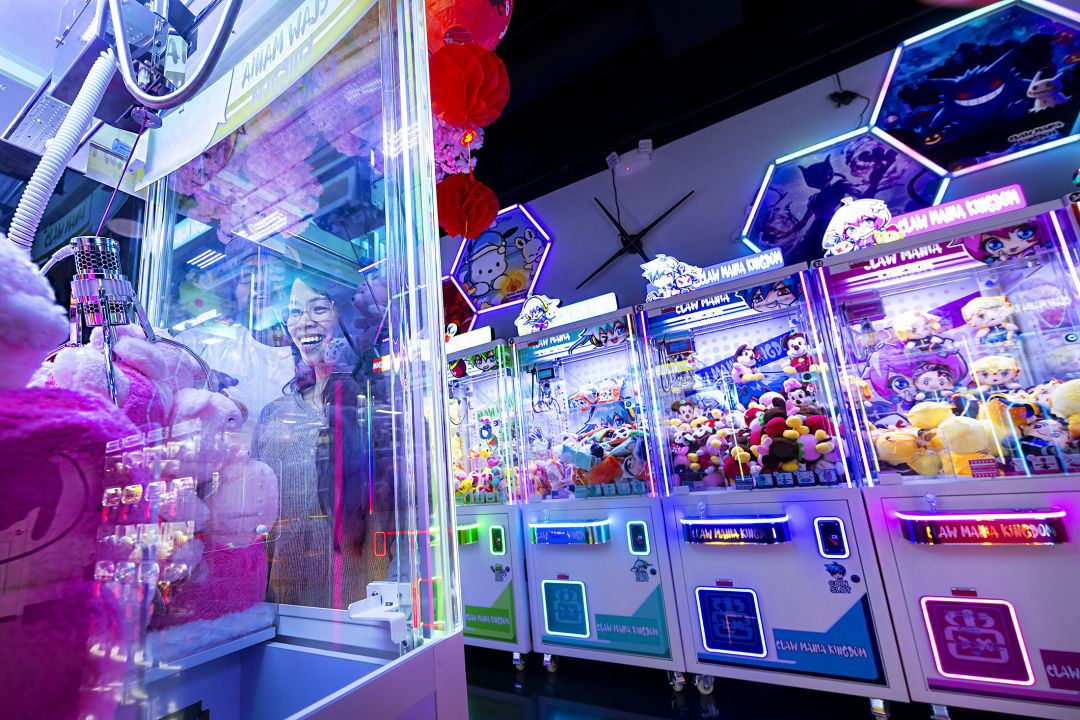
Claw machine arcades, like Claw Mania Kingdom, have been sweeping the city.
It’s not hard to get suckered into the thrill of a claw machine. When I studied abroad in Taiwan, I’d pour my few 10-New Taiwan dollar (NTD) coins into alleyway machines, hovering the claw over cute keychains and miscellaneous trinkets. On a few occasions, I would win, and pure adrenaline would flow through my veins. When I lost, I’d groan in frustration, then push another coin into the slot.
Since that semester, I’ve been a largely reformed claw machine addict—that is, until the very same clawcades started popping up in Houston.
Take a brief stroll around Asiatown’s Dun Huang Plaza, and you’ll see no less than four claw machine arcades. Amble across the street to Sterling Plaza and Dynasty Plaza, and there are another three, nestled in corner spaces among restaurants, boba shops, and hair salons. Hop on the highway to Katy Asia Town, and there are at least two more arcades at the center, and likely more on the way.
Across the city, clawcades have popped up faster than many Houstonians expected, and they show no signs of stopping. In this edition of Ever Wonder Why, we’re asking the new-age question: Why is everything a claw arcade now?
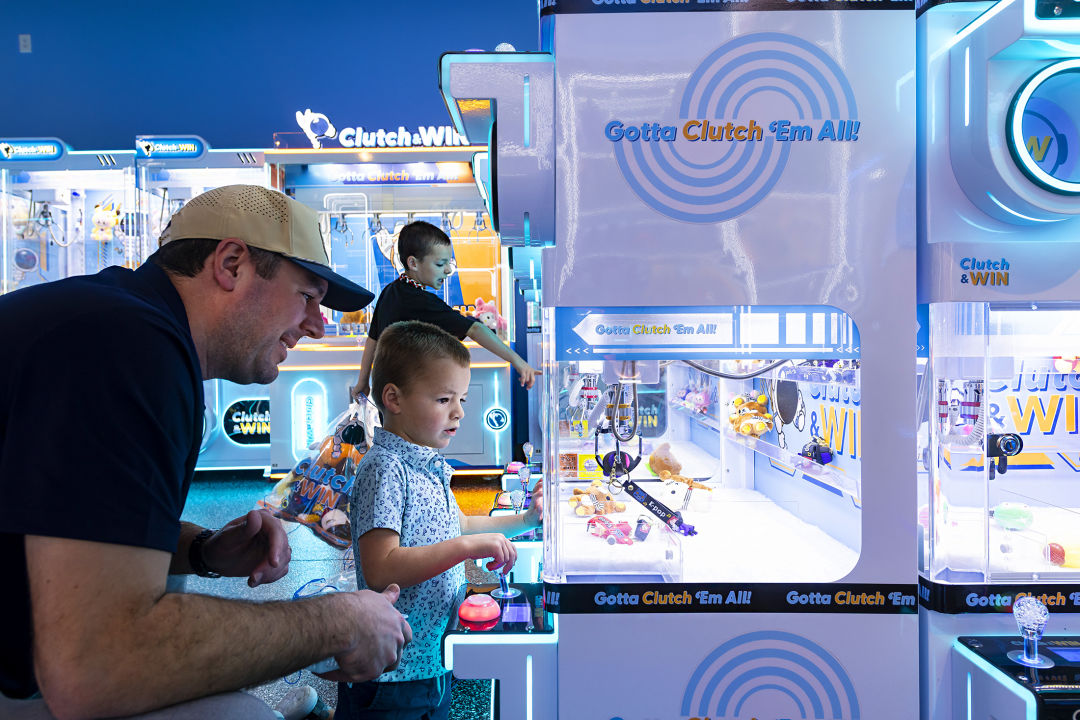
Clawcade Clutch and Win caters to suburbanites, shortening the driving distance to Asiatown or Katy.
The future of fun?
Stateside, the claw has largely been relegated to Toy Story references (“the claaaw!”), grocery store novelties, and the dine-in arcade at Pizza Hut. Inspired by a steam-powered shovel used in the Panama Canal to dig out dirt, the first tabletop claw machine game was invented in 1926 in Hartford, Connecticut. Still, the US hasn’t seen the same claw boom as much of Asia.
In 1951, the Johnson Act cracked down on gambling activities nationwide, putting claw machines—then classified as gambling machines—in jeopardy. At the time, some operators had gambling elements and adult prizes like watches and cigarette lighters, prompting concern from lawmakers. Legend has it that the FBI even stepped in and destroyed a few machines!
Abroad, however, the claw machine developed a different legacy. In the 1970s, European and Asian countries adopted the game, adding technological advancements such as the now-familiar three-pronged claw. Nicknamed “claw cranes” and “UFO catchers,” the games spread globally, becoming especially popular in gamer-friendly Japan. Japanese arcades filled with crane games soon swept across Asia, attracting young players with prizes such as plush toys, collectibles, and snacks. The trend continued to grow, and by the 2000s, countries including China, South Korea, Vietnam, Taiwan, and Thailand, had integrated claw arcades into shopping centers and other commercial spaces.
An insatiable demand for claw machines in Asia has even influenced policy. The Taiwanese government once increased production of 10-dollar coins to meet demand. In South Korea, the law prohibits prizes valued at more than 5,000 won ($5 USD) in efforts to curb addiction, and in Thailand, NGOs have called for tighter regulation, arguing that youth gambling is a major concern.
Prizes have, too, evolved. Today’s machines can hold Bluetooth headphones, tech-forward hair dryers, and even—in one instance I experienced abroad—live lobsters.
The humble claw machine is now also just one component of the hip “clawcade.” A portmanteau of “claw” and “arcade,” the clawcade is exactly what it sounds like: dozens of claw machines filled with giant plushies, exotic snacks, and other covetable goodies.
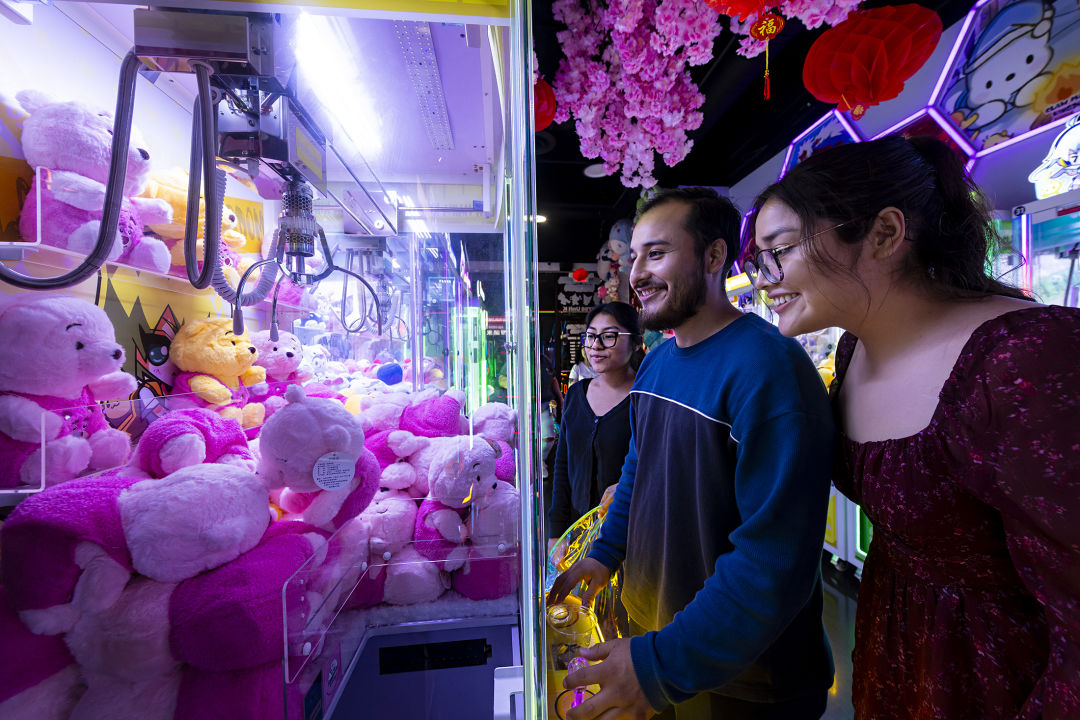
Popular in Asia, the clawcade has finally made its way back to the US, where claw machines were invented.
Clawcades in Houston
Asiatown hot spot Claw Mania Kingdom brought the clawcade concept to Houston in February 2024, the first of its kind. According to spokesperson Annie Tran, Claw Mania differs from traditional American arcades in a few ways. Unlike the Asian clawcades it’s modeled after, Claw Mania doesn’t feature video games or Skee-Ball machines. Instead, the arcade, with its two locations, houses around 110 claw machines in total, each filled with trendy plushies from brands like Sanrio and popular anime like Chainsaw Man. In place of quarters, the clawcade sells token packages upfront, ranging from $10 to $100. Each prize won can be traded in for points at the prize desk; win enough points, and players can trade up for larger rewards.
Tran says Claw Mania’s owners chose Houston because it was something of a clawcade desert. Asiatown, in particular, was appealing because of its heavy foot traffic and large Asian clientele, many of whom were already familiar with the concept. Weekends at Dun Huang Plaza are “very packed,” Tran says, and that’s when many visitors eventually wander into the clawcade.
Thus, Claw Mania’s success quickly snowballed. The owners later opened a second location across the street at Sterling Plaza. These days, Tran says the competition has grown rapidly. “Even in that mile radius…I believe there’s like, over 15 claw machine arcades now,” she says.
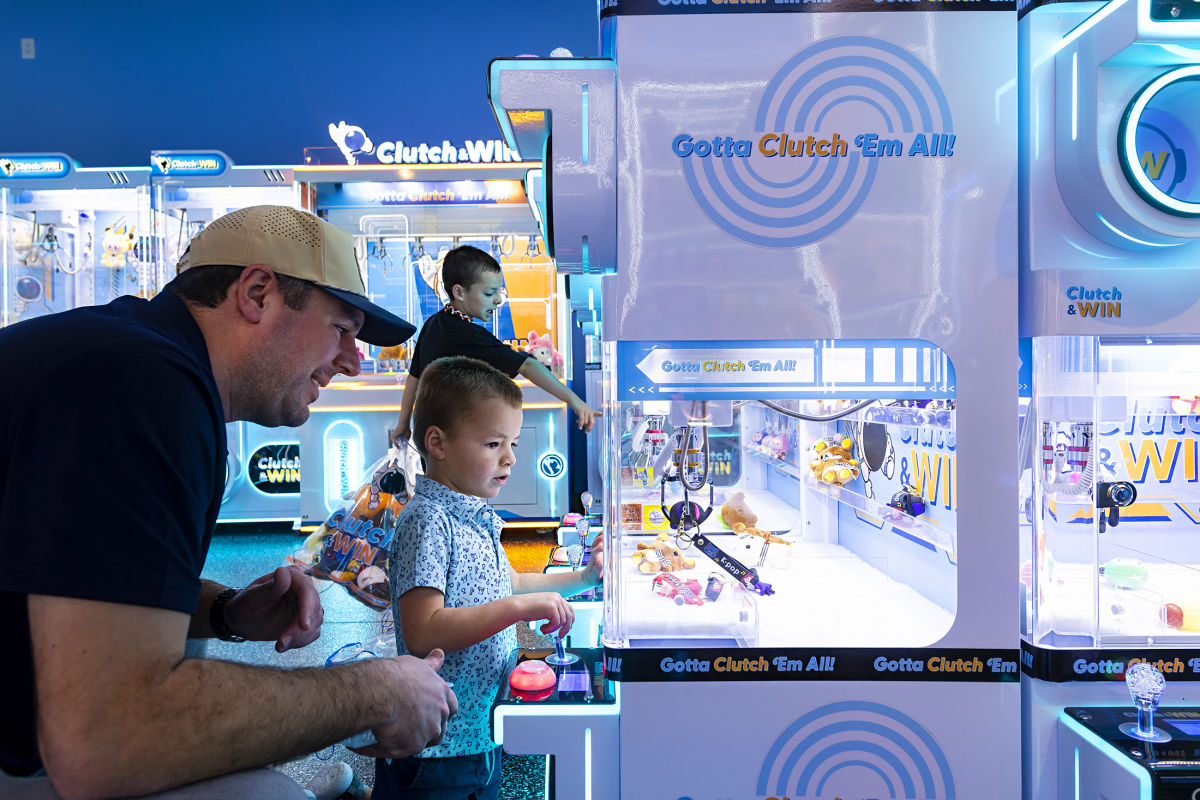
But clawcades are no longer limited to Asiatown. In Cypress, Clutch and Win co-owner Jennifer Bui launched the Houston suburb’s first claw machine arcade in November 2025. Located just off Highway 290, Clutch and Win shortens the drive for suburban claw enthusiasts—a boon for people like Bui and her business partner, who previously frequented Claw Mania Kingdom in Asiatown. “We’ve already gotten a lot of feedback [from customers saying] ‘Oh, we’re so glad we don’t have to drive to Chinatown anymore,’” Bui says.
Business boom
Jonathan Horowitz, founder of Convive Hospitality Consulting, has also noticed the claw surge. Horowitz recently spent time in Tokyo, Japan, where he says he saw clawcades on nearly every block. Given Houston’s large Asian population and the heavy foot traffic in Asiatown, he says the concept’s arrival felt inevitable. “Everybody’s kind of catching on to the trend of these claw machine arcades,” he says. “It’s our time now to experience these things.”
Clawcades have also proliferated because of their relatively simple business model. “The good part for the operators is [clawcades] don’t take up a whole lot of space,” Horowitz explains, noting that rent is often cheaper, and there are fewer operational and overhead costs. Claw machines, like restaurant equipment, can also be leased rather than purchased, and labor costs are typically limited to a few attendants and cashiers. “If you’re in a good spot, with a lot of foot traffic…you’re going to have a chance to make really good profit,” he adds.
The target demographic also works in the operator’s favor. Many clawcades attract younger age groups—kids, teens, and young adults who frequently visit Asiatown and other busy retail centers around Houston.
According to Bui, the biggest expense at Clutch and Win isn’t rent or staffing—it’s the prizes. The arcade features 61 machines, ranging from claw machines to gachapon capsules that must be refilled with prizes constantly. To keep inventory appealing, Clutch and Win maintains suggestion boxes where customers can recommend the prizes they want to see. To sweeten the pot, both Claw Mania Kingdom and Clutch and Win emphasize attainable win rates. “We strive to be fun and fair,” Bui explains. “Everybody that comes to Claw Mania—they win,” Tran adds.
Are more clawcades coming?
The short answer: almost certainly.
Tran says that Claw Mania hopes to open additional locations across Houston this year, potentially expanding as far as Pearland. Meanwhile, smaller claw arcades are already appearing in neighborhoods such as Spring Branch and Garden Oaks. “I think you will continue to see [clawcades] grow until it either becomes less trendy, or you reach the saturation point,” Horowitz says. The “tipping point,” he notes, may still be years away.
But Bui believes the trend has staying power. She likens clawcades to bubble tea shops, which, despite once feeling niche, are now appearing on nearly every corner. They’ve become a permanent part of Houston’s dining landscape. “Boba is here, and it’s going to stay here,” she says. “[Clawcades] are still fairly new to the market.”