
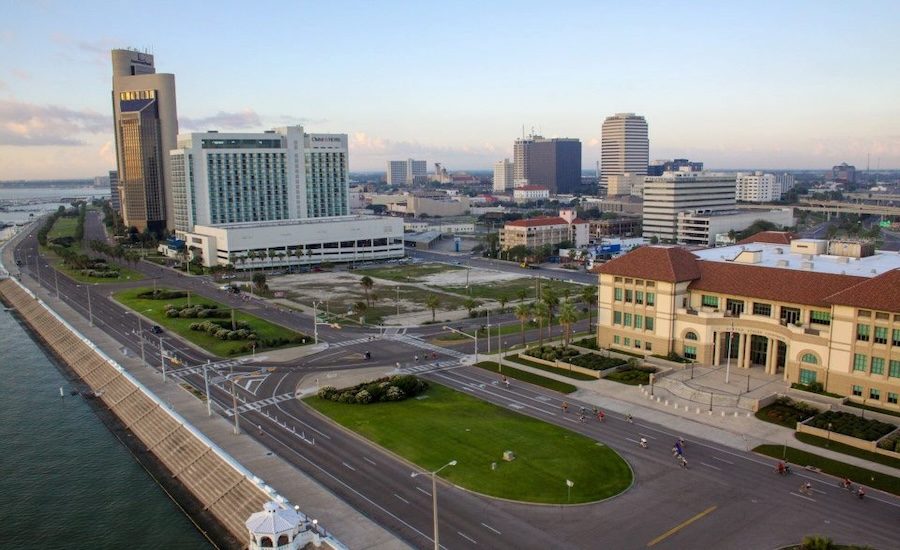
In the Texas Gulf Coast city of Corpus Christi, officials are moving forward with nearly $1 billion in water infrastructure upgrades as they face a long‑building supply shortage and new pressure after the governor’s warning this week that the state may be forced to intervene.
Projects currently under construction or in engineering include Nueces River groundwater well fields totaling 36 million gallons per day (MGD), the 24-MGD Evangeline Groundwater Project, and a 16-MGD reclaimed-water initiative. Three desalination sites—Inner Harbor, Harbor Island and the Barney Davis Power Plant—have returned to planning after the collapse of a previous seawater proposal. “These projects are not ‘plans’ for the future; they are active construction and engineering efforts,” the city said in a March 9 statement.
The initiative comes under significant pressure. City modeling shows water supply could fall below projected demand as early as June 2027, communications director Elisa Olsen told the Texas Tribune. “We are not out of water, but our water supply is declining,” she said.
Meanwhile, the groundwater program, central to the city’s near-term strategy, faces permitting challenges on multiple fronts. New wells in rural Nueces County have encountered treatment issues due to salinity, and additional drilling in San Patricio County has drawn opposition from residents. The city of Sinton filed a February challenge to the Evangeline project’s permits, arguing the proposed withdrawals could cause unreasonable declines in countywide water levels, according to Inside Climate News.
Industrial users are helping finance new supply development through the city’s Drought Surcharge Exemption Fee program, which charges participating facilities $0.31 per 1,000 gallons each month, generating approximately $6 million annually.
The urgency reflects a decade of industrial expansion along the bay—particularly in petrochemical and energy development—that has outpaced available supply, ICN reported. Reservoir levels have also fallen during the current prolonged drought, compounding demand pressures.
The recent initiative gained momentum after the city council voted in September 2025 to cancel the Inner Harbor Desalination Plant, a 30-MGD facility in progressive design-build development with Kiewit Infrastructure South Co. The cancellation terminated a $50-million design contract at only 10% completion, ENR reported in November. The cost trajectory told the story: early estimates put the plant at $220 million, before post-2019 construction inflation and capacity expansions drove the figure to $757 million at the 2024 contract award, then to $1.2 billion by July 2025, when the council pulled the plug. Arcadis and GHD were among the engineering firms on the project, with more than 150 Kiewit and engineering staff assigned at the time of termination.
Mayor Paulette Guajardo, who had advocated continuing the project, said terminating Kiewit’s contract would flush $50 million “down the toilet.” Drew Molly, then chief operating officer of Corpus Christi Water, had warned city manager Peter Zanoni in writing that cancellation would leave the city “without a fully permitted alternative.” Molly subsequently resigned to take a position in Houston.
James Dodson, a former water department director, told ICN the city had “dismissed repeated opportunities to develop groundwater import projects” while maintaining a singular focus on desalination. Sean Strawbridge, former CEO of the Port of Corpus Christi Authority, cited the city’s “lack of experience, their lack of knowledge, their lack of recognizing the risks,” adding: “Time is up.”
The canceled project carried significant state investment. The Houston Chronicle reported $235 million in direct state funding and more than $700 million in low-interest loans approved by the Texas Water Development Board through the State Water Implementation Fund. Speaking from an event in Manor, Texas, Gov. Greg Abbott (R), whose appointees sit on that board, said Tuesday the city did not follow through on the commitment. “You know what they did? They squandered it, and then they changed their plan, and then they were indecisive about what to do.”
Abbott went further, issuing a direct ultimatum. “What Corpus Christi leaders have to do is make a decision,” he said. “We can only give them a little time more before the state of Texas has to take over and micromanage that city and run that city to make sure that every resident who goes to the water tap and turns it on, they’re going to be getting water out of their faucet—not because of what local leaders are doing, but because of what the state of Texas will do.”
He added that the state is “fully committed to making sure that Corpus Christi residents are gonna have the water they need to live their lives like the rest of the people in the state of Texas.” ENR reached out to the governor’s office for clarification on what a takeover would entail and the legal authority under which it would occur, but did not receive a response.
Texas Sen. Charles Perry, R-Lubbock, told a local radio station that “locals did not want to pay for water, and that is one aspect that we’re seeing play out in Corpus that we’re gonna have conversations about around the state,” the Tribune reported.
The city has imposed conservation measures in the interim, banning lawn watering and requiring residents to use a five-gallon bucket when washing vehicles.
The Corpus Christi City Council is expected to address the matter at its March 17 meeting.