

City leaders and Dallas ISD board members called on voters in the district to double down on investments they’ve approved in years past at a news conference Thursday morning.
Voters in the Dallas school district will see a proposed $6.2 billion bond issue on the ballot in May. The political action committee promoting the proposal kicked off its campaign Thursday, highlighting progress the district has made over the past 15 years.
Miguel Solis, president of the nonprofit Commit Partnership and co-chair of the bond campaign, said Dallas ISD has come a long way since he came to the district in 2009 as an eighth grade social studies teacher. When he arrived in the district, Solis saw great potential in its students, but also dysfunction and instability in its leadership. The district had eight superintendents in 16 years, and only 10% of the district’s eighth graders went on to earn a postsecondary credential.
That began to change in 2012, when the district adopted a number of turnaround strategies, including implementing more rigorous evaluations for teachers and principals and offering better pay to the highest-performing teachers. Following those changes, voters in the district “added rocket fuel,” Solis said, approving historic bond packages in 2015 and 2020 that were aligned with the district’s academic strategy.
The Education Lab
Since then, the district has seen a rapid turnaround. Between the 2023-24 school year and last year, the number of F-rated campuses in the district declined from 24 to two. District Superintendent Stephanie Elizalde has made a goal of having no D- or F-rated campuses next year.
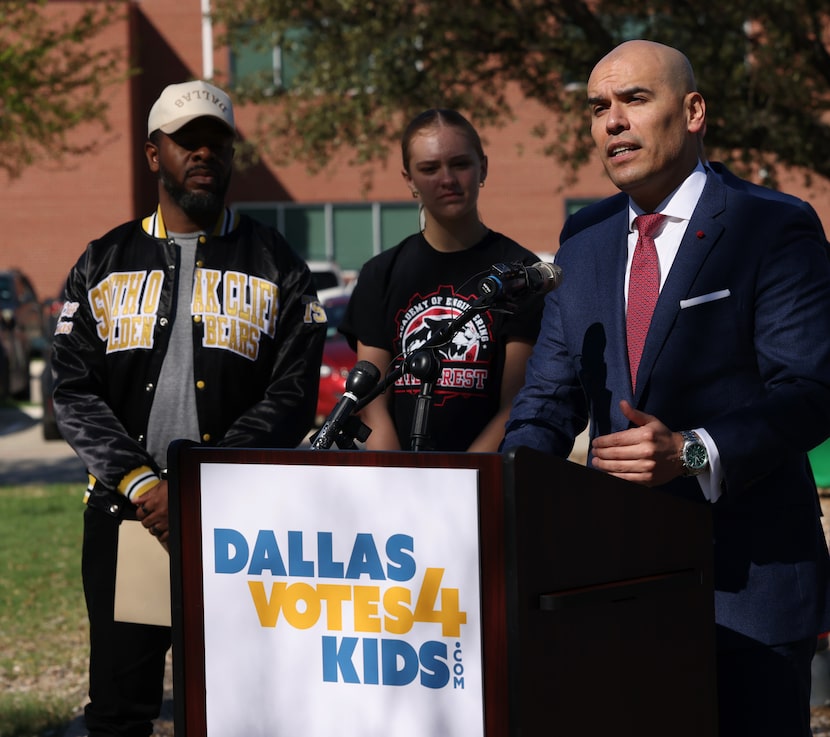
Miguel Solis delivers his message that Dallas voters should maintain their dedication and investment in approving the upcoming ISD Bond proposals. The PAC promoting Dallas ISD’s bond issue held a press conference at the Marcus Park Recreation Center, 3003 Northhaven Road in Dallas on March 12, 2026.
Steve Hamm
Solis, who is also a former Dallas ISD administrator and school board trustee, said the renovations and improvements the district made as a part of the previous bond packages were a key part of that turnaround. But the work isn’t done, he said: Across the district, too many students still go to school in aging buildings and portable classrooms. The proposed bond issue will help the district continue the progress it made in years past, he said.
“When students walk into modern schools, they see that they matter,” he said. “Facilities communicate belief, they communicate expectations, they communicate opportunity.”
Largest school bond in Texas history
If voters approve it, this year’s $6.2 billion bond issue would be the largest in Texas history. District leaders say it would carry a property tax increase of about $2.79 a month on a $500,000 home, which is the average home value in the district.
The proposal comes in four parts. The largest portion, at nearly $6 billion, would go toward construction and renovation projects across the district. With that money, district officials hope to build 26 campuses to replace existing schools, update and modernize its other campuses and add enough classroom space to allow it to remove all its remaining portable classrooms, among other projects.
The remaining bond money, roughly $314.3 million, is divided among three smaller proposals. Proposition B would give the district $144.7 million for technology upgrades. Proposition C would allow the district to spend $143.34 million to refinance old debt, allowing it to pay that debt off more quickly and saving $10 million in the process. Proposition D would provide $26.25 million for upgrades and renovations to the district’s aging swimming pools.
Trustee Byron Sanders, who represents parts of central and southeast Dallas, said there’s a strong connection between investments the district made in facilities upgrades in previous bond issues and the academic growth the district has seen during the same period.
Pointing to past success in Dallas ISD
As an example, Sanders pointed to South Oak Cliff High School. In 2016, students staged a walkout to protest poor conditions at the campus. Built in 1952, the building had deteriorated over its decades of use. Its roof leaked. There were mice. District leaders used $52 million from the district’s 2015 bond fund to overhaul the campus, relocating students for two years while construction crews worked. When South Oak Cliff reopened in 2020, it was, for all practical purposes, a brand-new school.
The following year, the school’s football team won the first state championship Dallas ISD had seen in decades. The team followed that win up with two more state titles, in 2022 and 2025. The school has seen rapid academic growth during the same period: The year after it reopened, South Oak Cliff received a 69 in Texas’ school ratings. Last year, it earned an 89, putting it one point away from an A rating.

Byron Sanders, Dallas ISD Trustee, District 5, proudly models his South Oak Cliff Golden Bears letter jacket while boasting of the state championships won by the school’s football program while speaking to promote Dallas ISD’s bond issue during a press conference held at the Marcus Park Recreation Center, in Dallas on March 12, 2026.
Steve Hamm
Sanders said it’s no coincidence that South Oak Cliff began to do better academically after the district renovated the building. When students are in a building that feels comfortable and has lots of natural light and plenty of space for them to work, it makes them think differently about their own ability to perform at a high level academically, he said.
The athletic turnaround is also no surprise, Sanders said. Before the renovation, many students who were zoned to South Oak Cliff went to suburban districts like Lancaster, DeSoto and Cedar Hill ISDs, he said. But after the campus reopened, South Oak Cliff students began to feel more ownership of it, he said, and younger students in the neighborhood began to see the school as a part of their future. Over time, student athletes who might once have looked elsewhere began to stay, he said.
Building a high-quality school system is crucial if Dallas wants to give students the best possible future, Sanders said. But it’s also important if the city wants to stay competitive, he said. If the city wants to continue to be a place where people move in search of a bright future, its schools need to reflect that, he said.
“As the city of Dallas, we call ourselves a world-class city. And you know what? I believe that. I believe we’re on that trajectory,” Sanders said. “But a world-class city doesn’t just have OK schools. A world-class city has exceptional schools.”
The DMN Education Lab deepens the coverage and conversation about urgent education issues critical to the future of North Texas.
The DMN Education Lab is a community-funded journalism initiative, with support from Bobby and Lottye Lyle, Communities Foundation of Texas, The Dallas Foundation, Dallas Regional Chamber, Deedie Rose, Garrett and Cecilia Boone, Judy and Jim Gibbs, The Meadows Foundation, The Murrell Foundation, Ron and Phyllis Steinhart, Solutions Journalism Network, Southern Methodist University, Sydney Smith Hicks, and the University of Texas at Dallas. The Dallas Morning News retains full editorial control of the Education Lab’s journalism.