
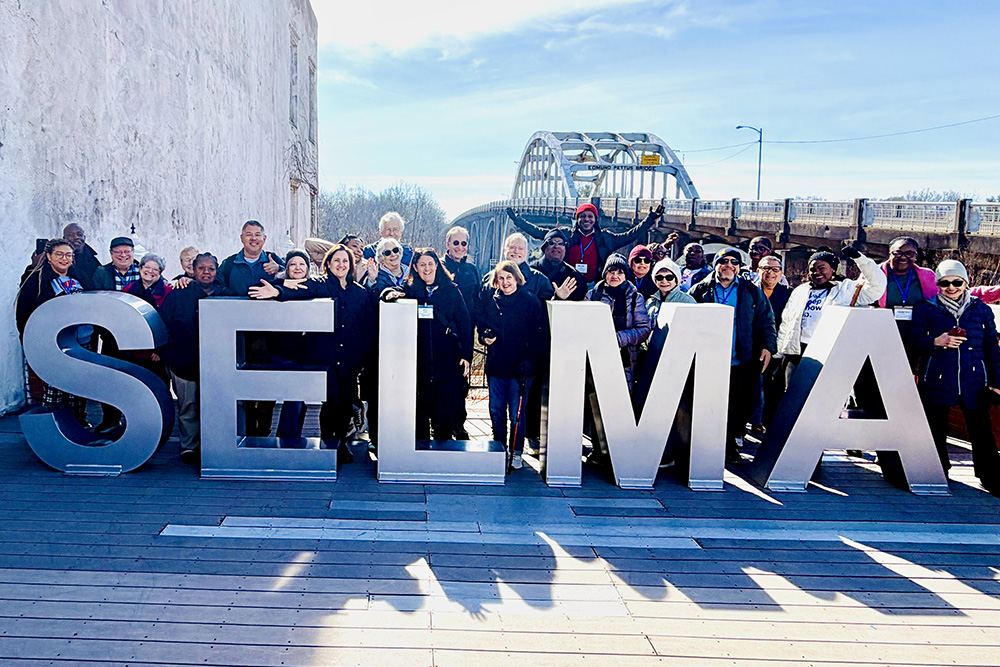
A group of 28 Houstonians recently completed a four-day Civil Rights journey through Atlanta, Ga. and Montgomery and Selma, Ala. Participants described the experience as emotionally overwhelming, spiritually sacred and deeply transformative.
The Feb. 22-25 journey, “Bridging Histories, Building Futures,” aimed to have the group “not travel as tourists, but as learners, as witnesses and as partners.” The trip was made possible by a grant from the Jewish Federation of Greater Houston’s Local Impact Fund and led by Beth Fine-Nelson, program director of Houston Congregation for Reform Judaism.
Participants included three rabbis and a cantor – Rabbi Steve Gross of HCRJ, Rabbi Scott Hausman-Weiss of Congregation Shma Koleinu, Rabbi Steve Morgen, rabbi emeritus of Congregation Beth Yeshurun and Cantor Diane Dorf. Joining them were Pastor Harvey Clemons Jr., of Pleasant Hill Baptist Church, newly licensed minister Lucyll Freeman and Michael Green, choir director at The Church Without Walls, along with members of their congregations and communities.
Pastor Clemons, Minister Freeman and Green’s presence highlighted the interfaith nature of the journey and its mission to strengthen relationships between the Jewish and Black communities.
This partnership has deep roots in the Civil Rights Movement, when Jewish leaders, clergy and activists stood alongside Black Americans in the fight for desegregation and voting rights. The joint participation of Black and Jewish leaders on this journey continued that historic allyship, grounded in faith and a collective responsibility to advance justice and equality today.
The group visited the National Center for Civil and Human Rights and the Martin Luther King Jr. National Historical Park in Atlanta before traveling to Montgomery and Selma.
In Montgomery, they toured the Rosa Parks Museum, the Freedom Rides Museum and the National Memorial for Peace and Justice.
In Selma, they walked across the Edmund Pettus Bridge, the site of the 1965 “Bloody Sunday,” when peaceful marchers for voting rights were brutally attacked by state troopers.
After walking across the bridge, the group met Twanya Dixon in the Civil Rights Memorial Park. Calling today’s challenges, a “modern day Goliath,” she quoted James 2:17 and 26: “Faith without works is death.” She reminded the group, “They walked, they sang, they prayed, they marched, they died. We have more, so we can do more – and we gonna do more.”
“Our trip through the Deep South was both profoundly unsettling and extremely sacred,” Rabbi Gross said. “As we traveled from Atlanta to Montgomery, we stood face to face with some of the darkest chapters of American history.”
The rabbi spoke candidly about the difficulty of grappling with a nation that “embraced, perpetuated and defended the horrors of slavery, racial terror and segregation for most of its history.”
Yet, the journey was not solely about grief. Rabbi Gross emphasized the sacred allyship formed between Jewish and Black participants.
“Throughout our four days together, we took every opportunity we could to share narratives of oppression and injustice,” he said, noting the painful differences and striking similarities between the communities’ histories.
“Grief, humility and moral reckoning” filled their hearts, but so did hope. From the bus boycotts to the Freedom Rides, participants witnessed how ordinary people, united in faith and persistence, reshaped laws and restored moral conscience. Tikkun olam, repairing a broken world, is possible,” said Rabbi Gross.
Rabbi Steve Morgen reflected on the spiritual dimension of the journey, invoking the teaching that “the whole world is a very narrow bridge and the main thing is not to be afraid.
“Standing in places marked by hatred and injustice, the call is not to retreat in fear, but to move forward with moral courage,” he said. “Crossing the Edmund Pettus Bridge became more than a physical act; it symbolized the narrow bridges communities must cross together, guided by faith, trust and a shared commitment to justice.”
Houston Police Officer Aaron Peña described the experience as spiritually transformative.
“What struck me most was the spiritual depth of the journey,” he said. “The consistent message of love, the greatness of G-d, the dignity of every human being and the call not to judge others but to treat even our enemies with humanity, was powerful.”
As a law enforcement officer, he said the trip prompted serious reflection. “It challenged me to think about how I treat people, the history connected to my profession and the responsibility I carry in wearing the badge. I left grateful that I have the opportunity to stand on the right side of equal justice.”
Courage, hate, triumph, fear and hope marked every stop along the way. These sacred places now serve as lasting reminders, urging the 28 travelers not to remain passive. By journey’s end, participants could no longer ask, “What happened?” They had stood where history unfolded, listened to the stories and felt both the weight of injustice and the power of courage.
Now, the question turns to the present: What does this history ask of us in Houston?
The answer demands action. The relationships formed across faiths and communities will not end at the airport; instead, they will continue through dialogue, partnership and a shared commitment to justice.
Already, these communities are planning next steps, seeking, in the words of former U.S. Rep. John Lewis, of blessed memory, to “make good trouble.”
“Bridging Histories, Building Futures” was more than the name of the Civil Rights journey; it is a responsibility.