
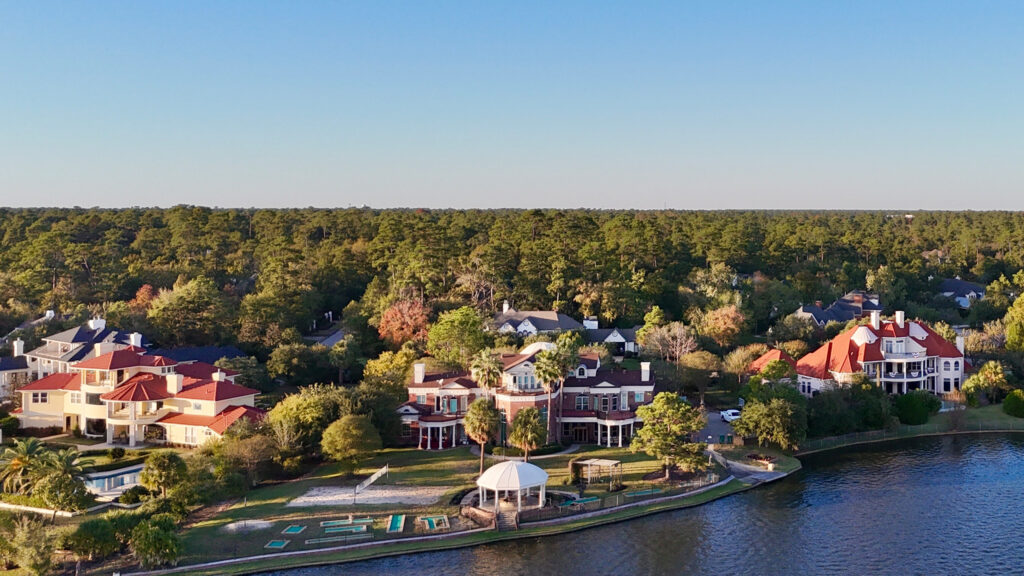
Real estate trends are hyperlocal, and this holds true for both typical homes and luxury homes. Luxury in the U.S. does not always come with a seven-figure price tag. There are markets within the country where a luxury home can be obtained for under $800,000. While that is still well above the national median for a typical home, the national luxury threshold starts at just over $1.2 million as of February 2026. In the Houston-Pasadena-The Woodlands, TX metropolitan area, the threshold to luxury begins at $794,170, one of the lowest among luxury markets nationwide.
Luxury Pricing at a Glance
Houston
USA
Luxury Threshold 90th Percentile
$794,170
$1,205,081
High-End Luxury Threshold 95th Percentile
$1,155,159.00
$1,987,555
Ultraluxury Threshold 99th Percentile
$2,644,196.00
$5,767,743
Million-Dollar Listing Share
6.1%
12.6%
Median Days on Market 90th Percentile
54
83
Median Square Feet $1 – $2 Million Price Tier
4,052
2,913
A Tale of Two Trajectories
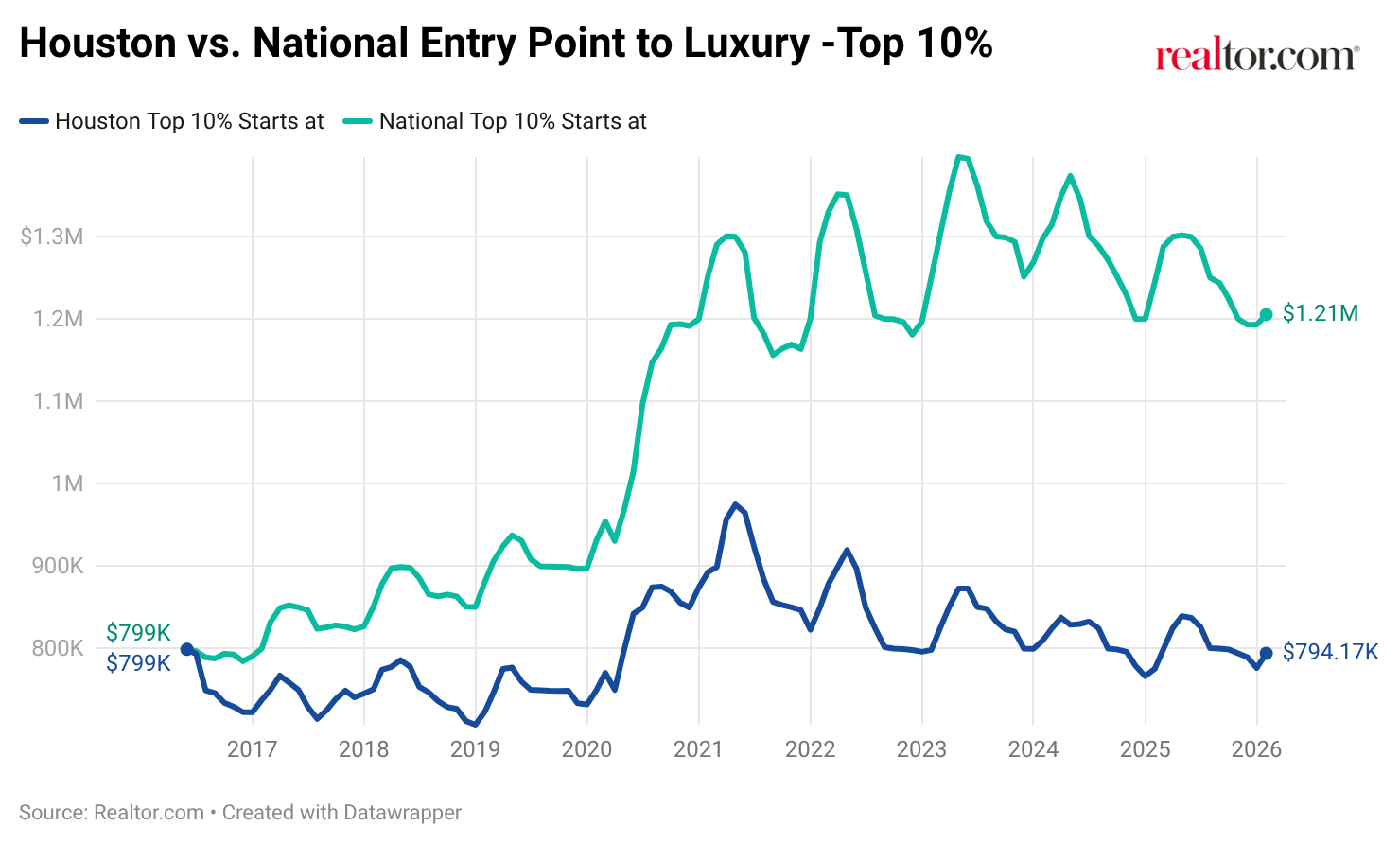
The starting point for luxury for both the U.S. and the Houston metro was $799,000 in June 2016. Since then, both have experienced similar peaks and troughs, but at very different amplitudes. While the national luxury benchmark has increased by 50.8%, Houston’s luxury threshold is essentially unchanged, down just 0.6%. That divergence tells the story of a market where accessible land and steady outward growth have kept luxury pricing remarkably stable, even as national benchmarks surged during the pandemic era and have since recalibrated.
Houston’s Economic Engine
The rich economic engine behind Houston has created one of the most resilient metros in the country. In terms of household count, the Houston metro ranks 5th nationally, making it one of the largest markets in the U.S. Houston got its start in the mid-1800s as a regional trade center before evolving into a rail and port hub. During the early 1900s, the city was transformed by the oil boom, an industry whose influence still echoes today. Houston also became the location for the NASA Manned Spacecraft Center and the home of the world’s largest medical center.
Many cities take on different identities throughout their history, but each stage of Houston’s development has endured and continued to grow. The result is an increasingly diverse, polycentric metropolitan area that extends well beyond energy into aerospace, transportation, life sciences, and international trade. That economic breadth has supported steady housing demand without the boom-bust volatility seen in markets driven by a single industry.
The Houston area has been able to capitalize on the availability of land in Texas by sprawling outward, rather than following the pattern of many other areas that experienced sharp post-pandemic price surges. Houston did see a modest bump in luxury pricing after the onset of COVID-19, but overall trends have remained relatively stable compared to metros such as Austin, TX, which experienced a pandemic-era “tech” surge that has since undergone a significant recalibration.
Luxury Bargain
Houston offers an entry point to luxury under $800,000, a rare distinction among markets that average at least 500 million-dollar listings over the trailing 12 months. For that price, buyers gain access to a metro anchored by world-leading industries and a strong foundation in the energy sector.
At the $1 million to $2 million price tier, the size advantage is substantial. The median luxury home in Houston at this price point spans 4,052 square feet, nearly 40% larger than the national luxury median of 2,913 square feet. That kind of square footage gap means buyers in Houston are getting significantly more home for their dollar than in most luxury markets. In many of the nation’s most expensive coastal metros, a million-dollar home may offer under 2,000 square feet. In Houston, the same budget buys a modern, spacious property with room to spare.
Houston’s luxury homes also sell relatively quickly. At just 54 days on market for the 90th percentile tier, luxury homes in Houston move nearly a month faster than the national median of 83 days. That pace signals an active luxury buyer pool and sustained demand, particularly notable in a market where pricing remains well below that of most luxury markets within the US.
A Newer Luxury Stock
Houston’s luxury housing stock skews noticeably newer than the national profile, and the distribution of construction decades highlights a metro where much of the high-end inventory has been built in recent years.
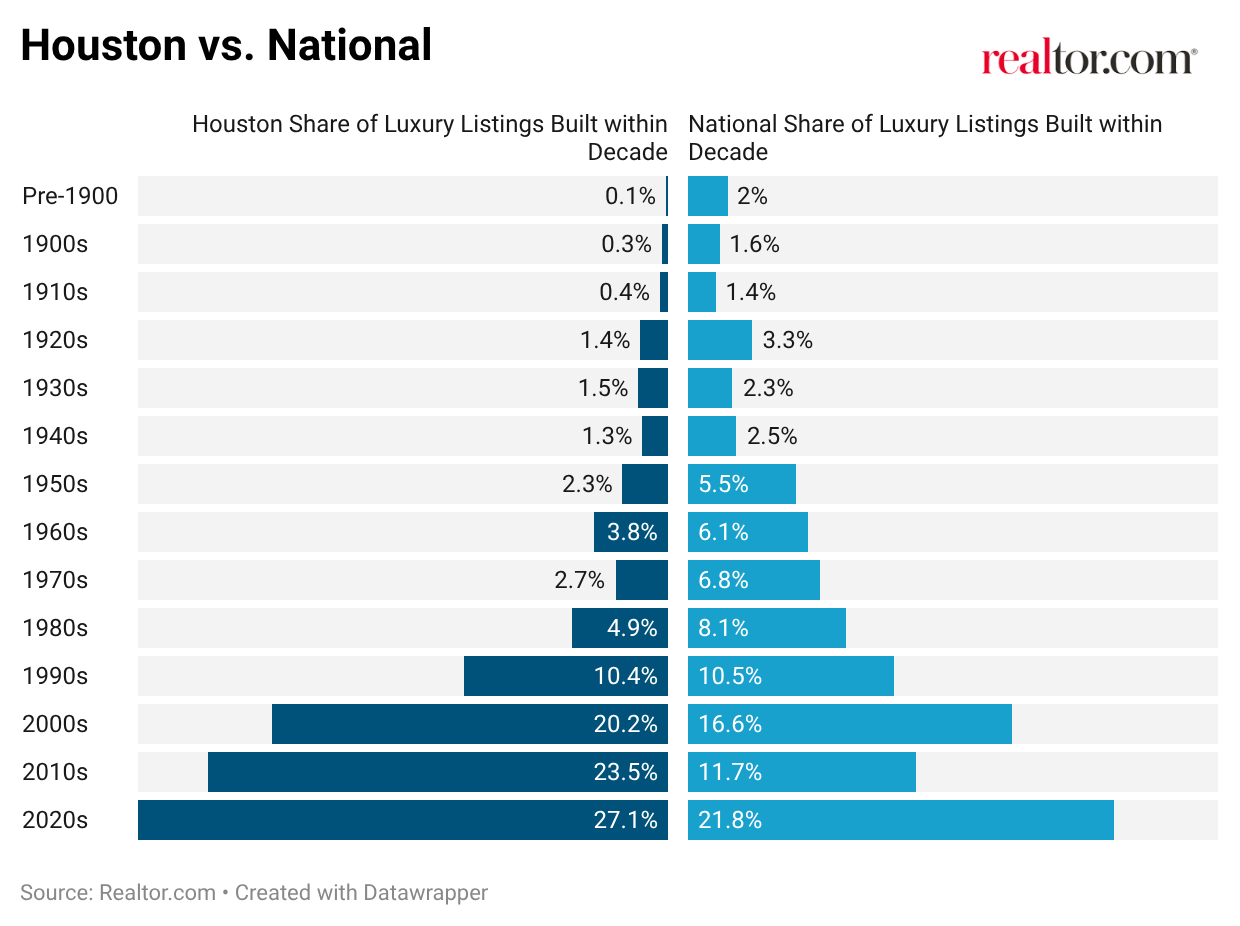
Over half of Houston’s luxury properties (those in the 90th percentile by listing price) were built in 2010 or later. Homes from the 2020s alone account for 27.1% of the luxury stock, the largest share of any single decade and noticeably above the 21.8% national figure. The 2010s added another 23.5%, roughly double the national share of 11.7% for that decade. Combined, homes built since 2010 make up roughly half of Houston’s luxury inventory, compared to about a third nationally.
At the other end of the timeline, Houston has a much thinner legacy of older luxury homes. Properties built before 1970 represent just under 10% of the luxury stock in Houston, compared to roughly 25% nationally. The 1920s through 1960s, decades that produced a substantial share of luxury homes in older coastal metros such as San Francisco, New York, and Boston, account for a relatively small portion of Houston’s top-tier inventory.
This newer construction profile is consistent with Houston’s growth pattern: a metro that has expanded outward with new master-planned communities and subdivisions rather than relying on a fixed stock of legacy properties. In many older luxury markets, value is anchored by neighborhood prestige and scarcity. In Houston, value at the luxury tier is more closely tied to modern finishes, square footage, and recently built homes in planned developments. The result is a luxury market defined by what’s new rather than what’s scarce.
Houston’s Most Expensive ZIP Codes
Just because the Houston metro offers some of the most affordable luxury homes in the country does not mean it lacks ultraluxury enclaves. The following are the most expensive ZIP codes within the Houston metro (minimum 10 active listings):
Rank
ZIP
Area
Median Listing Price
Median Square Feet
Listing Count
Median Days on Market
Median Year Built
1
77005
West University Place
$1,598,750
3,189
70
52
1990
2
77401
Bellaire
$1,224,000
4,037
38
40
1992
3
77019
River Oaks
$952,375
2,826
135
50
2003
4
77098
Montrose/Upper Kirby
$857,250
2,578
75
53
1999
5
77027
Highland Village
$707,000
1,726
99
74
1997
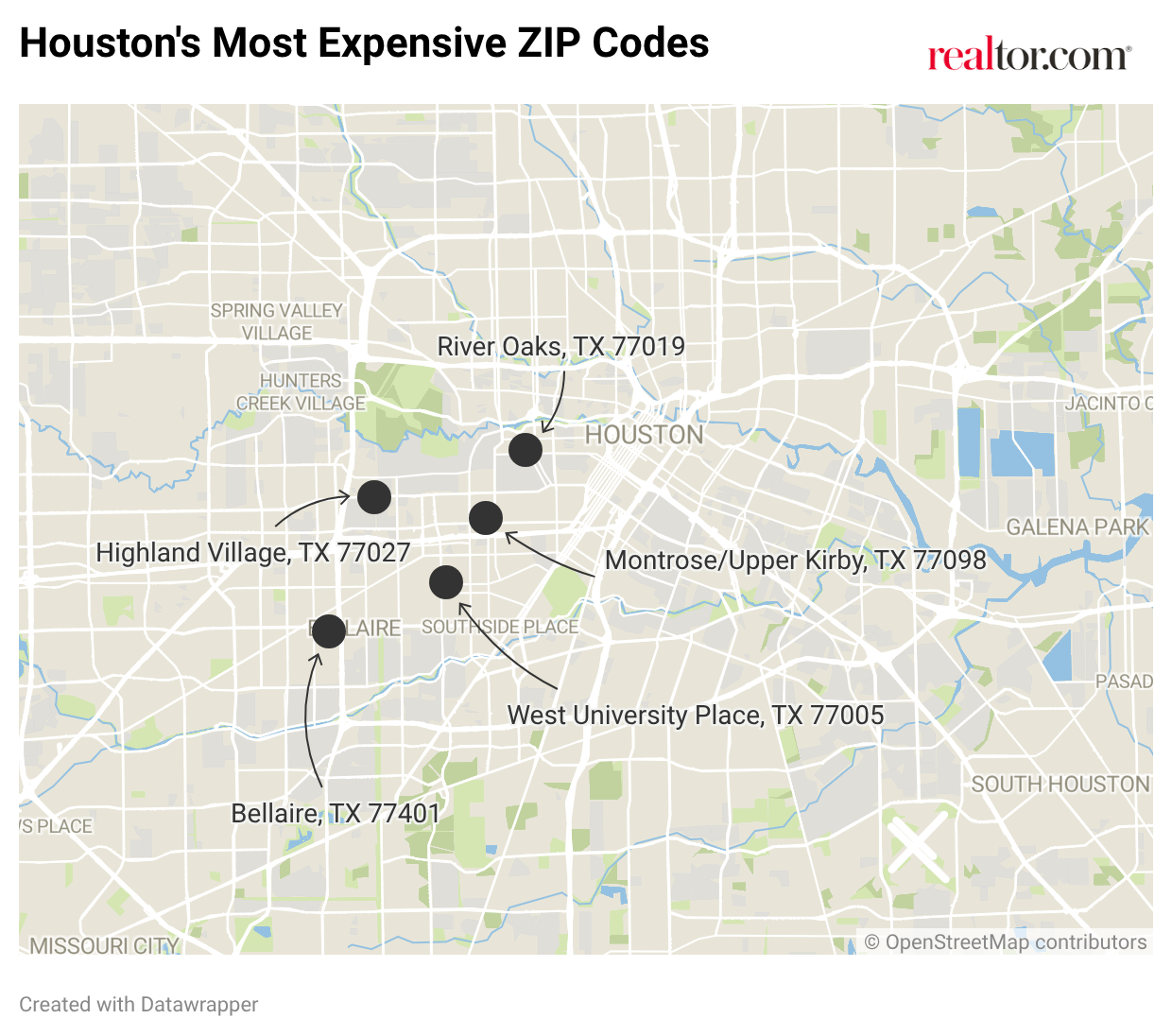
Houston’s top five ZIP codes reflect a set of established inner-loop neighborhoods where location, character, and an older housing stock drives pricing well above metro-wide norms. Even in a region known for its vast land availability, these areas command a significant premium for their proximity to the city’s core.
The 77005 ZIP code, which includes Rice University and the West University Place area, leads the metro with a median listing price of nearly $1.6 million. Known for tree-lined streets, top-rated schools, and walkability, the neighborhood commands a premium rooted in lifestyle and scarcity of available lots. Despite median homes here dating to 1990, many properties have been renovated or rebuilt, blending older neighborhood charm with modern updates.
The 77401 ZIP code (Bellaire) follows at $1,224,000, offering the largest median square footage on this list at 4,037 square feet. Bellaire has attracted buyers looking for newer, larger homes in a family-friendly setting with its own municipal identity, all within minutes of the Texas Medical Center, the Galleria and NRG Stadium – home of the Houston Rodeo. Homes here also move fastest among the top five, with a median of just 40 days on market.
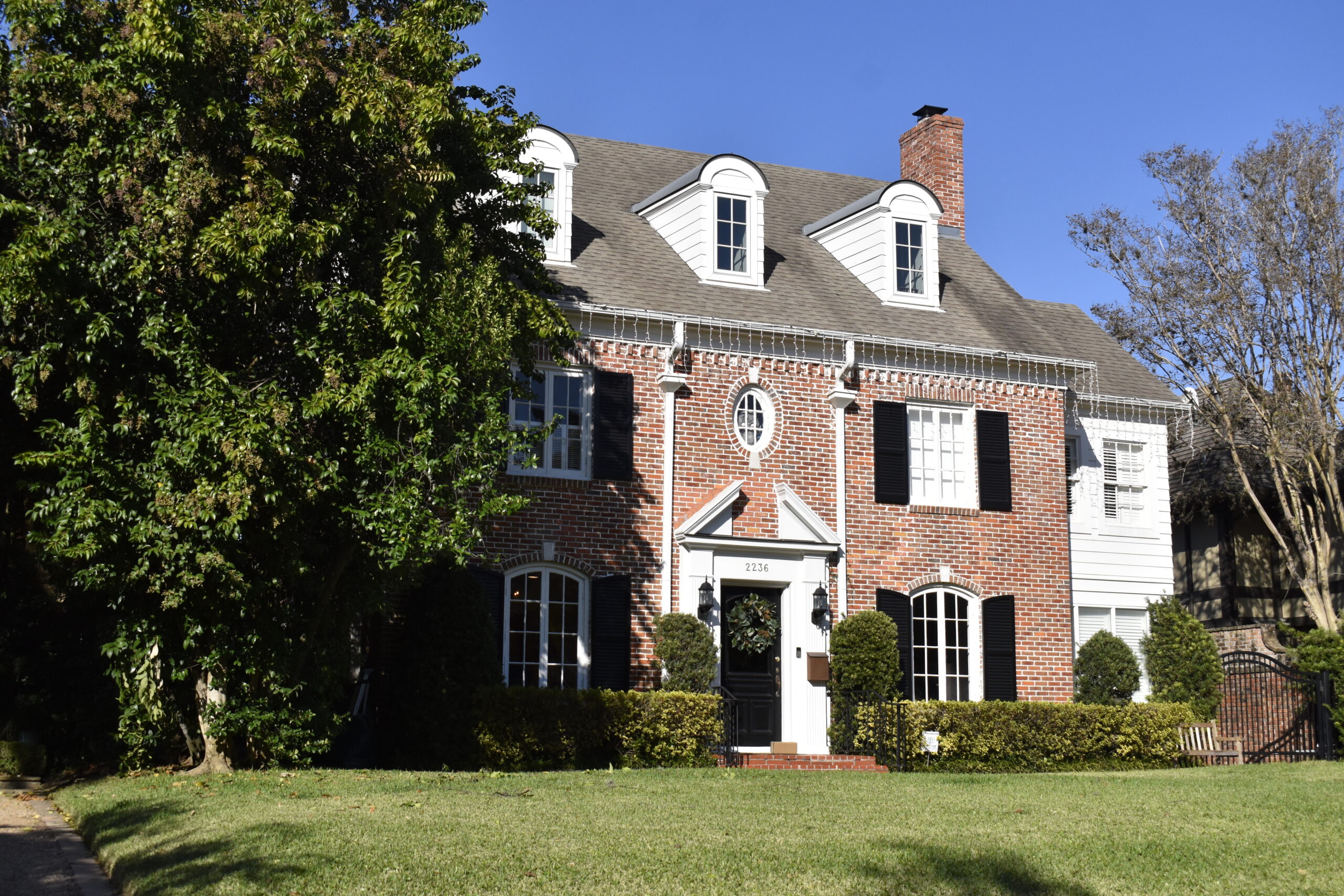
The 77019 ZIP code, encompassing the River Oaks and Montrose neighborhoods, has the deepest inventory on this list at 135 active listings and the newest median build year at 2003. River Oaks is arguably Houston’s most recognizable luxury enclave, home to estates that have long defined the city’s high-end market. Montrose adds a more eclectic, urban character to the mix. Together, they create one of the most active luxury submarkets in the metro.
The 77098 ZIP code (Montrose/Upper Kirby) and 77027 (Highland Village) round out the list. Both are inner-loop neighborhoods where buyers trade some square footage for proximity to Houston’s cultural institutions, dining, and employment centers. The 77027 ZIP code, with a median listing price of $707,000 and a median size of 1,726 square feet which sits just below the metro’s formal 90th-percentile luxury threshold, it represents a high-demand “gateway” to the luxury market, and also reflects a market with a higher concentration of townhomes and smaller-footprint properties near the Galleria.
Across all five ZIP codes, the pace of sales is notably brisk. Every ZIP on this list has a median days on market at or below 74 days, and four of the five come in under 55 days. That is faster than the metro-wide luxury pace of 54 days for the 90th percentile and well ahead of the national luxury pace of 83 days. These are neighborhoods where demand consistently outpaces supply, keeping turnover tight even as median listing prices generally sit well above the metro’s luxury entry point.
The median year built for these top ZIP codes ranges from 1990 to 2003, generally older than the metro’s overall luxury median build year of 2010. That contrast is instructive: Houston’s most expensive pockets are defined by established, inner-loop neighborhoods where value is driven by location and neighborhood prestige, while the broader luxury market is shaped by newer construction on the metro’s expanding edges. Both patterns coexist, giving Houston a luxury landscape that spans legacy enclaves and modern planned communities alike.
The Takeaway
Houston stands out as an appealing luxury market, not because of record-setting price points, but because of the value it delivers relative to the rest of the field. A luxury entry point under $800,000, homes that offer roughly 40% more space than the national norm at the $1 million to $2 million tier, and a selling pace that outpaces most peers by nearly a month all point to a market where luxury is both more attainable and in demand. Layer in a diversified economic base that spans energy, aerospace, health care, and international trade, and the fundamentals behind Houston’s luxury market become clear. For luxury buyers seeking scale, modern construction, and proximity to a globally connected metro without the price premiums of coastal markets, Houston continues to stand out as one of the most obtainable options in the country.
All data in this report is sourced from Realtor.com® listing trends as of February 2026, reflecting active inventory of existing homes, including single-family residences, condos, townhomes, row homes, and co-ops. Listings reflect only those posted on MLS platforms that provide listing feeds to Realtor.com. New-construction listings are excluded unless actively listed on participating MLSs.
Metropolitan and micropolitan areas are defined using the Office of Management and Budget’s OMB-2023 delineations, with Claritas 2025 household estimates used for relative comparisons. Where appropriate, we limited analysis to metros or micros with a minimum threshold of active million-dollar listings on average over the past year to ensure meaningful comparisons.
Historical listing trend data extends to July 2016, but year-over-year comparisons in this report use February 2025 as the baseline.
Luxury by the Numbers
90th percentile = Entry-level luxury (top 10% of prices)
95th percentile = High-end luxury
99th percentile = Ultraluxury (often rare or custom properties)