
It’s one of the largest military posts in the country, but also a place that’s been at the center of national scrutiny. Fort Hood, formally known as Fort Cavazos, has a complex history but also a critical mission: training the U.S. Army’s heavy forces.
In September, CBS News Texas, along with other local media outlets and several influencers, was invited to tour the post for a behind-the-scenes look.
The morning began at Fort Worth Alliance Airport. After a quick safety briefing, crews boarded a Blackhawk helicopter bound for Fort Hood.
“What makes our Army so special and so unique are our soldiers, and the soldiers that are in the front right here of this Blackhawk helicopter — pilots and crew chief, working for left and right—they make this helicopter lethal,” said Col. Kamil Sztalkoper, director of public affairs for III Armored Corps at Fort Hood.
Inside the installation
As the Blackhawk passed Gatesville, the tan outlines of the massive installation came into view. Crews deboarded the chopper and headed toward the main headquarters. About 35,000 soldiers live and work at Fort Hood, which spans more than 218,000 acres of Central Texas. It houses more than 2,000 fighting vehicles. Its primary mission is to train and deploy heavy forces. It’s the only U.S. Army post capable of stationing and training two armored divisions.
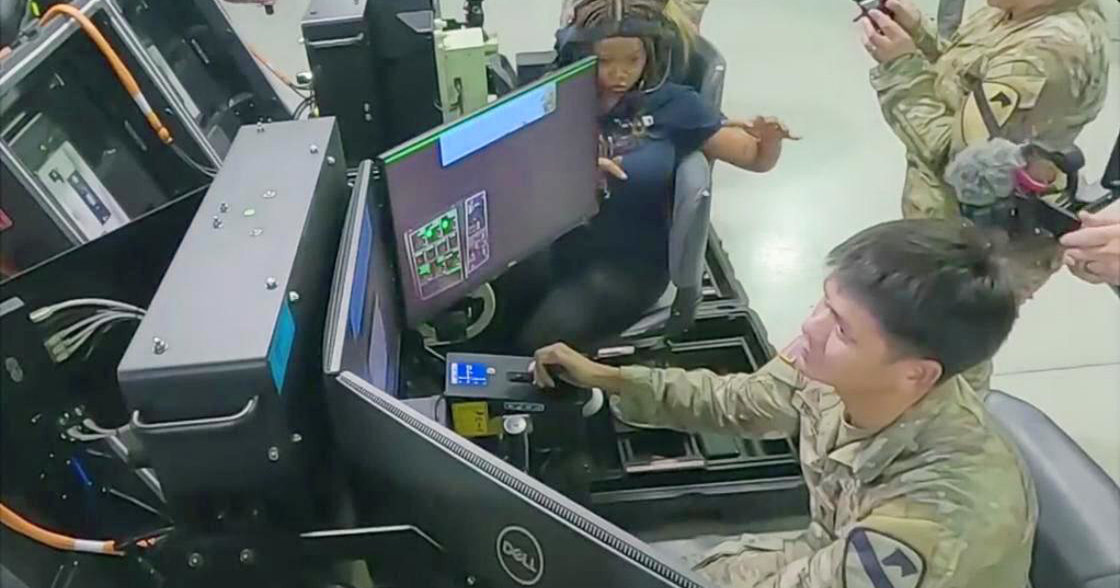
Crews received rare access to a virtual training facility, where soldiers train on armored combat vehicles like the Bradley Fighting Vehicle, currently in use in Ukraine. Using high-tech simulators, the military trains soldiers on different roles within the vehicle—from commander to gunner to driver. The virtual training saves time, money and energy before soldiers move to live training grounds.
“So this helps us not only train, but it gives us more intellect on how the system works itself. So if we’re struggling on something, this is a great tool to come in, do some practice before we actually go and do the live training,” said Staff Sgt. Johnathan Plummer.
Combat power and live-fire drills
Sztalkoper said about 48 percent of the country’s combat power comes from Fort Hood. Crews arrived at Clabber Creek Range to observe a live-fire training exercise with soldiers preparing for real-world missions.
“We used this in Operation Desert Storm, Desert Shield, in Iraq, in Afghanistan as well,” Sztalkoper said. “This platform has been around since the early ’80s.”
Among the soldiers was 24-year-old Jacqueline Striker, who joined the military in 2019. She is one of just five female master gunners in the entire Army.
“I get to shoot some big guns,” Striker said. “It was definitely difficult. It’s one of the hardest knowledge schools in the Army. It has an 80 percent failing rate, but I didn’t want to come back and tell everyone I failed, because I don’t like failing.”
Reforms and reckoning after Vanessa Guillén’s death
Striker’s achievement is part of a growing effort to empower soldiers and strengthen training across the force. But despite progress, serious concerns about soldier welfare persist.
In 2020, 20-year-old soldier Vanessa Guillén was murdered at Fort Hood after reporting sexual harassment by a supervisor. Her death sparked national outrage and led to reforms in how the military handles sexual misconduct.
“The brutal murder of Vanessa Guillén really allowed us to look at ourselves, and what can we do to make things better,” Sztalkoper said. “So, the Fort Hood Independent Review Committee looked at everything that we need to make changes on, and we did that. Women over there — over 70 recommendations from the Fort Hood Independent Review Committee — we made those. We implemented those. And, you know, I think we’re doing extremely well right now when it comes to issues of sexual harassment, sexual assault.”
CBS News Texas asked about ongoing concerns from female soldiers, many of whom continue to post about sexual assault and harassment.
“I appreciate the question, and those soldiers know — talk to your leadership. Know we have the services available for soldiers and family members that are needed,” Sztalkoper said.
Focus on training amid broader missions
CBS News Texas also asked officials about Fort Hood’s role at the southern border and the president’s orders to deploy troops to what he calls “dangerous cities” like Chicago and Portland, despite criticism that the U.S. should not be militarizing cities.
“A lot of the soldiers, from what I heard, they are proud to be supporting the mission on the border and helping defend our nation,” Sztalkoper said. “I’ll be honest, that is a question definitely for leaders in the Pentagon. I think here at Fort Hood we’re focused on what you see right here—training on the ten-level task, individual soldier tasks, driving Bradley Fighting Vehicles, going into the range. We still have a mission at the end of the day to be a combat-credible force, and whatever that may be… wherever we have to go.”
Restoring trust and telling untold stories
While negative headlines have plagued the base, officials said they are working to shift the narrative and restore trust.
“There are so many amazing things happening here on a daily basis that are just not told. The stories of great soldiers are not told. The great training that soldiers are doing are not told.”
As crews boarded the Blackhawk back to North Texas, the message from soldiers was clear: it’s a job they carry out with pride and honor.
“We have so many great soldiers, so many great leaders that care, which are passionate, and they want to help individuals from all walks of life,” Sztalkoper said.