
Last month, actor James Van Der Beek died of colon cancer at age 48. The Dawson’s Creek star was among a growing number of younger adults who’ve been diagnosed with the disease — a trend that has puzzled researchers.
As scientists try to understand what’s behind the rise, new research from the University of Texas at Dallas and UT Southwestern Medical Center suggests the disease may behave differently in younger patients.
In a study published in January in the journal Advanced Science, the researchers found tumors in younger patients tend to develop in tissue with more scarring, making it stiffer. The phenomenon appears to be driven by changes in collagen — a structural protein that helps give tissues their shape — and by chemical signals that prompt nearby cells to grow and multiply. The stiffness wasn’t limited to tumors: Even normal tissue near the tumors in younger patients was stiffer. The findings suggest mechanical changes in the colon may arise before tumors form, helping set the stage for early-onset colorectal cancer.
“I think why this is so interesting is that we have this clear, distinct feature between these early-onset tumors and later-onset tumors,” said Dr. Michael White, an assistant professor of colon and rectal surgery at the University of Texas M.D. Anderson Cancer Center, who was not associated with the study. “This is probably the first step to begin following a potential risk factor that we can identify and hopefully make some population-level change to decrease risk.”
News Roundups
An unexpected finding
Colon cancer is the leading cause of cancer death in the United States for people under 50, according to a new analysis from the American Cancer Society. Early-onset colorectal cancer has been rising for three decades, increasing by about 0.5% to 2.4% each year. Since 2020, these cases have accounted for about 12% of all colorectal cancer diagnoses in the U.S.
If trends continue, the rate of early-onset colorectal cancer could rise by as much as 124% by 2030, according to some estimates. The steepest increases are expected among adults ages 20 to 34, and younger patients are more likely to be diagnosed after the disease has advanced.
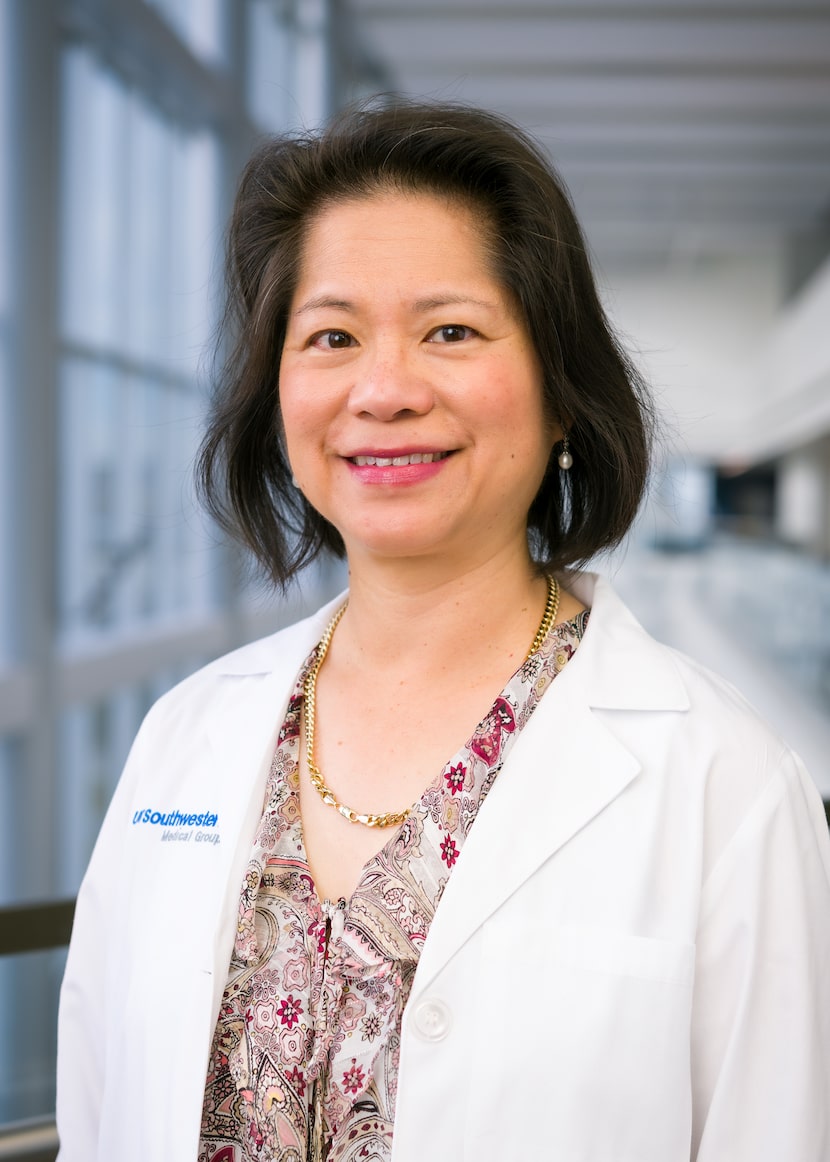
Dr. Emina Huang is a colorectal surgeon and executive vice-chair of research at UT Southwestern Medical Center who co-led the new study.
Brian Coats
There doesn’t appear to be any genetic reason driving the trends, said Dr. Emina Huang, a colorectal surgeon and executive vice-chair of research at UT Southwestern Medical Center, who co-led the new study. “It just seems that the disease has shifted about maybe 20 to 30 years earlier in time.”
One hypothesis for why, Huang said, involves chronic inflammation — a long-term immune response linked to conditions such as metabolic liver disease, heart disease and diabetes. Other research has pointed to possible causes for inflammation, such as changes in the gut microbiome, including imbalances between beneficial and harmful bacteria or exposure to mutated strains producing DNA-damaging toxins. Scientists have also raised concerns about the growing presence in the environment of microplastics that can enter the body carrying bacteria, chemicals and other contaminants that may contribute to cancer risk.
Whatever the cause, Huang said she began noticing something unusual while operating on younger colon cancer patients several years ago at the Cleveland Clinic in Ohio. On exam, she could feel the tissues were maybe stiffer, but she wasn’t sure.
After joining UT Southwestern, she began seeing the same pattern in patients there. Wanting to investigate further, Huang reached out to Jacopo Ferruzzi, a bioengineer at the University of Texas at Dallas who studies tissue mechanics, or how biological tissues respond and adapt to physical forces such as compression and tension.
Together they decided to conduct a study to examine whether younger patients with colon cancer were developing stiffer tissues. Huang and her colleagues at UT Southwestern collected colon tissue samples from 19 patients diagnosed with colon cancer after age 50 and 14 patients diagnosed before age 50. For each patient, the researchers collected samples from the primary tumor and from nearby tissue that appeared normal and was at least five centimeters away, allowing comparison between healthy and cancerous tissue. Ferruzzi and his team then did biomechanical testing, including pressing tiny probes into the tissue to measure its resistance to pressure and examining how the samples responded to compression.
Ferruzzi expected tissues would be stiffer among older patients. But that’s not what he and his team found.
“Here we saw the opposite, at least with regard to colorectal tissues,” said Ferruzzi. “The younger patients had stiffer tissues.”
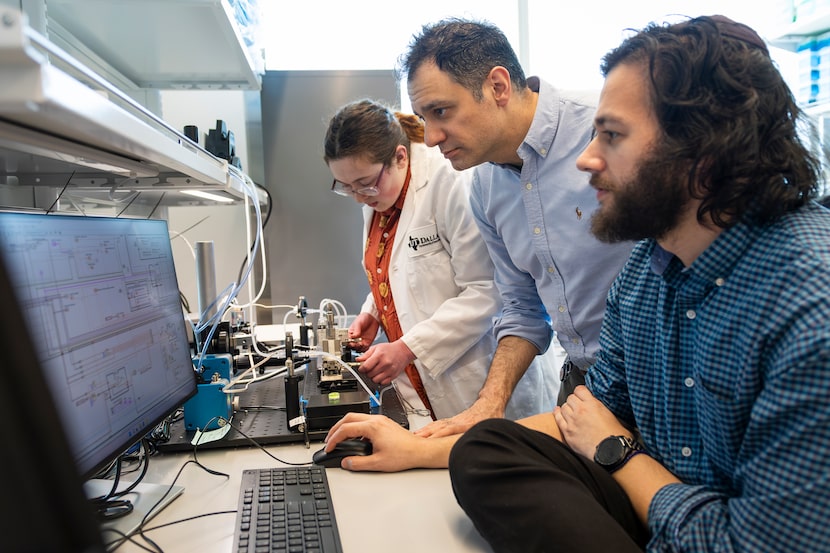
Jacopo Ferruzzi (center) is an assistant professor of bioengineering at the University of Texas at Dallas. His team’s research found that cancerous and non-cancerous tissue of people with early-onset colorectal cancer is stiffer than the tissue of older people with the disease.
james coreas
What was more surprising to him was that they found the stiffness in normal tissue, which, he said, “suggests that these tissues are stiffer even before cancer develops there. If that were to be true, that could be a potential driver of cancer.”
Finding markers of cancer
While it remains unclear what triggered the inflammation that led to tissue stiffening in the patients, Ferruzzi said the changes may be driven by fibroblasts — cells that produce collagen. When activated, these cells can reorganize collagen in ways that make the surrounding tissue more rigid. Cells lining the colon sense that increased stiffness, potentially triggering faster cell growth — an early step in cancer formation.
Huang and Ferruzzi plan to do more studies in a larger group of patients to identify markers of tissue stiffness. This is especially important because early mechanical changes may be too subtle for doctors to detect during routine exams or colonoscopies, which are recommended starting at age 45 for screening colon cancer.
Such markers could help flag risk before cancer develops, allowing clinicians to recommend treatment or lifestyle changes to prevent disease, Huang and Ferruzzi said. Further research may also help clarify the underlying causes of early-onset colon cancer, whether related to diet, environmental exposures or other factors.
Miriam Fauzia is a science reporting fellow at The Dallas Morning News. Her fellowship is supported by the University of Texas at Dallas. The News makes all editorial decisions.
 Can food be medicine? Health is shaped by far more than what happens in a doctor’s office
At a Dallas Morning News pop-up newsroom event, North Texas health experts discussed small ways families can treat food as a pharmacy.
 For North Texas families battling rare disease, new FDA proposal offers hope
The regulatory shift may help advance a Leigh syndrome treatment developed by UT Southwestern scientists.
 Making small changes: Learn how food impacts health at free panel hosted by The News
Experts say small changes can make a big difference. Join us for a panel discussion this week.
 Exercise may help mood in people at high risk for psychosis, UT Dallas study finds
The research suggests even modest exercise may strengthen brain connections and ease mood symptoms.