
History does not always announce itself with a plaque or a monument. Sometimes, it must be unearthed from 80 boxes of city archives or reclaimed through the fading memories of neighborhood’s elders.
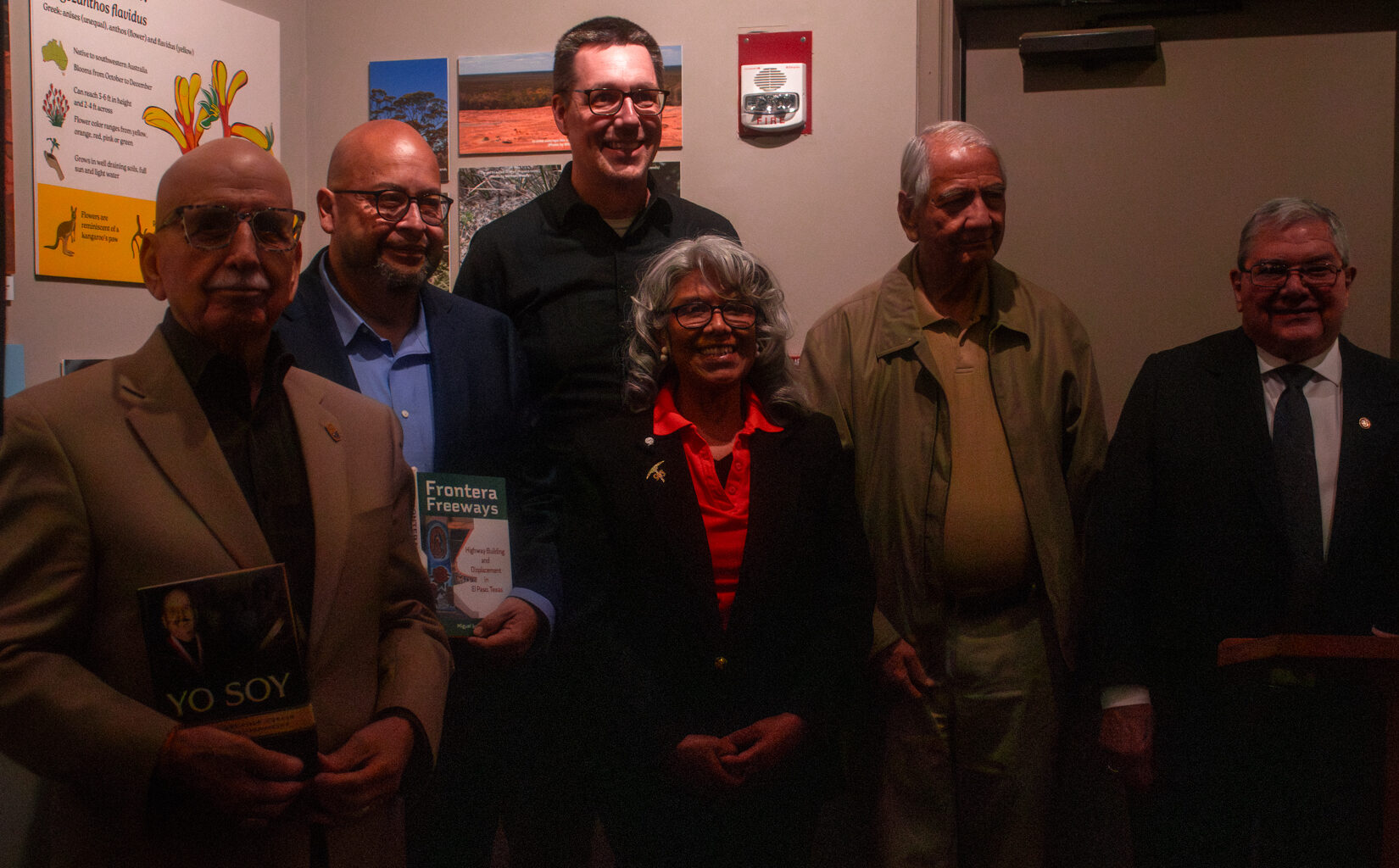
On Feb. 18 the community gathered at the University of Texas at El Paso (UTEP) Centennial Museum for a book signing and conversation featuring two of the region’s prominent academic voices: Miguel Juárez and Roberto Villarreal.
The event focused on their respective works, “Frontera Freeways” and “Yo Soy.” While the books approach the Borderlands from different angles, both authors share a singular mission: giving a permanent voice to a history that many in power have sought to overlook.
Juárez opened the discussion by detailing his 14-year fight to save Lincoln Park High School, a segregated Mexican school that served as a cultural hub long before the city’s official Mexican American Cultural Center existed.
He recalled the dismissive attitudes of city officials who claimed “no one of any prominence” had ever attended the school.
“I thought, well, how did you know this history? You have to research that history [to know],” Juárez said. “It’s just not going pop up in a flag because in our multicultural communities, we don’t have historic markers sometimes.”
To find out the truth, Juárez spent years digging through over 80 boxes of city planning records in UTEP’s Special Collections Department. His research uncovered a pattern of systemic displacement that targeted not only the Latino community but also the African American residents in South Central El Paso.
“The African American community lived in South Central El Paso, and they [the city] passed a series of funding issues too, for, for [slum] flight, for takeoff [of] life, early renewals, and [guess] who they targeted as urban renewal sites, the black community,” Juárez said. “So, the black community [there], they’re [their homes] those are large apartment complex [they] and owned, they were just torn down.”
Juárez noted that local narratives often sanitize the city’s past, creating a disconnect between academic findings and public perception. He argued that the lack of public documentation has led many to believe such hardships never occurred.
“People say displacement that happened in El Paso? Where? We don’t see it. Why? Because we never report it, right? Have you ever heard, the news media today say, these people were displaced? No, they’re not going to say it. We have the ideal community here,” Juárez said.
While Juárez examines the external forces of urban development, Villarreal’s “Yo Soy” focuses on the internal journey.
Villarreal, a Professor Emeritus who arrived at UTEP in 1976, reflected on his roots in South Texas, where he said the culture of discrimination was “far more intense.”
“At that time, if you look at statistics, about 95% of the students were out [of school] by the fourth grade,” Villarreal said. “My wife claims the reason why I made it better is because I was very stubborn, and I am.”
Villarreal’s journey included years as a migrant worker, “picking onions” and cotton, often attending school only part time. He failed four times and did not graduate high school until age 22. Despite holding four degrees, Villarreal emphasized that a degree is not the only measure of a person.
“Inside, I would be my [own] parent and my family, but outside, in order to survive, you become somebody else and I paid a price for that. My goal had been to dignify a human being,” Villarreal said. “Sometimes you need to gain self-respect because you are told not to have respect for yourself. After all, [back then] you’re at the bottom.”
When asked what a hypothetical “new chapter” of their books would consist of today, both authors pointed toward a need for unity and continued vigilance against political regression. Juárez spoke of his work with the El Paso Black community to ensure they are “at the table” during city planning discussions.
“The work continues, I invited them. They’ve created an organization; they’re putting plaques around the city.” Juárez said. “History repeats itself, so that’s what we have to [do], be vigilant about [it] so we don’t get displaced as well.”
While Juárez emphasizes the importance of anchoring history in the physical landscape, Villarreal looks toward the evolution of the community’s social fabric.
“I would say that a new chapter should include… how the two major movements can overlap more than before, and the idea [is] that in our world we need to have far more integration and a sense of understanding of each other,” Villarreal said.
The evening concluded with a call to action. Juárez, who obtained his Ph.D. later in life, urged students to never stop learning.
“Life is short. Even if something happens to you, you continue going forward,” Juárez said.
Villarreal offered a final reflection on his 30 years of teaching across the street at Benedict Hall, admitting that even as a professor, he often felt the same “terror” his students felt.
“When a student was jammed or fearful, I said, ‘You’re not the only one who’s afraid. I’m terrified,’” Villarreal said. “It helps a student to understand that all of us are fearful. It doesn’t matter what rank you have.”
Following the discussion, both authors stayed to sign copies of their books, engaging individually with attending students and community members who came to have their own histories validated.
As the event wrapped up at the Centennial Museum, the message was clear: whether through the archival maps of “Frontera Freeways” or the personal reflections of “Yo Soy” the voices of the border are no longer waiting for permission to be heard.
Adrian Gonzalez Jr. is a staff reporter for The Prospector. He may be reached at [email protected]