
Corpus Christi officials are hoping to dispel portrayals of the city, its water situation and the timeline that a water emergency would be possible.
For months, a model has shown the city entering into a water emergency in November.
A water emergency would be called when the city’s total water supply falls short of meeting demand. It would require curtailment, which is the forced reduction of water use.
City Manager Peter Zanoni, in a March 13 media briefing, said a series of five new models — expanding from a single scenario — have been in development to better project the potential for a future water emergency, ranging from worst-case to best-case scenarios.
The new models take into account more accurate data on contributing factors such as accelerated evaporation rates, permitting dates and a timeline on when different water supply projects could come online, he said.
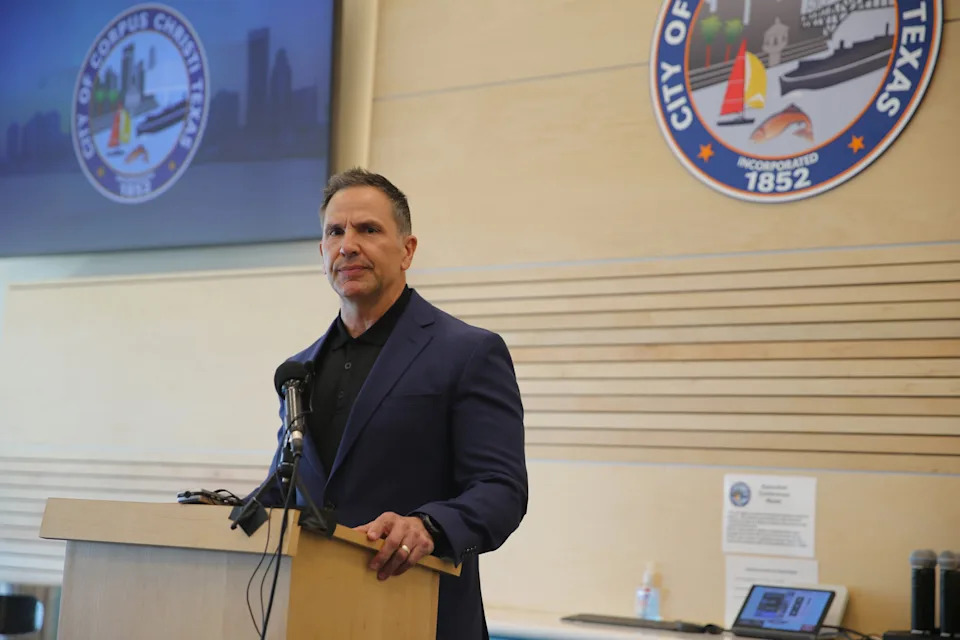
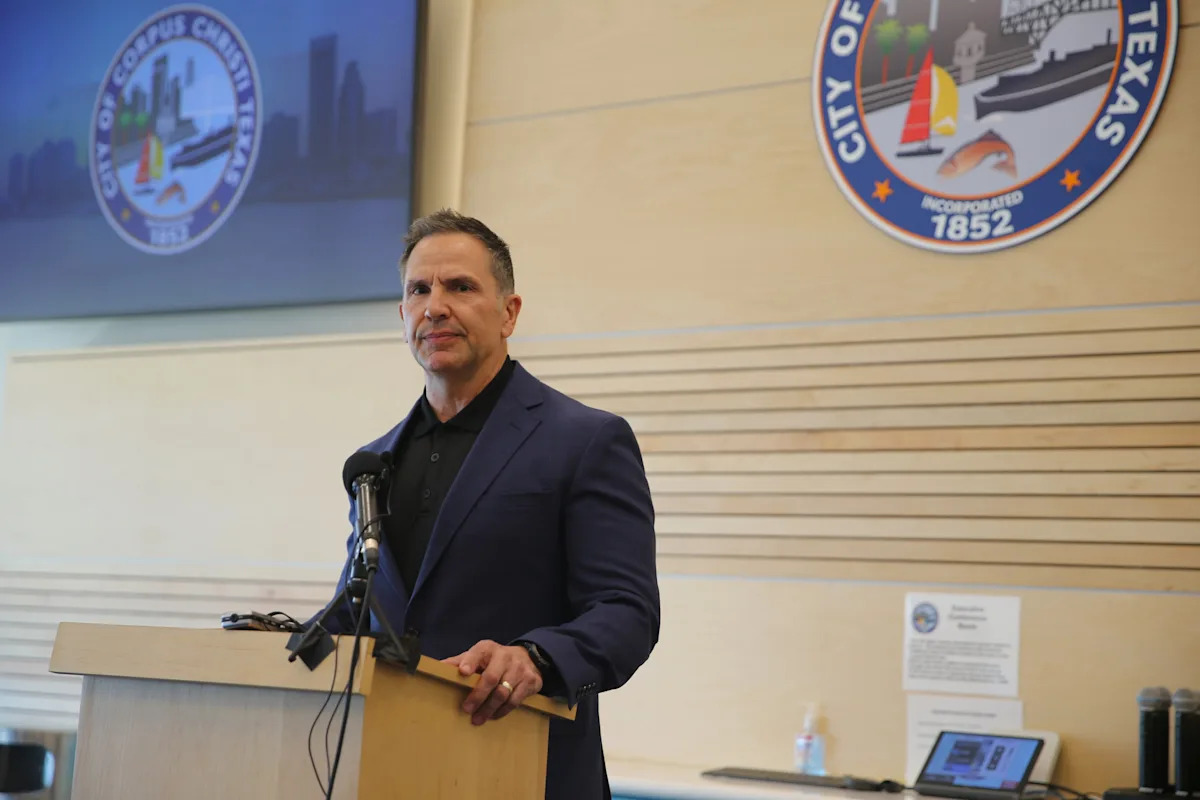
Corpus Christi City Manager Peter Zanoni briefs media on the city’s water situation on March 13.
One of them doesn’t assume any rainfall, Zanoni said.
He described some of the models as being “misinterpreted” recently — for example, that curtailment could come as soon as May.
“That’s not the case,” he said. “There is a range of probability on when that level 1 emergency could be called.”
One of the models shows the city not reaching curtailment at all, Zanoni said.
Water supply crisis: Corpus Christi leaders respond after governor’s criticism on water
The modeled scenarios were not provided during the briefing. They are expected to be presented during a City Council meeting on March 17.
Additional data would be collected through the weekend, Zanoni said.
There is possibility that the Texas Commission on Environmental Quality may issue a draft permit for one of the city’s Nueces County groundwater wells on March 13, he added — a change that would impact the models.
He highlighted ongoing water supply projects, including two groundwater well fields in Nueces County, a groundwater well field in San Patricio County and industrial effluent reuse.
The projects are either complete, in design, in construction or preparing to launch construction, according to city officials.
However, permits needed for one of the Nueces County groundwater wells and the proposed well field near Sinton haven’t been secured.
Permitting from the state and the San Patricio Groundwater Conservation District are the only significant, but missing, pieces for two of the projects, Zanoni said.
The city is doing what is within its power to do, he said.
“The last holdup that we’re working through right now in a few of those projects is unfortunately a piece of paper,” Zanoni said.
Seawater desalination: Corpus Christi leaders reconsider desal plant as questions remain
City officials have said that the projects, should all go forward, total additional 76 million gallons of water added to supply. Investment in the past year has reached about $1 billion.
Although the combined capacity of Lake Corpus Christi and Choke Canyon Reservoir measured 8.7% as of March 13, the city has largely been relying on water delivered through the Mary Rhodes Pipeline from the Colorado River and Lake Texana.
Kirsten Crow covers city government and water news. Have a story idea? Contact her at kirsten.crow@caller.com.
Consider supporting local journalism with a subscription to the Caller-Times.
This article originally appeared on Corpus Christi Caller Times: Officials say some representations of water emergency are inaccurate