
Austin, TX — Athena is back.
The beloved great horned owl has returned to the Lady Bird Johnson Wildflower Center and laid two eggs in early March, continuing a nesting tradition that began in 2012.
“We are all so excited,” said Andrea DeLong-Amaya, horticulture educator at the Wildflower Center. “Everybody’s glued to their TV monitors, watching the camera and every move. It’s pretty exciting. We’ve been watching her for over a decade now.”
Great horned owls typically lay two eggs per clutch, meaning Athena’s nest may now be complete, though staff say she has surprised them before. If all goes well, the eggs will incubate for about five to six weeks before hatching.
Since first nesting at the Center, Athena has laid 20 eggs prior to this season — now 22 including this year, and has successfully hatched 18 owlets. If both eggs hatch this year, they would be her 19th and 20th owlets.
Why This Spot?
Athena at the Wildflower Center in March 2026
Athena nests in a large sotol planter above the courtyard entrance, a space that was never designed for owls.
“That was a planter for the sotol, and it’s been that way since the beginning of the Wildflower Center, and she picked it,” DeLong-Amaya said.
Experts believe the location checks all the right boxes.
“She probably feels very protected there because it’s a very sturdy place,” DeLong-Amaya explained. “It’s east-facing, so it’s not too sunny, and the protection from the sotol plant gives her shade for her nestlings. It’s near the water and the habitat here at the Wildflower Center is excellent, so there’s lots of food sources.”
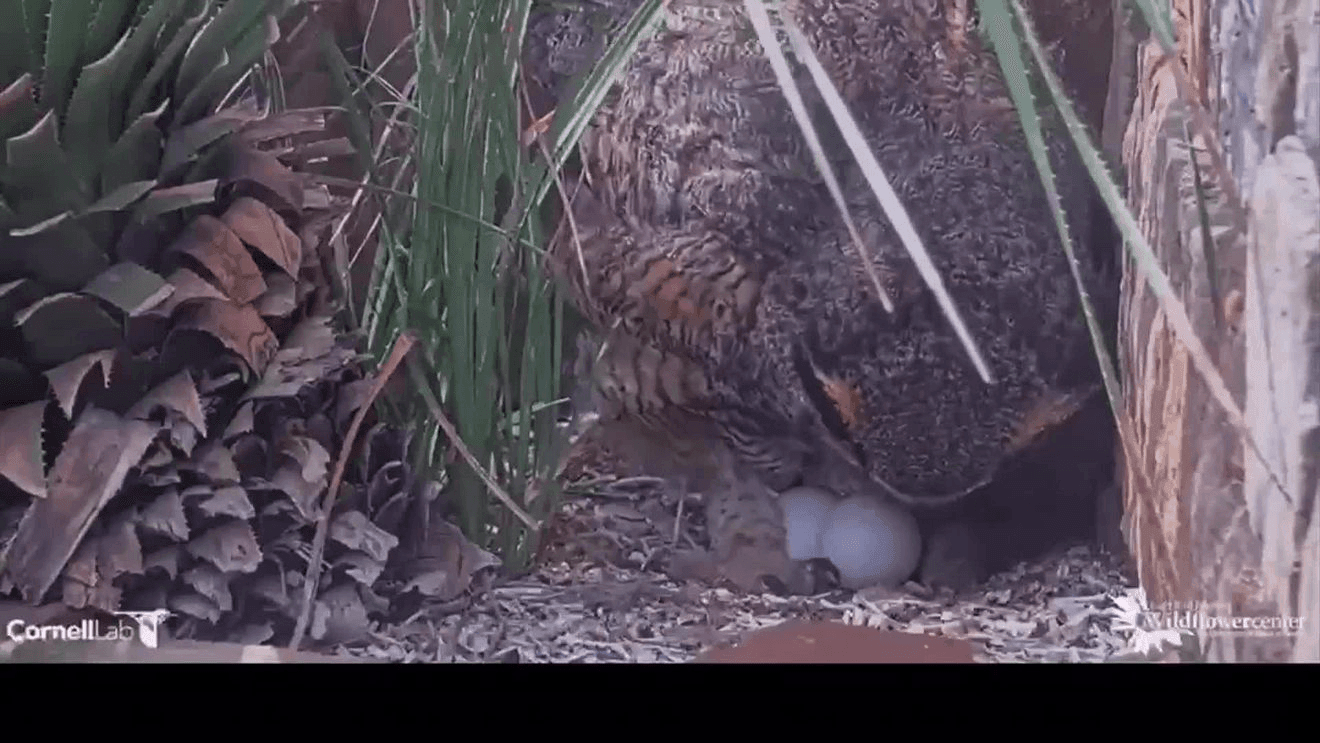
Clip of the Cornell Lab livestream, March 2026
A wildlife camera, made possible through a partnership with the Cornell Lab of Ornithology, allows fans around the world to watch Athena 24/7 at wildflower.org/athena.
About Great Horned Owls
Great horned owls are one of North America’s most adaptable and widespread raptors. They can be found from Alaska to South America and are known for their distinctive “horned” ear tufts and deep hooting calls.
They typically begin nesting earlier than most birds, often in late winter, and use old hawk nests, tree cavities, cliffs, or even human-made structures. Incubation lasts about 30–37 days, and owlets usually fledge around 9–10 weeks after hatching.
While great horned owls can live more than 25 years in captivity, survival in the wild can be much tougher, especially during the first year of life.
For now, Athena’s fans are crossing their fingers.
“Every year we cross our fingers that she’ll come back,” DeLong-Amaya said. “We’re always very grateful when she shows back.”
You can watch Athena and follow her nesting journey live at wildflower.org/athena.