
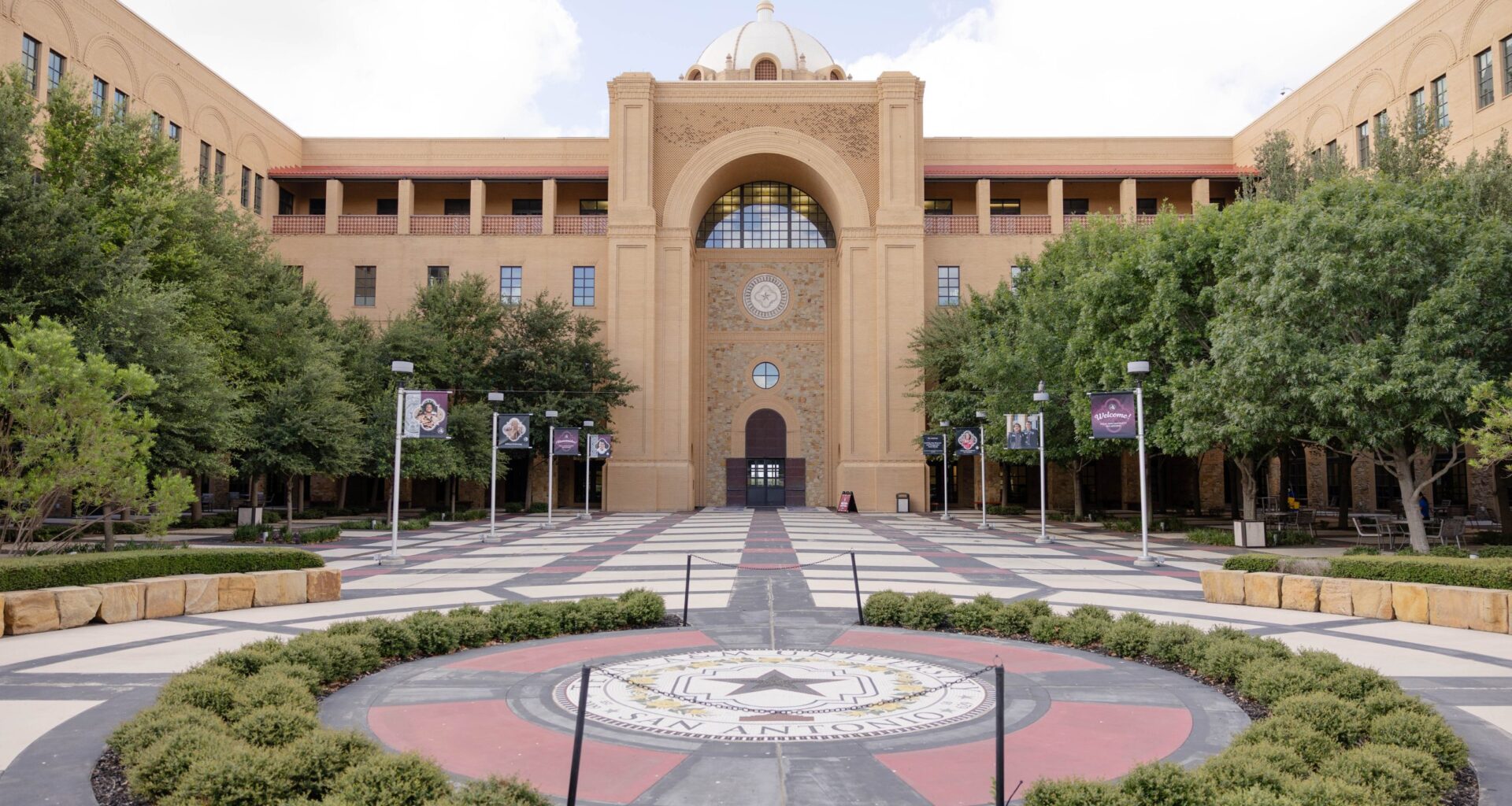
Texas A&M University-San Antonio officials are proposing to grow their degree offerings over the next few years with a focus on engineering and health sciences. This May they will propose two new degree programs to the board of regents: Biological Sciences and Electrical Engineering.
The move is aimed to better connect the school’s student pipeline to local workforce needs.
“A critical issue for us will be that we need to expand our academic programs and offerings,” said TAMUSA President Salvador Hector Ochoa. “Our goal is to begin to align what the workforce needs of San Antonio in the greatest 75-mile radius and [explore] how we can be greater contributors.”
The 17-year old institution is among the youngest in the Texas A&M System and in the San Antonio Region. Its location in the South Side of San Antonio, a region historically underserved but that is now growing both in population and in employers, has helped inform the degree plans offered by colleges and universities in the region.
Recently, companies like Toyota and JCB — the world’s largest privately owned manufacturer of construction, agricultural and defense equipment — have expanded operations in San Antonio’s South Side.
In the case of Toyota, which established its manufacturing facility in 2006, the latest expansion into a brand-new 500,000-square-foot factory is expected to yield hundreds of new jobs. JCB is expected to open its one-million-square-foot factory this fall, with at least 500 new hires.
 Toyota Motor Manufacturing Texas’ production operations manager leads a tour of the new rear axle plant. Credit: Amber Esparza / San Antonio Report
 A scissor lift on the floor of JCB’s manufacturing plant near Palo Alto Road. Credit: Jasper Kenzo Sundeen / San Antonio Report
Currently TAMU-SA offers 39 undergraduate programs, 23 graduate programs and its first doctoral program in educational leadership, which is slated to start this fall pending one final approval.
With this need for growth in mind, Ochoa and his team have drafted a plan to present these four-year undergraduate degree pathways to the Texas A&M Board of Regents in May, with the goal of having the biomedical sciences ready to welcome students as early as this fall, and the electrical engineering degree by 2027.
TAMUSA Provost Mohamed Abdelrahman said student enthusiasm for these degrees has been evident for some time. The Biology program, which currently offers 17 undergraduate degree pathways and two graduate degrees, has the university’s highest enrollment, with about 700 students.
“[When] we added a pre-health track and that track very quickly showed growth and interest from these students,” Abdelrahman said. “Many of the students that joined the biology program are interested in professional degrees — getting to [a] medical school, in veterinary, dentistry, things along this path.”
New offerings
Because Biology has grown into one of the largest programs at TAMU-SA, Abdelrahman said it is the one with a more readily accessible foundation, including faculty who can teach the foundational courses while they build the full Biological Sciences program.
This means that if approved, no immediate hirings would be likely.Instead, the program would lean on its existing faculty and staff to teach the early-level courses.
The Electrical Engineering program would be a brand-new pathway and slightly more complicated, Abdelrahman said. The closest program offered at TAMUSA today is Electronic Systems Engineering Technology, he said, which is technology-focused and doesn’t fully compare in terms of foundational courses needed for the Electrical Engineering track.
So while courses could be initially taught out of the Electronic Systems facilities, some faculty would be likely hired to teach even the beginning courses of the new pathway.
“That will take a little bit of time because it’s our first program in engineering,” Abdelrahman said. “That’s likely to require a little bit more scrutiny from the SACSCOC, our regional accrediting institution.”
Aside from receiving the support of the Texas A&M Board, both programs would also need to get approval from the Texas Higher Education Coordinating Board, and the Southern Association of Colleges and Schools Commission on Colleges, known as SACSCOC.
Abdelrahman said these pathways can help the university retain students who would otherwise transfer, seeking these options outside of TAMUSA or the region. They would also hope to differentiate their offerings by partnering with regional industry leaders to offer hands-on experience along the way.
One of TAMUSA’s goals with the additions is to keep more of its graduates in San Antonio.
“Our focus is on our region and helping our region, but again we educate for the nation, … and many of these students may relocate,” Abdelrahman said.
If approved, the Biomedical Sciences program could easily and quickly attract at least 100 students, Abdelrahman said. As for engineering, growth is expected to be slower.
Today about 85% of students that attend TAMUSA stay in Bexar County, Ochoa said, and the local workforce demand could be a great opportunity to continue building that talent pool.
“We have the capacity — slowly but surely, and with the support of the ANM system — to grow,” Ochoa said. “We have to really take advantage of what’s around us. The companies around us — Toyota, JCB — they need engineers. The hospital across the street and the clinic will need health care. And the proximity for our students to do internships and practicums there is incredible.”
The San Antonio Report partners with Open Campus on higher education coverage.