
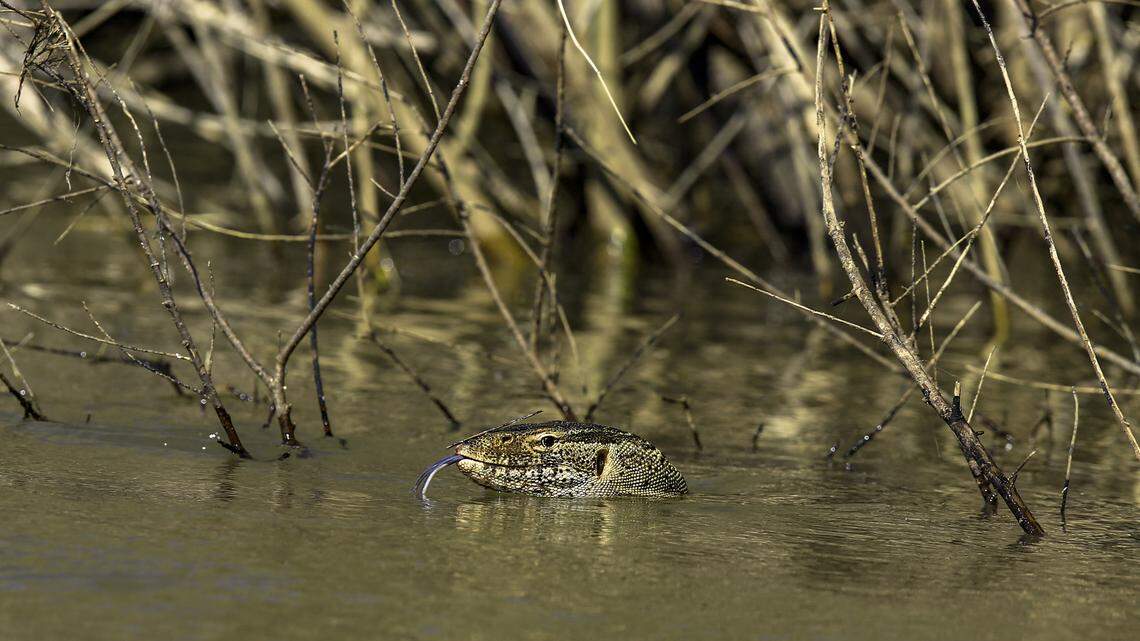
A predatory reptile that eats young crocodiles, climbs trees, swims through saltwater and has drawn comparisons to a velociraptor is quietly establishing itself across four South Florida counties.
The Nile monitor is large, aggressive, and already breeding in the wild. Wildlife officials want residents paying attention.
Unlike the green iguanas that have become a familiar, if unwelcome, sight in the region, Nile monitors are aggressive predators. They feed on turtles, snakes, young crocodiles and other reptiles, birds and their eggs, and small mammals.
If it’s small enough to catch, they’ll eat it.
These lizards were first introduced to Florida roughly 40 years before being added to the state’s prohibited species list in 2021, according to the Florida Fish and Wildlife Conservation Commission (FWC).
That four-decade head start gave the species plenty of time to dig in.
The FWC now views Nile monitors as a high priority nonnative species for removal and is monitoring breeding populations in Miami-Dade, Broward, Palm Beach, and Lee counties, according to ABC News.
Why Wildlife Officials Are Worried
South Florida already contends with invasive Burmese pythons, iguanas, and other nonnative species that disrupt local ecosystems.
The Nile monitor adds a different kind of pressure: a fast, adaptable predator that thrives in humid environments, travels over land and through both fresh and saltwater, and reproduces at a high rate.
Frank Mazzotti, a professor of wildlife ecology at the University of Florida, told ABC News that waiting for proof of damage is the wrong approach.
“You cannot wait until an invasive species has demonstrated its impact upon the ecosystem,” Mazzotti said. “Because if you do, then it’s too late.”
That urgency is compounded by how difficult these animals are to capture. Snake hunter Mike Kimmel, who has firsthand experience wrangling them, put it bluntly.
“Using traps and catching them with the dogs – I’ve interacted with them alive before and they are…it’s like catching a tornado,” Kimmel told Local10. “Swim, burrow, they climb trees, they are like modern day velociraptors.”
The comparison tracks. Nile monitors possess razor-sharp claws and a lengthy muscular tail, aren’t afraid to bite or scratch humans, and can exploit practically any terrain to escape.
What Do Nile Monitors Look Like?
For anyone spending time outdoors in South Florida, the identifying features are distinct:
Olive-green or black body with yellow striping on the head and jawCan grow up to 7 feet long and weigh up to 20 poundsRazor-sharp claws, a long split tongue, and a long muscular tail
Their size alone sets them apart from most native lizards. A 7-foot lizard with yellow striping on its jaw is hard to mistake for anything else once you know what you’re looking at.
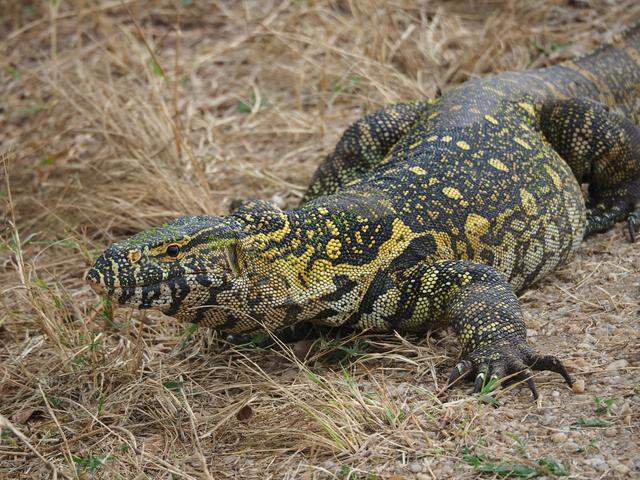 Nile monitor lizard crawling in dry grass. Timon Cornelissen Timon Cornelissen/Pexels
As for how they arrived in Florida, the exotic pet trade bears much of the blame. Mazzotti’s assessment of Nile monitors as pets was direct.
“They’re very wild, they’re very active,” Mazzotti said. “They don’t make good pets at all. They don’t calm down.”
He added: “They’re crazy. They’re very hard to handle, and you have to take great care that they don’t escape and that you don’t get bit.”
Difficult to handle, prone to escape, and perfectly suited to South Florida’s warm, wet climate — that combination helps explain how a species from another continent gained a foothold here.
Nile monitors are not native to Florida and are not protected in the state except by anti-cruelty law, per the FWC.
What You Should Do If You Spot One
Florida law allows anyone to capture and humanely kill Nile monitors year-round without a permit or hunting license, including on private property with the landowner’s permission, due to their impacts to native wildlife, per the FWC.
Reporting sightings to the FWC also helps officials track how far the population has spread.
The agency is actively working to remove these animals, but the lizards’ speed, climbing ability, burrowing behavior, and comfort in water make containment a serious challenge.
Breeding populations are already documented across four counties. Their high reproduction rate and adaptability to multiple environments mean the range is likely to keep expanding unless removal efforts can outpace the spread.
Production of this article included the use of AI. It was reviewed and edited by a team of content specialists.

Miami Herald
Ryan Brennan is a content specialist working with McClatchy Media’s Trend Hunter and national content specialists team.