
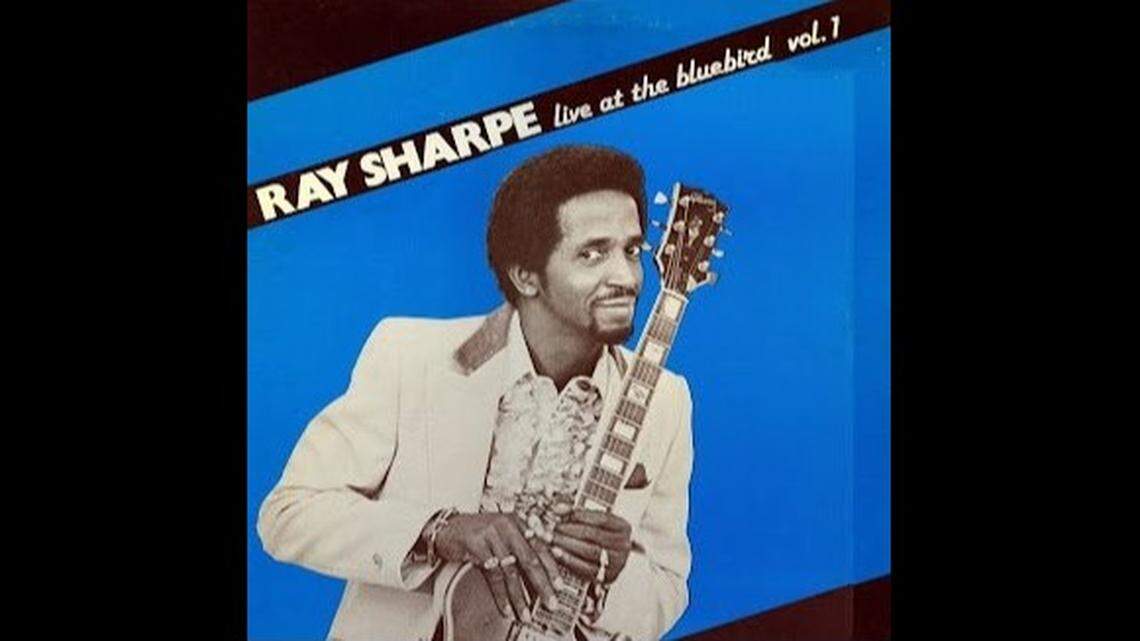
Ray Sharpe
Contributed
If you’re of a certain age, you may remember the musician Ray Sharpe, or at least his 1959 hit “Linda Lu.” It was his sole entry on the pop charts due to bad luck and bad timing, but not a lack of talent.
That was the song with the startling opening lines: “Well now, they call my baby Fatty; But her real name, her real name, her real name is Linda Lu.”
When the record went national, nobody noticed those lines because the official lyrics had changed “Fatty” to “Patty.” An example of Top 40 radio censorship.
Edward Ray Sharpe was born in Fort Worth in 1938. He grew up in the Butler Place public housing complex on the east edge of downtown, listening to music on the radios of his neighbors who tuned in to station KCNC and turned the volume up loud.
Ray fell in love with R&B and country music, an unusual combination at the time for a Black kid with musical aspirations. In Fort Worth’s segregated school system, he attended the former George Washington Carver elementary and junior high, which was known for its slick-sounding school chorus.
His first public performance was in a ninth-grade talent show singing the classic ballad “Frankie and Johnny” — and yodeling. The audience reaction convinced him he was destined to be a musical artist.
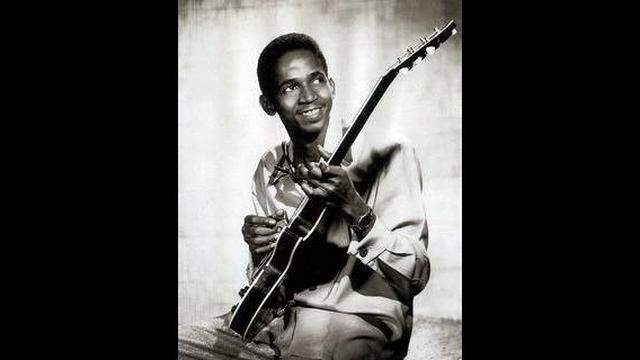 Ray Sharpe as a young man. Contributed
He saved his money and bought a second-hand Stella guitar for $14 at a downtown pawn shop. He taught himself to play by picking out the tunes he heard, practicing outside at night so as not to disturb his mother. He soon learned why the guitar had been so cheap; it wouldn’t stay tuned.
He was about 16 when he began going to “Chitlin’ Circuit” clubs on the east side of Fort Worth, places with names like the Star Grill, the Penguin Club and Club Zanzibar. Such clubs were the only venues that booked Black artists, and some of those places were close enough to walk to. They were tough joints; when they weren’t being raided by the police, they were getting bombed.
 A front-page story in the Fort Worth Star-Telegram on Dec. 12, 1957, about the Penguin Club being bombed for a second time in four months.
But if you were a performer, they didn’t check IDs. It was playing at these clubs that taught Sharpe both his craft and the music business. He started out making only $6 or $7 a night, but the experience convinced him to focus on blues.
At I.M. Terrell High School, his talent was recognized as more than just that of a skinny kid with big ambitions. (Among other musical talents to come out of Terrell were Bobby Day, Ornette Coleman and “King Curtis” Ousley.) Opportunities being what they were in the Jim Crow era, following graduation he went to work as a school janitor for Fort Worth ISD, which paid more money than being a busboy.
He formed a performing trio with two friends, calling themselves the Blue Whalers. It was while playing at the Penguin Club on East Rosedale that one of his fans noticed a large woman on the dance floor who was a regular. He suggested Sharpe mention her in one of the songs he liked to ad lib. Sharpe composed the song as a gag and performed it without giving it a second thought. Soon it was being requested nightly. “Linda Lu” is called a crossover song, meaning in traditional blues style but with R&R licks, something “easy to dance to.”
Sharpe found himself in Las Vegas in 1959 dealing blackjack and picking up an occasional performing gig when he was heard by songwriter-producer Lee Hazlewood, who was handling Duane Eddy and later guided the career of Nancy Sinatra.
Hazlewood brought him to his Phoenix studio to record some songs. The only one that blew him away was “Linda Lu,” which Sharpe didn’t consider a “real song.” However, Hazlewood had an ear for what the public wanted and correctly judged it a hit in the making.
To back up Sharpe for the recording session in May 1959, Hazlewood brought in Duane Eddy. He sent the demo to Jamie Records, which released it nationally. Radio stations didn’t agree with Hazelwood’s evaluation of “Linda Lu” and started out playing the flip side, “Red Sails in the Sunset,” an old pop standard. When it didn’t take off, they flipped the record and started playing “Linda Lu.” The rest, as they say, is history. Ray Sharpe was just 21 years old.
“Linda Lu” quickly climbed the charts to No. 46 on Billboard’s “Hot 100” that summer and soared even higher in the Dallas-Fort Worth market where it was in heavy rotation on KFJZ and KXOL in the company of artists like Chuck Berry and Chubby Checker. It made both the Top 40 and R&B charts and got Sharpe a spot on a Dick Clark Caravan of Stars tour alongside big-name stars like Lavern Baker and The Coasters.
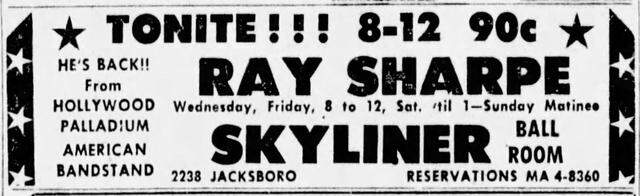 An ad in the Fort Worth Star-Telegram from November 1959
“Linda Lu” allowed Sharpe to break out of the Chitlin’ Circuit. By 1960 he was a regular at the Skyliner Ballroom on Jacksboro Highway, a jumping nightspot that booked Black artists like Fats Domino with white artists like Delbert McClinton and “exotic dancers.”
In 1962, he opened Club Linda Lou in a former bowling alley at 601 N. Main St. Described later by a former patron as “a down and dirty beer joint,” it proved to be a huge financial misstep, closing within two years.
 An ad in the Fort Worth Star-Telegram on June 7, 1963.
Sharpe never had another hit like “Linda Lu,” though he continued to write and perform his music. He recorded a couple of albums in the years that followed and released singles off those albums. He recorded several sides in New York with legendary producer Phil Spector who preferred to promote the “girl-group” sound.
In 1966, he was a session player on some King Curtis jazz recordings. While his own career sputtered, Sharpe’s songs were recorded by others, including Roy Head (remembered for the 1965 blue-eyed soul hit “Treat Her Right”) and Neil Young (remembered for his solo albums and group work with Crosby, Stills and Nash).
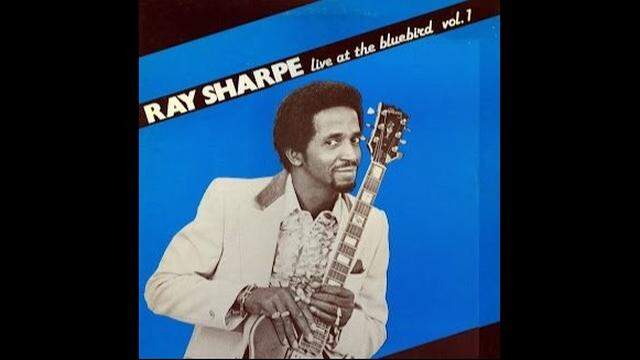
Top 40 radio may have forgotten Ray Sharpe, but Fort Worth didn’t. He performed often here, and a succession of Star-Telegram music columnists related his story every few years. He also remained a fan favorite at J&J Blues Bar and Como’s Bluebird Club. At the latter he recorded a live album in 1982 (“Ray Sharpe: live at the Bluebird”). In 1987, Star-Telegram music columnist Graham Snyder called Sharpe “a true music legend.”
 Ray Sharpe Contributed
Today, Sharpe is 88 years old and long retired from performing. He deserves a place in the Fort Worth Musicians’ Hall of Fame.
Follow More of Our Reporting on Explore more Fort Worth history in photos & untold stories
Related Stories from Fort Worth Star-Telegram