
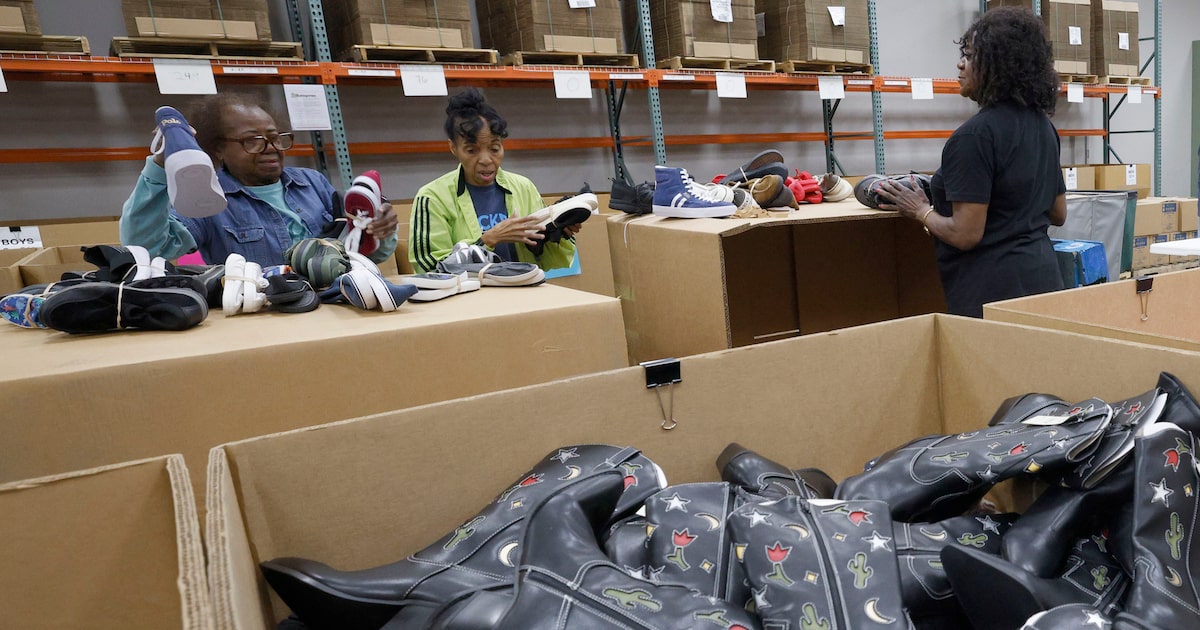
At the Buckner Humanitarian Aid Center in Dallas, the sound of generosity is not loud.
It’s the soft thud of cardboard boxes being opened, the shuffle of volunteers sorting sneakers by size, the hum of a warehouse that has quietly changed more than five million lives.
For 26 years, Buckner Shoes for Orphan Souls has turned something as ordinary as a pair of shoes into a lifeline for millions.
What began as a small radio campaign in the mid‑1990s has grown into one of the longest‑running humanitarian programs of its kind, powered not by a massive staff but by a small team and an army of volunteers who believe that dignity can start at the feet.
Breaking News
The program’s origins trace back to a Dallas Christian radio station, KCBI, whose general manager visited Russian orphanages and saw children sharing shoes from a basket by the door.
“They wanted to serve a few hundred kids,” recalls Shawn Spurrier, director of Buckner Shoes for Orphan Souls. “But the community really responded; they were able to serve a few thousand kids for about five years in a row.”
In 1999, Buckner International took over the effort. Since then, the program has delivered more than five million pairs of shoes to children in 86 countries, including communities in the United States.
Spurrier still marvels at how the program grew. “It almost felt like a movement,” he says. “People resonated with the simplicity of providing something that isn’t a luxury for us, but is for children throughout the world.”
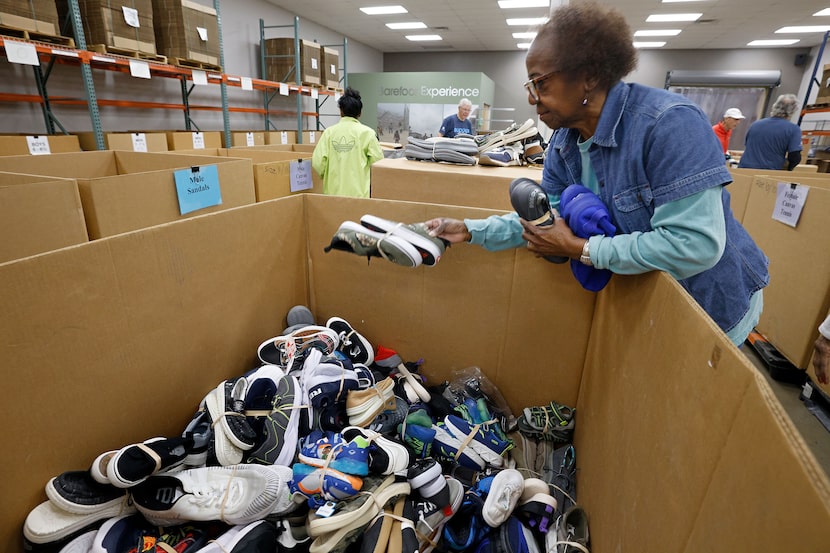
Carolyn Griffith of Dallas, a volunteer for Buckner Shoes for Orphan Souls program, sorts the donated shoes at the Buckner Center for Humanitarian Aid, Wednesday, Feb. 25, 2026, in Mesquite.
Chitose Suzuki / Staff Photographer
The gateway effect
A pair of shoes is not just footwear in the communities Buckner serves. It’s access.
“In many regions, if you don’t have a pair of shoes, you can’t go to school,” says Steve Watson, Buckner’s director of humanitarian aid. “But you don’t have the money because you don’t have an education. It’s this vicious cycle.”
Shoes break that cycle. They also protect children from foot‑borne illnesses and tropical diseases that can be catastrophic and entirely preventable.
But the most powerful impact, Spurrier says, is opportunity.
He tells the story of Dulce, a young girl in Guatemala whose family was on the brink of losing their home. Her mother wanted to learn to read, and her father struggled with alcoholism and steady work.
“Dulce coming in to receive a pair of shoes was the introduction,” Spurrier says. He recalled how his staff met Dulce’s family and linked them to programs that offered literacy training and job skills — support that helped them finally break the cycle that had kept them in such a precarious situation.
“You never know the story a pair of shoes is going to tell”, Spurrier says.
Even after more than a decade with Buckner, Spurrier still encounters moments that stop him cold. That was the case in Oaxaca, Mexico, where he met Romina, a 7‑year‑old girl receiving her first new pair of shoes.
“They were just basic black school shoes,” he says. “But she broke down weeping.”
Concerned something was wrong, Spurrier asked the family’s translator what had happened. The truth was far gentler: Romina was overwhelmed that someone had thought of her at all.
“That moved me to tears,” he said, shaking his head. “That moment reminded me why we do what we do.”
For Watson, dignity is the heart of the work.
He remembers a boy in Guatemala who lived in a dump and didn’t attend school because he lacked shoes and proper clothes.
When the boy approached a distribution event, other children shouted, “You don’t belong here.”
Watson found a pair of shoes that fit him. “That’s giving dignity,” he says. “Now he could go to school. Now he belonged.”
Spurrier adds that dignity extends to parents, too. “Imagine being a mom who can’t afford shoes for her child’s first day of school,” he says. “Providing that pair of shoes eases a burden. It’s dignity for the whole family.”
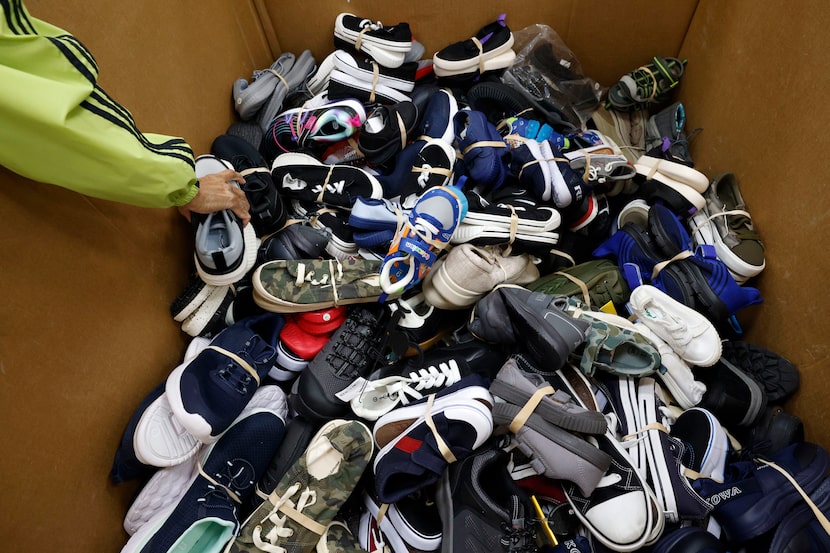
Catherine Bates of Dallas, a volunteer for Buckner Shoes for Orphan Souls program, sorts the donated shoes at the Buckner Center for Humanitarian Aid, Wednesday, Feb. 25, 2026, in Mesquite.
Chitose Suzuki / Staff Photographer
Volunteers keep showing up
Inside the warehouse in Dallas, the heartbeat of the operation is a group of retirees who show up every Wednesday. Among them is Ed Wales, 82, who has been volunteering since 2007.
His connection to the mission began decades earlier. In 1995, he heard radio station KCBI describe Russian orphans hauling water uphill because their orphanage had no running water. “I was driving to work,” he recalls. “I broke down. I had to pull the car over. My tears were just flowing. I said, ‘I’m going to be involved in that.’”
Wales, a 20‑year Air Force veteran and longtime health care worker, adopted a son in 1973. “I’ve always had a soft spot for orphans,” he says.
He still remembers putting shoes on children in Russia in 1999. “Some were wearing shoes that were just tattered,” he says. “The light on their faces… your heart soars.”
When volunteers come into the warehouse, their job is to process the shoes. They sort every pair by size, type, and gender: athletic, canvas, leather; men’s, women’s, boys’, and girls’.
They remove all the packaging and tags tucked inside the shoes, then rubber‑band each pair together, heel to heel. And before the shoes move on, every single pair receives a handwritten note with a message of hope and encouragement.
In the middle of the 45,000‑square‑foot warehouse, tucked between towering stacks of shoeboxes, there is a corner that stops people in their tracks. It’s called the Barefoot Experience, but it feels more like a quiet invitation to step into someone else’s life.
Three wooden boxes sit side by side, each filled with the kind of ground children around the world walk on every day — dirt packed hard by heat, loose pebbles that bite at the skin, jagged rocks that make every step a calculation.
These textures come from the places where Buckner delivers new shoes to children who have never owned a pair.
Volunteers pause, slip off their shoes, and place their feet onto the earth. The shock is immediate. The coldness of the rocks. The sting of the pebbles.
The uneven ground forces the body to tense with every step.
For a moment, the warehouse fades, and what remains is the simple, humbling realization of what it means to walk without protection.
The displays are meant to echo the rugged mountain paths of Ethiopia, Mexico, and Perú, places where children rise before dawn, walk miles to do their chores, and return home with soles bruised and spirits tested.
“Walking barefoot across these surfaces is a powerful reminder of what thousands of children endure every single day,” said Spurrier.
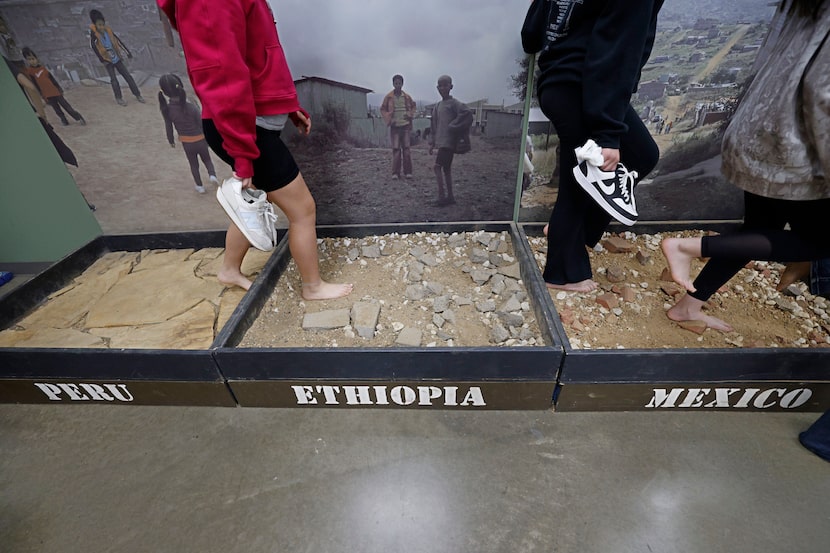
Students from Ruth Cherry Elementary School in Royse City, Texas, step onto the soil without shoes at the “Barefoot Experience” at the Buckner Center for Humanitarian Aid, Wednesday, Feb. 25, 2026, in Mesquite, after their volunteer works for Buckner Shoes for Orphan Souls program.
Chitose Suzuki / Staff Photographer
A small team, a big impact
Despite its global reach, the Buckner Humanitarian Aid Center operates with just 17 staff members: 10 on the humanitarian aid team and three on the shoes team. The rest is powered by 6,000 to 8,000 volunteers a year.
Last year alone, Buckner shipped 133,000 pairs of shoes to children in Texas and around the world. About 40% of all shoes go to Latin America.
Shoes arrive through church drives, civic groups, manufacturers, and donors across the country.
Watson explains that giving a child a pair of shoes is often the first doorway into a family’s life.
When their team ships a container of shoes, they also include school supplies, food, and other essentials because the goal is to care for the whole person, not just one need.
A simple pair of shoes can unlock so much more. In many communities, children aren’t allowed to attend school without them.
But families often can’t afford shoes precisely because they lack education and job opportunities, a cycle that, according to Watson, repeats itself generation after generation.
By providing shoes and school supplies, Buckner helps remove that first barrier so a child can go to school. And once that connection is made, families are invited into the Family Hope Center programs, where parents can access job‑skills training, parenting classes, cooking classes and other resources that strengthen the entire household.
In that sense, a pair of shoes doesn’t just protect a child’s feet; it can open up an entirely new world for the whole family.
“God uses ordinary people and ordinary means to love and serve his world,” Spurrier said. “A pair of shoes is ordinary. But what it leads to can be profound.”