
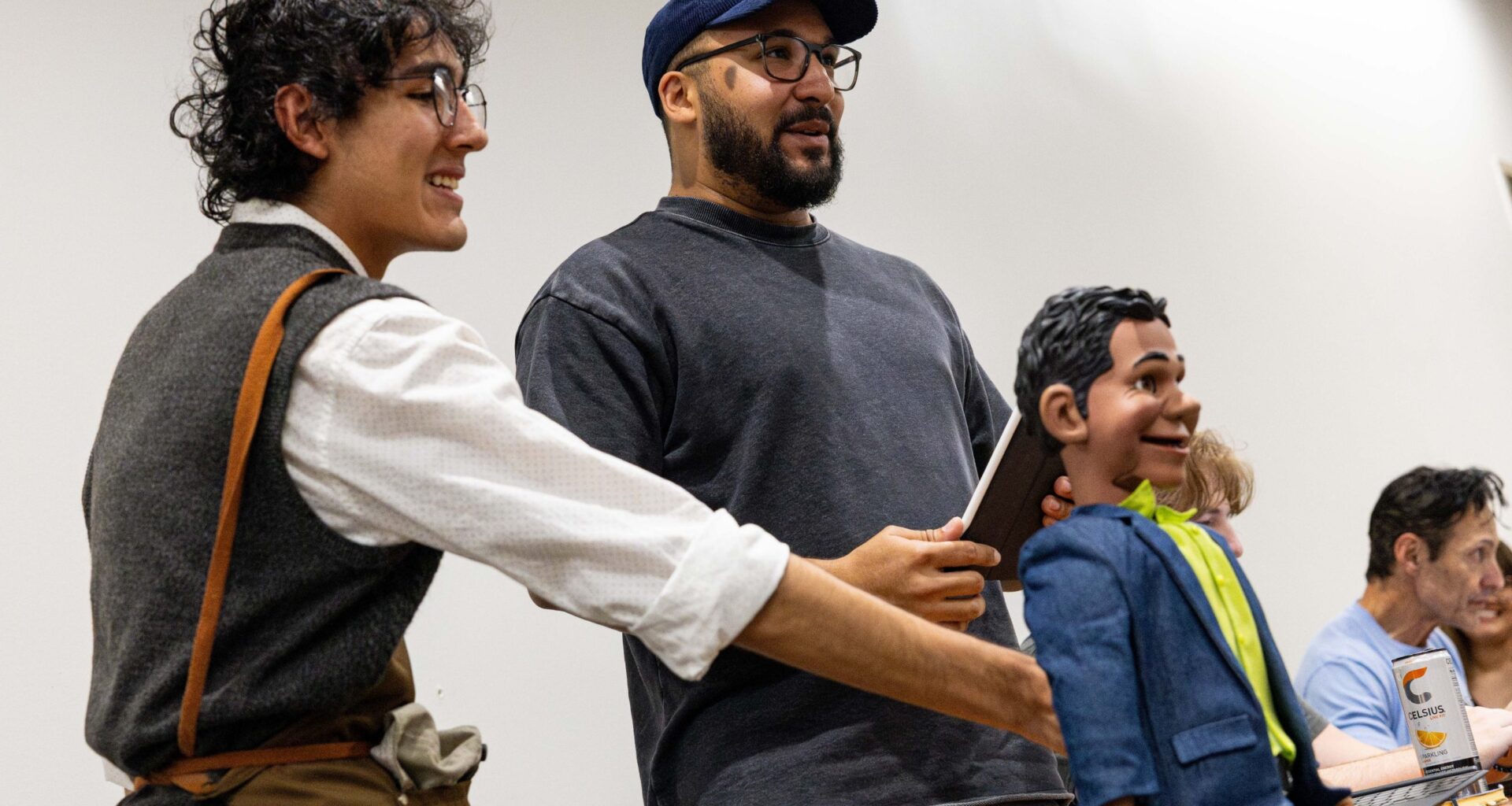
When Bradley Freeman Jr. envisioned the first theatrical production of the Dramatic Arts Program at the University of Texas at San Antonio, he tapped back into his senior year in high school.
About a decade ago, his senior class cemented the Brownsville, Texas school’s first theater program, which remains alive a decade later.
“Within four weeks, from November to December, we put on a very illegal version of Aladdin,” Freeman recalled, laughing. “We only did three showings of it. But our first one we had a line [of people] that wrapped around the theater. So, we had to add an extra show.”
Though their understanding of copyright was limited, that show not only was student-led and successful, but Freeman credits it with having shown his community that the theater program at Veterans Memorial Early College High School was to be taken seriously.
Freeman, 27, turned his love for arts, theater and television into a successful career as a puppeteer. He is the man behind some of the fuzzy characters entertaining children through the TV, including Rizzo the Rat in “The Muppet Show,” and Tamir in “Sesame Street.”
Today he is splitting his time between the classroom as an Assistant Professor of Practice in UT San Antonio’s Film and Media Department teaching Children’s Media, and helping establish the university’s first Dramatic Arts Program, which launched last fall.
 Bradley Freeman Jr. speaks with his cast and crew before a full run through rehearsal of Little Shop of Horrors at UT San Antonio’s downtown campus on March 6, 2026. Credit: Amber Esparza / San Antonio Report
It is this “Aladdin effect” that kept him coming back to the classic musical “Little Shop of Horrors” as an option for the new program’s theater premiere, he said.
“Little Shop kept standing out as a really great first show to meet the criteria that we were looking for, which was a show with a name that people will recognize, a show that doesn’t have a massive cast, … and then has a spectacle aspect that makes people remember the show and talk about the show to their friends.”
The musical tells the story of a struggling flower shop on New York City’s Skid Row and a shy florist’s discovery of an unusual plant that could help save it. The plant, Audrey II, is an iconic — and quickly growing — puppet that the cast at UT San Antonio is learning to master.
“Little Shop of Horrors” premieres on April 10 and runs until April 26 at the Buena Vista Theater located at the UT San Antonio Downtown Campus at 501 W Cesar E Chavez Blvd.
We talked to Freeman about his unique background and experience directing a college production. His answers have been edited for clarity and brevity.
Tell us a little bit about where you grew up and how you found your way into puppeteering.
I grew up in Brownsville, in the Rio Grande Valley, and I sort of go back to when I was like 5 years old. Honestly I feel like it’s when I made the decision in my head that I wanted to be a puppeteer. I was raised on shows like “Sesame Street,” “The Muppet Show,” “Barney,” “Between the Lions” and “Bear in the Big Blue House.” And one of the things that I really loved about those shows was that the characters were real and you could really reach out and touch them. There’s something special about watching them interact with each other because I knew that it was really happening.
There’s like such a magic to these things coming to life. It’s in my nature to just have this love, this just absolute sort of tractor-beam attraction toward that specific thing and I’ve had it since I was young. There’s not a time that I can remember when I didn’t want to be a part of something like this.
 Bradley Freeman Jr. speaks with his cast and crew before a full run through rehearsal of Little Shop of Horrors at UT San Antonio’s downtown campus on March 6, 2026. Credit: Amber Esparza / San Antonio Report
Knowing exactly what you want to be at such a young age is pretty unique. Tell us how you went about pursuing and achieving this childhood dream?
Everything that I would do was in an effort to build the skills that I felt I might need once I actually got to my destination.
So, doing a lot of theater and building up acting skills, learning how to play a crowd, how to get the emotions out, how to tell the story efficiently, how to build a strong character.
When I was in band, all those musical skills really weirdly came in handy. I’m a drummer, for example, so when Animal from the Muppets needs to play the drums, they call me so that I can match exactly what’s actually happening, or when Dr. Teeth or Ralph are playing the piano, I’m doing the fingers because I know where the chords are and I can play it accurately.
Everything that I did along that path, I pulled an element of that, and it’s things that I still use very, very, very consistently today.
How does that translate to what you are teaching and directing today?
Folks who are passionate about what they do really like to share their passion because the more the merrier. Truthfully it’s like, “Come play in my sandbox. Let’s do this. Let me share this. It’s so much fun.”
The whole thing is making sure that the students leave with more skills and knowledge than they came in with. What I’m able to provide is the teamwork aspect, the idea that like this isn’t happening because you are in the show, you are part of this ensemble and if we’re all working together to make the best show then we’ll have the best show.
I’m so lucky that we have such an amazing cast who are so supportive of each other. So wonderful, so funny and they’re not afraid to pitch ideas and they’re not pitching ideas that will only benefit themselves, they’re pitching ideas that might help this other person.
Tell us more about how you fell into the director role and how is that going so far?
I was telling Paul Ardoin [UT San Antonio Dramatic Arts director] about the whole story of my high school theater program and just nerding out about it. And he was like, “Well, do you want to direct our first show? Why don’t you do it again?” And I said I would love to, but there’s a couple things; I’ve never directed a theater show before, like a musical theater show before, not on my own.
And I was afraid of the time commitment considering I do have a fairly active career in puppetry that takes me to a bunch of different places. And he said, “Well, maybe we can figure it out.”
 The work truck for transporting the puppets for UT San Antonio’s production of Little Shop of Horrors is parked near the Buena Vista Theater on March 6, 2026. Credit: Amber Esparza / San Antonio Report
And so when Little Shop came up, I was like, “Here’s how we can make something that feels great. … I’m friends with people over at at Monkey Boys Productions who build the plants for the off-Broadway production right now in New York and they can send the plants over. And I’m friends with Marty [Robinson], who was the original Audrey II, and I’m friends with the current cast.” I felt like we could really have some really great synergistic moments where we have so many more resources.
And so far, so good. We created contingency plans for when I’m not available here. We have our assistant director, Vic Travenio, who is also an amazing actor that’s been in a ton of films and TV shows including Pee-Wee’s Playhouse, which makes me lose my mind every time I think about it. And he comes in and really delves deep into the acting and the character of the show.
This being the Dramatic Arts Program’s official first theatrical production, tell us how you went about casting the actors?
We started talking about this a year ago and there was no Dramatic Arts Program. So doing a musical theater show without a formal program was like, “Do we have anybody?” We could have everybody we need, or we can have three people.
So we were very cautious about it and I said this [Little Shop of Horrors] alleviates a lot of that because it’s only about 12 people in the cast.
When we started auditioning for the show we had three days of auditions; the first for the UT San Antonio dramatic arts kids, then we opened it up to all UT San Antonio students from any major, then all college students within San Antonio.
And our plan from the beginning was to add a fourth day open to anybody in San Antonio who wanted to audition if we didn’t have the full cast. But then it turned out that by the second day we had almost everybody that we needed here and more. We kept just finding that everybody who was best suited for the show were already UT San Antonio students, with the exception of one student who is an Alamo Colleges student who will be attending UT San Antonio next year.
 Little Shop of Horrors cast members warm up with a dance exercise before a full run through rehearsal of the UT San Antonio production at its downtown campus on March 6, 2026. Credit: Amber Esparza / San Antonio Report
How do you hope this first production informs what you can do in the future?
I think it shows that there’s so much more possible than we might want to believe for several reasons; One is the passion of the students that are here is palpable, it is there in everything that they do. They’re not discouraged at any turn. They’re excited when their understudy goes on. They’re excited to get notes.They’re excited to try it again and run it again and again and again and again. They’re happy to be there.
And that’s a great start, internally at the very least. To have the students who are willing to do it no matter the cost is very telling about the future of this program because they will then infect the next group. And if the next group coming in follows in their footsteps then we can establish a program of passion and professionalism that just continues through the years.
And externally, it’s hard to say. I think I’ll know more after the premiere on how the community receives it and once we see the interest.
But one thing that I do forget sometimes is how ingrained UT San Antonio is in the community. It’s something that I wanted to take advantage of for sure when we started, because I wanted for this program to not only be really good for the students, but to be good for the community as well.
The San Antonio Report partners with Open Campus on higher education coverage.