
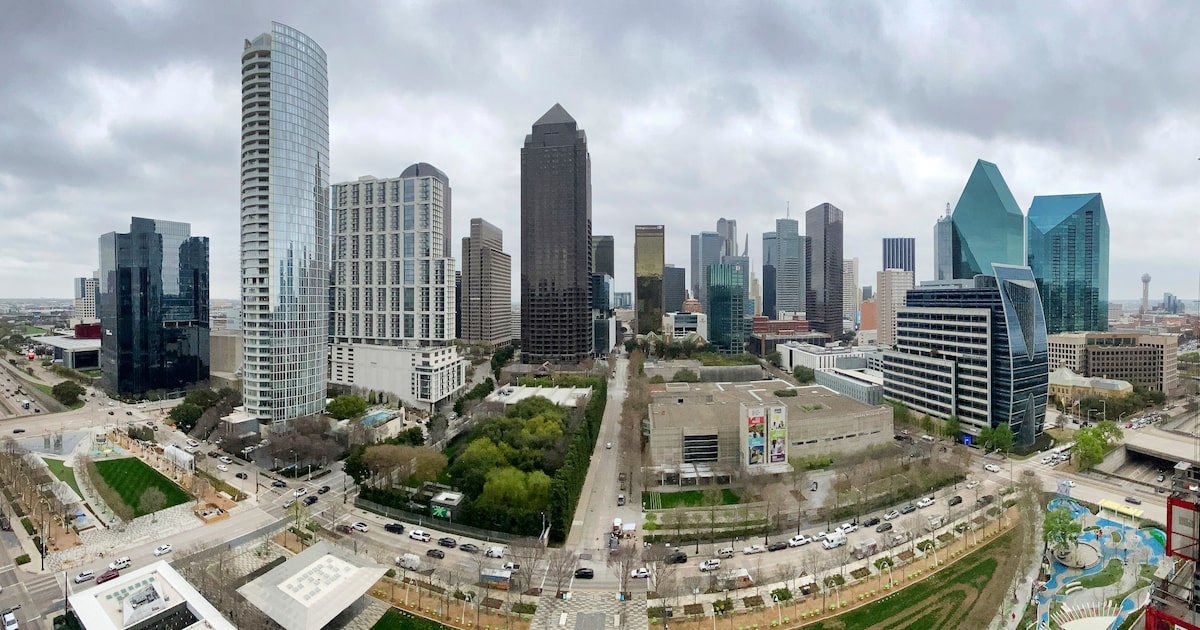
Texas consistently grows faster than the rest of the nation. What will it take to keep that growth going?
Pia Orrenius, a vice president and senior economist at the Federal Reserve Bank of Dallas, has spent years studying how Texas outperforms the U.S. in job and output growth. Now, she’s focused on warning signs about its future.
Some of the forces behind Texas’ long boom are weakening as new challenges emerge, Orrenius said. To sustain its economic edge, she said Texas needs to invest heavily in skilled workers, expanding its labor force, modernizing infrastructure, preserving open markets and adapting to artificial intelligence.
Related

Texas’ $2.7 trillion economy ranks as the eighth-largest in the world, surpassing countries such as Russia, Canada and Italy, according to the Texas Economic Development Corporation. But in North Texas alone, parts of the region still struggle with persistent poverty. With millions of people projected to move to North Texas by 2050 for new jobs, officials across the state’s public and private sectors are creating and bolstering programs in an effort to ensure local residents are not left behind further.
Business Briefing
Here are five ways Texas can maintain its economic dominance.
Build and attract skilled workers 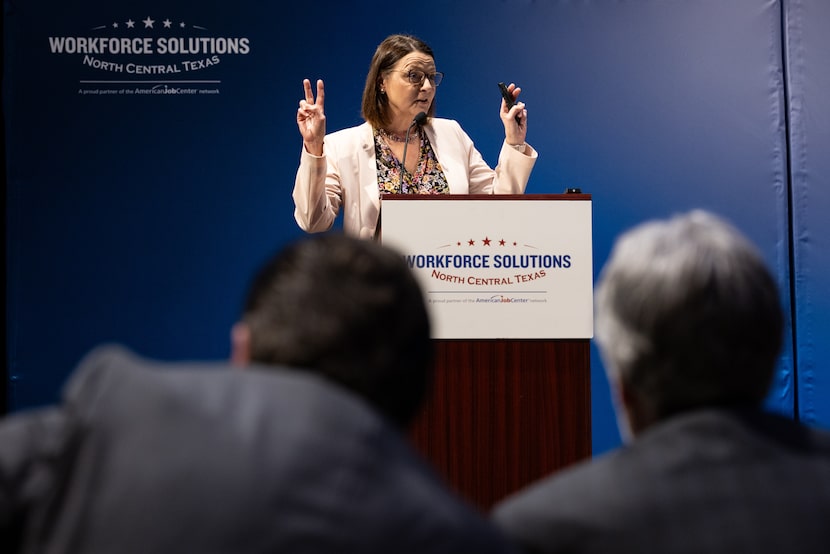
Pia Orrenius, Federal Reserve Bank of Dallas labor economist, gives a keynote speech during a Workforce Development Awards luncheon on Wednesday, March 4, 2026, in Hurst.
Angela Piazza / Staff Photographer
Texas’ nearly 90% high school graduation rate surpasses the national average, according to an August 2025 Dallas Fed report. But the state still trails the national average in the share of young adults with college degrees.
Looking specifically at 25- to 34-year-olds, Orrenius said Texas has a gap of about 3.7 percentage points compared with the rest of the nation. That represents hundreds of thousands of workers in a state with more than 30 million residents.
“We’re going to still need high-skilled workers to fill high-wage jobs,” she said, pointing to Texas’ growing high tech, financial services and advanced manufacturing sectors.
That means continued investment in four-year degrees, technical programs and workforce training that align with real employer demand, she said.
Orrenius also cautioned that a key driver of Texas growth is slowing. Migration from other states and countries, which surged to record levels from 2022 through 2024, is shrinking rapidly.
With fewer new workers flowing in, Texas has to develop and retain the talent it already has. That puts additional pressure on education systems, workforce boards and employers to create clear, attainable paths into good jobs.
Grow the workforce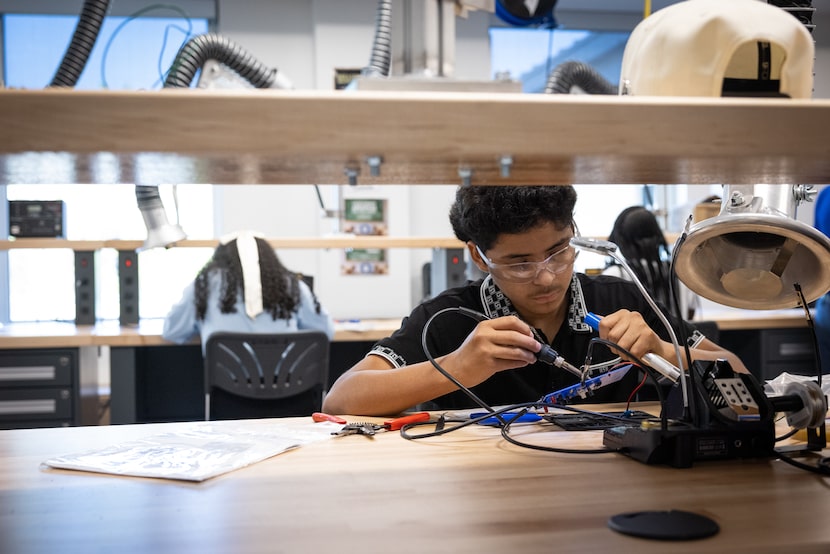
Electronics student Emerson Cortez uses a soldering iron to disassemble a chip at Dallas ISD’s Career Institute North, on Aug. 21, 2025.
Angela Piazza / Staff Photographer
Texas has a reputation as a young state when it comes to its working population. But Orrenius noted that it’s aging, and slowing migration makes it harder to replace older workers.
“The baby boomers are retiring here, just like the rest of the nation,” she said.
That demographic shift means overall labor force growth will no longer be as automatic as it has been. To keep the workforce expanding, Orrenius suggested, Texas needs to bring more people off the sidelines.
That includes parents who struggle with child care, older workers who might otherwise leave the labor market, people with disabilities and residents who face transportation or credential barriers, among others.
Upgrade infrastructure
Infrastructure investments helped Texas get to this point by supporting rapid population and business growth.
For decades, that meant roads, ports and other traditional projects. Texas used public-private partnerships and toll roads to expand its highway network and connected its ports and border crossings to the rest of the country.
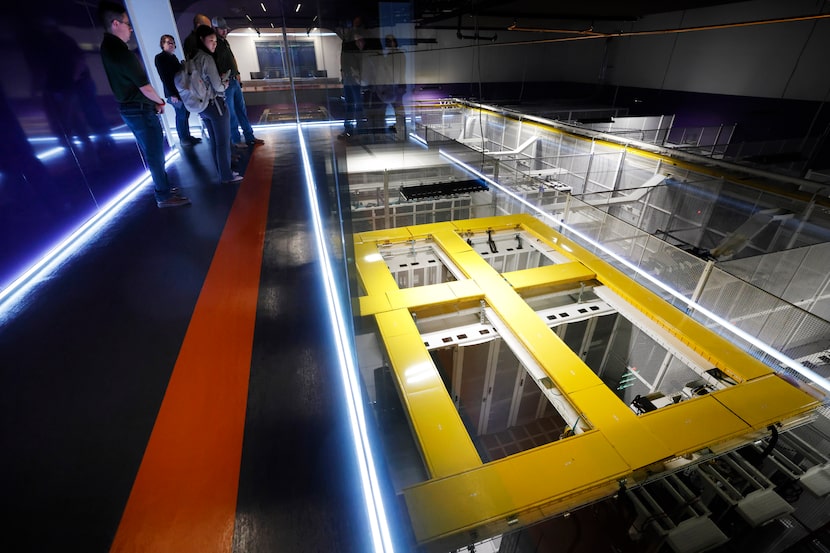
People on a group tour look down into Dallas TX1 data center’s server vault at the NTT Data center campus in Garland, Texas, March 4, 2026.
Tom Fox / Staff Photographer
In a future defined by energy hungry industries, data centers, and new forms of manufacturing, the priorities are changing toward power and water infrastructure, Orrenius said.
She pointed in particular to the explosion of data centers, where Texas now ranks near the top nationally.
“The data center build-out is tremendous, and we’re No. 2 in the nation for data center build out,” she said, describing them as “power guzzlers.”
According to ERCOT, the grid operator, peak electricity demand is projected to climb from about 85 gigawatts to 145 gigawatts in the next six or seven years. Orrenius called that “a very, very big increase.”
The good news, she said, is “our electricity prices are holding steady so far,” unlike in some other states facing similar pressures. She credited Texas with staying ahead of it by building out a supply of power, including traditional generation and renewable energy.
But the scale of the coming demand will test the system. Those pressures extend to water, particularly as industrial users and growing cities compete with agriculture and the environment. Future infrastructure will be central to whether Texas can accommodate new industries without undermining quality of life.
Preserve free and open markets 
Annieky Yip, takes her bag filled with fresh duck eggs from Lee-Lynn’s Farm and Ranch at the Dallas Farmer’s Market, Saturday, Feb. 4, 2023, in Dallas. Other people ate food and leisurely shopped during their weekend.
Rebecca Slezak / Staff Photographer
Texas is the nation’s largest exporter, even though California has a larger overall economy. Much of that strength is tied to energy and energy-related products, but manufacturing and cross-border trade with Mexico and Canada also play major roles.
Orrenius stressed the importance of trade agreements, especially the United States-Mexico-Canada Agreement, which replaced the North American Free Trade Agreement and is up for review.
“It’s important to the Texas economy, and also to Mexico and Canada, and also, finally, to the cost of living,” she said, referring to the impact of tariffs on the cost of goods.
She grouped free and open markets with flexible regulations and relatively low taxes as part of the policy environment that has helped Texas attract investment. Maintaining those advantages, she suggested, will be crucial in a period when some states and countries are rethinking globalization and adding barriers to trade.
Adapt to AI
Pages from the Anthropic website and the company’s logo are displayed on a computer screen in New York on Thursday, Feb. 26, 2026. (AP Photo/Patrick Sison)
Patrick Sison / AP
Of all the forces shaping Texas’ future, Orrenius reserved her strongest language for AI.
She said more and more of the Dallas Fed’s work now focuses on AI, as researchers try to understand how it’s already affecting the economy and how it might reshape jobs and wages in the years ahead.
“The big call to action for anyone who deals with workforce development is to figure this out and stay on top of it, because this is going to be the biggest change of our lifetimes,” she said of AI.
That means revisiting job descriptions, training curricula and basic assumptions about which tasks require a human worker. It may also mean preparing people for more frequent career shifts and reskilling over the course of their working lives.
Orrenius called AI both a risk and an opportunity. It could displace some workers, but also boost productivity and create new kinds of jobs. Whether Texas gains or loses from that transition will depend on how quickly it learns and adapts.
This reporting is part of the Future of North Texas, a community-funded journalism initiative supported by the Commit Partnership, Communities Foundation of Texas, The Dallas Foundation, the Dallas Mavericks, the Dallas Regional Chamber, Deedie Rose, Lisa and Charles Siegel, the McCune-Losinger Family Fund, The Meadows Foundation, the Perot Foundation, the United Way of Metropolitan Dallas and the University of Texas at Dallas. The News retains full editorial control of this coverage.
Here’s why Texas’ economy keeps outpacing the rest of the nationCothrum: It’s tough out there for recent college grads