
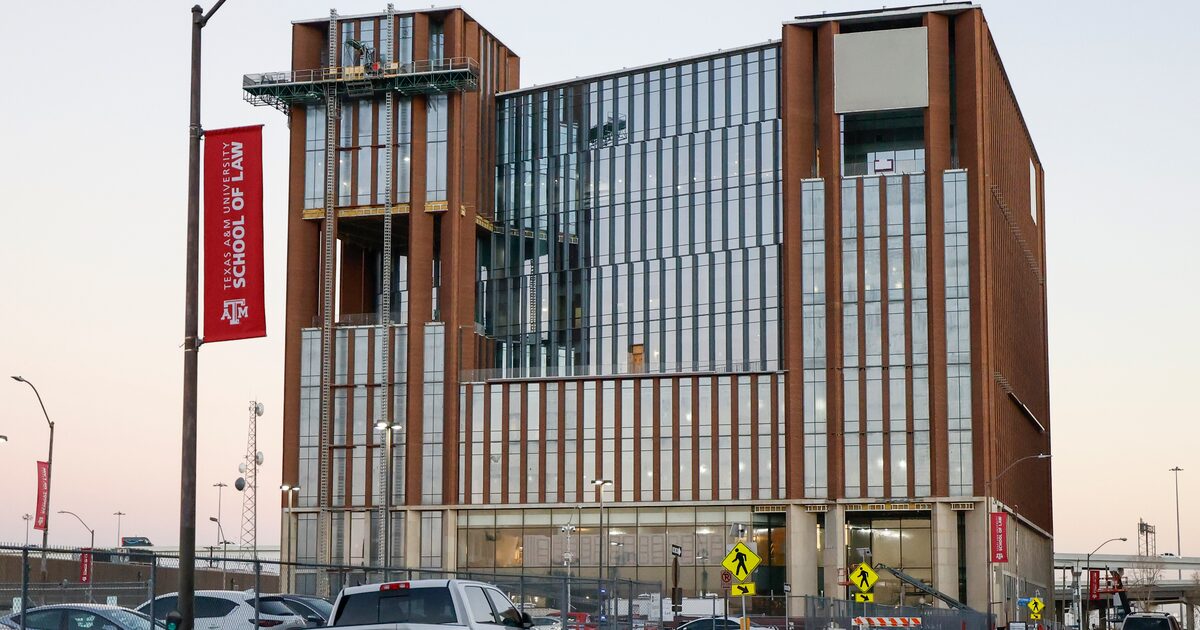
Students will soon be able to study at Texas A&M University’s new Fort Worth campus.
The downtown campus, which broke ground in 2023, is opening its first building and starting classes this fall.
The campus will house degree-granting programs from Texas A&M University and Tarleton State University, which is part of the A&M System. Texas A&M-Corpus Christi’s Center for Advanced Aviation Technologies will have a research presence, and six state agencies will be on campus as well.
Officials say the campus will help fill the region’s growing talent and research needs by collaborating in key area industries including health care, aerospace, and media and entertainment. Fort Worth, Tarrant County and Texas A&M leaders are also working to build a mixed-use innovation district around the campus that will connect companies with the university, startups and other businesses to foster economic development.
The Education Lab
“A&M has been investing in this area,” said Kim McCuistion, director of Texas A&M Fort Worth, pointing to the city’s demand for highly educated talent, its diverse industrial base and city leadership’s commitment to education.
Here’s what to know about Texas A&M’s Fort Worth campus.
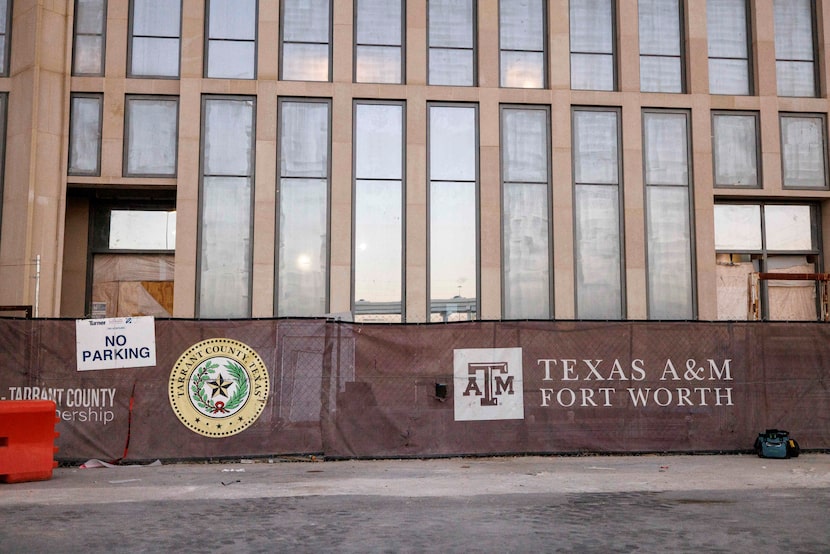
The Law and Education Building pictured on the Texas A&M-Fort Worth campus, Wednesday, Feb. 11, 2026, in Fort Worth.
Elías Valverde II / Staff Photographer
Why is Texas A&M building a campus in Fort Worth?
After the pandemic, city and business leaders looked for ways to ensure economic growth in Fort Worth. They proposed bringing an industry-driven campus to downtown to promote job growth, corporate development and research innovation, leading them to approach the Texas A&M System.
The university system already owned four blocks downtown, including its law school location, which it acquired from Texas Wesleyan University in 2013.
Related
“A&M decided to plant the flag. They said, ‘What we want to do is make sure that it’s not just an academic campus but that it really does engage the city,’” said Darryl Heath, executive director of the Fort Worth-Tarrant County Innovation Partnership, a nonprofit organization formed by the city and county that aims to develop relationships between corporations and Texas A&M.
City and county officials played a large role in establishing the campus, given its potential to help the city meet the needs of its growing economy.
Texas A&M system leaders and city officials have hailed the campus as a chance to bring a top research university to Fort Worth, which is among the few large cities in Texas without a Tier 1-designated institution. The status is a key driver in attracting top faculty, students and even industries to areas.
Related
Texas A&M-Fort Worth is the first urban campus for the Texas A&M System.
“The long-term vision is a compact, walkable campus that integrates academic, research and community-facing space in the heart of the city,” McCuistion said.
What programs will be offered this fall?
The Texas A&M Fort Worth campus will not offer its own degrees. Instead, students will take classes offered by Texas A&M University and Tarleton State University.
Texas A&M University will offer an undergraduate degree in engineering at the Fort Worth campus this fall. Students in the College of Performance, Visualization and Fine Arts can complete a bachelor’s in visualization, which prepares students for careers in visual media, such as marketing and animation. The College of Pharmacy is working to offer a master’s in pharmaceutical sciences, and third-year and fourth-year doctor of pharmacy students will complete their rotations in Fort Worth this year.
Texas A&M’s law school, which will move into the new building this fall, will continue to offer classes.
“Consistent with the overall model, we’ve identified broadly what degrees are going to be in demand among the community here and to the industry,” said Bobby Ahdieh, chief operating officer of Texas A&M-Fort Worth and dean of the Texas A&M University School of Law.
Related
Potential offerings include additional degree programs from the College of Enginering, MBA programs at the business school, and more undergraduate and graduate degrees for the College of Pharmacy and School of Performance, Visualization and Fine Arts. Ahdieh also said officials are discussing further investments in health care fields.
“From the conversations we’re having with individual hospitals in the D-FW metroplex, the demand and the need there is through the roof,” Ahdieh said. “Figuring out how we do that effectively will be an important project over the coming months and year or two.”
Meanwhile, Tarleton State will offer courses focused on health sciences, said Rachael Capua, vice president for external operations and dean of Tarleton State Fort Worth.
This fall, the campus will offer an associate’s degree in histotechnology, bachelor’s degrees in biomedical sciences, biotechnology and medical laboratory science, and a master’s in diagnostic molecular science.
The school is planning to launch another bachelor’s degree and two doctorate programs in the future.
How will the campus collaborate with industry?
The goal is to align industry partners’ needs with the “supply of research and talent that we have” within the Texas A&M System, McCuistion said.
Texas A&M officials said they are first focusing on industry partnerships in four key areas: health care, media and entertainment, agriculture and food, and aerospace and aviation.
Industry partners’ needs will drive research and program offerings at Texas A&M-Fort Worth.
The Fort Worth-Tarrant County Innovation Partnership has met with about 100 companies to identify which areas the campus should focus on, asking them, “What if you had a large-scale, Tier 1 research university coming to town? How could they help you? How could they add value to your bottom line?” Heath said.
In 2023, Lockheed Martin, an aerospace, arms, defense and information security company with a large presence in Fort Worth, was the first company to announce it would collaborate with the campus to establish a pipeline of engineers in the region. The company is discussing research opportunities, space and equipment needs, and funding strategies with Texas A&M-Fort Worth, Heath said.
Discussions with other companies, including Raytheon, Bell Flight, Cook Children’s Medical Center, Texas Health Resources and American Airlines, are continuing, according to Heath.
Heath said the partnerships between companies and the campus, plus the new facilities, will result in collaborative research, startup incubation, workforce development and education, and unique learning and engagement opportunities for students.
The campus will also serve as an anchor for a new mixed-use innovation district in downtown Fort Worth. Elements of the district will be modeled after the relationship between the Massachusetts Institute of Technology and Kendall Square, an internationally recognized innovation hub known for its high concentration of biotechnology and life sciences startups, in Cambridge, Mass.
The hope is that an innovation district will attract researchers and companies to the region and spark business opportunities.
“If we can create even some portion of that through these four industry programs in Fort Worth over the next 20 years, I’ll be thrilled,” Heath said. “That’s our goal — we create an engine in each of these industry areas that pulls companies, both startups and medium-sized and larger companies, towards the campus through these hub concepts.”
What are the plans for the campus?
The eight-story Law and Education building will be the first to open this fall and offer classes.
The campus is anticipated to grow to five buildings in total, including two research and innovation buildings and a performance, visualization and fine arts building. The next building to break ground will be Research and Innovation Building-A, which is in the pre-construction phase and will primarily house the state agencies.
Program offerings will expand as the campus grows and industry demands in the region change, Ahdieh said.
Ahdieh envisions the Fort Worth campus serving as a “study abroad” location for Texas A&M System students who want to gain experiential learning opportunities in a major metropolitan area.
“Imagine two or three days a week, you are off and you are working at some other venue, an externship or a co-op,” he said. “My guess is that’s a better education and students come out better prepared.”
The DMN Education Lab deepens the coverage and conversation about urgent education issues critical to the future of North Texas.
The DMN Education Lab is a community-funded journalism initiative, with support from Bobby and Lottye Lyle, Communities Foundation of Texas, The Dallas Foundation, Dallas Regional Chamber, Deedie Rose, Garrett and Cecilia Boone, Judy and Jim Gibbs, The Meadows Foundation, The Murrell Foundation, Ron and Phyllis Steinhart, Solutions Journalism Network, Southern Methodist University, Sydney Smith Hicks and the University of Texas at Dallas. The Dallas Morning News retains full editorial control of the Education Lab’s journalism.