
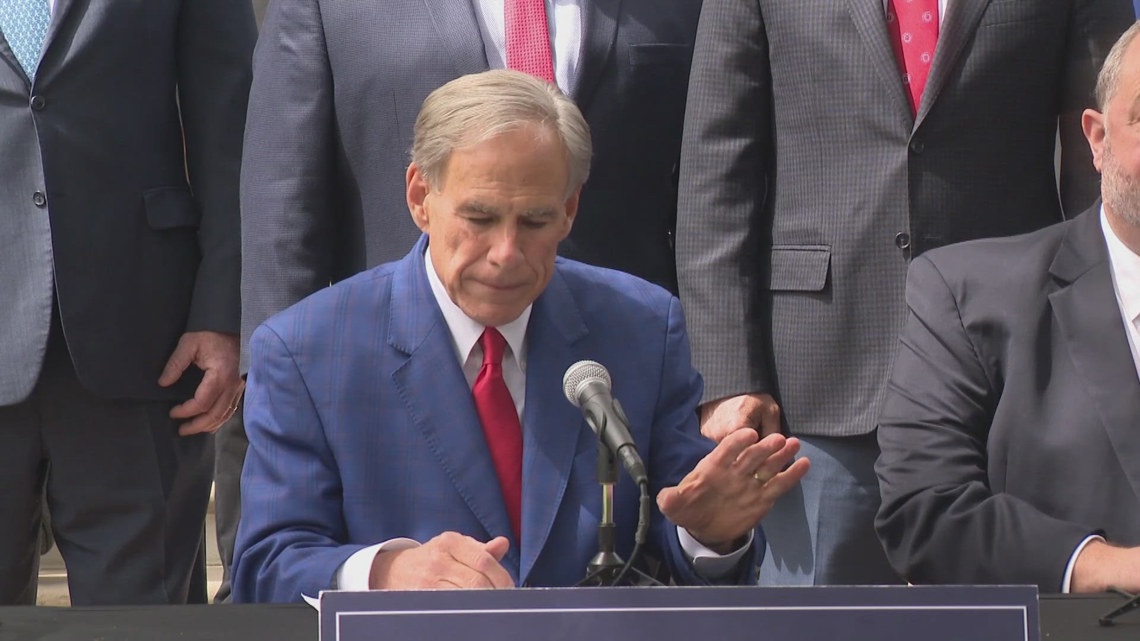
Abbott said the council will look to strengthen the workforce pipeline as the need to fill high skilled labor positions has become a growing challenge statewide.
AUSTIN, Texas — Texas is launching a new effort to strengthen the state’s workforce pipeline and prepare workers to fill highly skilled jobs. Governor Greg Abbott announced the launch of the Texas Jobs Council at an event at the Governor’s mansion on Monday afternoon.
Abbott was joined by Plumbers Local Union 68 Business Manager Wayne Lord, Texas Association of Business Interim President Megan Mauro and other business and labor leaders.
“For us to fulfill our destiny, for us to maintain our dominance,” Abbott said. “Business and labor are working together to meet the high demand for high-skilled labor positions like electricians, pipefitters, welders, plumbers, truckers, and a whole lot more.”
Earlier this month, Abbott celebrated Texas winning Site Selection magazine’s Governor’s Cup as the nation’s top-performing state in attracting jobs, businesses, and expansion projects for the 14th year in a row.
According to the Governor’s Office, Texas attracted more than 1,400 business location and expansion projects in 2025, representing more than $75 billion in capital investment and creating more than 42,000 new jobs.
“Texas right now is the hottest state in America for business and labor opportunity, as we’re ranked number one for the most new jobs, whether it be over the past year or since COVID or since I was elected Governor,” Abbott said. “We’re ranked number one for business expansion and capital investment. The number one business climate, number one for things like exports, technology and semiconductor.”
Abbott spoke about the need to fill trade jobs and how meeting the growing need has become a growing challenge statewide. Texas has a shortage of workers in construction, manufacturing and other skilled trades.
The Texas Jobs Council will be an official advisory board. Abbott said it will prioritize strengthening the workforce pipeline, including providing the existing workforce with resources to enhance their skills.
“They will work to equip new job applicants with the skills they need to be able to succeed, and they will work toward developing premier job skill training at high schools, colleges and in apprenticeship programs,” Abbott said.
Abbott said the Council will also work with state agencies, including the Texas Workforce Commission, the Texas Education Agency, the Higher Education Coordinating Board, and the Texas Department of Licensing and Regulation.
Members of the Texas Jobs Council include representatives from the Texas Association of Business, Texas Association of Manufacturers, Texas Oil and Gas Association, Texas Chemistry Council and Texas Association of Builders. It also includes labor leaders such as Teamsters Local 745 and Teamsters Joint Council 80, Teamsters Local 988, Plumbers Local 68, International Longshoremen’s Association, Heat & Frost Insulators Local Union 22, International Union of Operating Engineers 450 and Pipefitters Local Union 211.
“The creation of this new council sends a clear message to Texans about the governor’s strong commitment to expanding economic opportunity for everyone through workforce training and development,” Lord said. “The Texas Job Council will play an important role in supporting future business development by ensuring Texas has a skilled workforce ready to meet the needs of our state’s diverse and growing industries.”
The Texas Jobs Council will be co-chaired by the Teamsters Local 745 & Teamsters Joint Council 80 Vice President Brent Taylor and Megan Mauro of the Texas Association of Business.
“We’re looking forward to participating in this important task force,” Mauro said. “We also share the sentiment that the driving force of our economic success has always been tied to the strength of our workforce.”
The Texas Jobs Council is expected to focus on finding executive actions that can be implemented by state agencies “to reduce regulatory burdens and red tape surrounding workforce development,” and making policy and legislative recommendations that will be presented to the Governor and Legislature ahead of the 90th Legislative Session, which is slated to start in January 2027.
“We are unified on a mission,” Abbott said. “A mission that benefits all Texans, a mission that will keep Texas number one for business, keep Texas number one for jobs, and keep Texas number one for workforce training, ensuring great careers for generations of Texas.”
The Council will meet monthly beginning next month, and have quarterly meetings that Abbott said he plans to attend. The Council will deliver a final report in November, outlining recommended executive actions and legislative proposals.
“We are collaborating at every level to make sure Texas will have the best and largest skilled workforce in the United States of America,” Abbott said.
In June, Austin Mayor Kirk Watson said the Austin area currently has about $25 billion in infrastructure projects, including expansions of I-35 and the city’s airport. The mayor said about 10,000 people per year are needed to fill those jobs. However, Watson said if leaders allowed people to be trained for those jobs organically without additional training efforts, they’d only be about 4,000 people short.
The city recently partnered with Travis County, Austin Community College, Workforce Solutions, and industry leaders to launch the Austin Infrastructure Academy. It aims to train locals to fill those in-demand, well-paying trade jobs.
Texas 2036, a nonpartisan public policy think tank, said 63% of jobs in Texas will require a postsecondary degree, credential or training by 2036. However, only about 20% of young men and 30% of young women currently meet that mark.
Gov. Greg Abbott made expanding career training one of his seven emergency items during the 89th Texas Legislative Session.
House Bill 120, a wide-ranging bill to expand career training for young Texas students, was passed by state lawmakers and signed by Abbott. It expands access to dual credit and career and technical education (CTE) programs, especially for rural and military pathways. The bill also strengthens college and career advising.
Lawmakers also passed House Bill 20, which the Governor signed. It allows students to work toward graduation and certification in a high-demand field at the same time.
“The past couple of sessions combined, the state of Texas invested $7 billion to expand vocational education or career and technical education to make sure that students at the high school level and the college level, and at Texas State Technical College are going to have the resources and the availability of needed to educate them fully.”
Abbott said the creation of the Texas Jobs Council takes that a step further, beyond the education lens through which previous actions have focused, by bringing those in the labor and business industries who are in need of the workforce into the dialogue.
“Combining those two forces, to make sure that those who are already in the skilled trade programs, they’re going to have better strategies, better resources, better capabilities, and bring the know-how of what needs to be done for that particular job skill to our discussion point,” Abbott said. “We will be not just be creating the number of let’s say electricians we need, but making sure those electricians are fully equipped and trained and ready to go to work on day one.”
According to polling by the Texas Policy Project last month, 45% of people who want to work said they are very concerned about being unable to find a job. 34% said they are somewhat concerned and 14% said they are not too concerned.
In the same recent polling, a combined 23% cited either inflation/higher prices or the economy as the most pressing problems facing Texas.
Abbott is currently running for reelection. He is vying for a fourth term in office and will face Democratic State Rep. Gina Hinojosa from Austin in November. With the economy a top concern for Texas voters, it is a big part of the Governor’s message, as he points to the economy’s strength as proof that Republican policies are effective.