
Sign up for TPR Today, Texas Public Radio’s newsletter that brings our top stories to your inbox each morning.
The San Antonio African American Community Archive and Museum, or SAAACAM, has one of the only “Green Book” bus tours in the nation.
“The Negro Motorist Greenbook” was created by Victor H. Green in the 1930s to provide safe spaces for Black travelers to visit when segregation and violence against Black people was rampant nationwide.
That specific book featured over 80 locations in San Antonio.
There were lesser known “Green Books” throughout the nation, with San Antonio accounting for over 100 locations for Black travelers.
The “Green Book” became popular as the rise of sundown towns (also known as sunset towns) became common during the Jim Crow era. Sundown towns were areas where Black and other non-white travelers and residents were warned to stay home after dark. These areas even had signs that read “colored people must leave by sunset.” If not, they were subject to being humiliated, arrested, and even physically harmed. The “Green Book” informed travelers where they could stay the night while traveling without facing discrimination.
The SAAACAM “Green Book” bus tour is two-hours long and includes locations in East Side neighborhoods, from Dignowity Hill to Denver Heights and St. Paul Square. These locations include pharmacies, theaters, restaurants and other businesses. At some spots, guests are welcome to get off the bus and walk around. The final site is the SAAACAM exhibit space in La Villita.
1 of 3
— Green Book Tour-70.jpg
Guests stepped off the bus into SAAACAM’s exhibit space at La Villita.
Ivanna Bass Caldera / TPR
2 of 3
— Green Book Tour-77.jpg
A tour bus guest looks at SAAACAM’s timeline of African American legacy in San Antonio.
Ivanna Bass Caldera / TPR
3 of 3
— Green Book Tour-73.jpg
SAAACAM’s current exhibit at La Villita is “Soul of San Antonio.”
Ivanna Bass Caldera / TPR
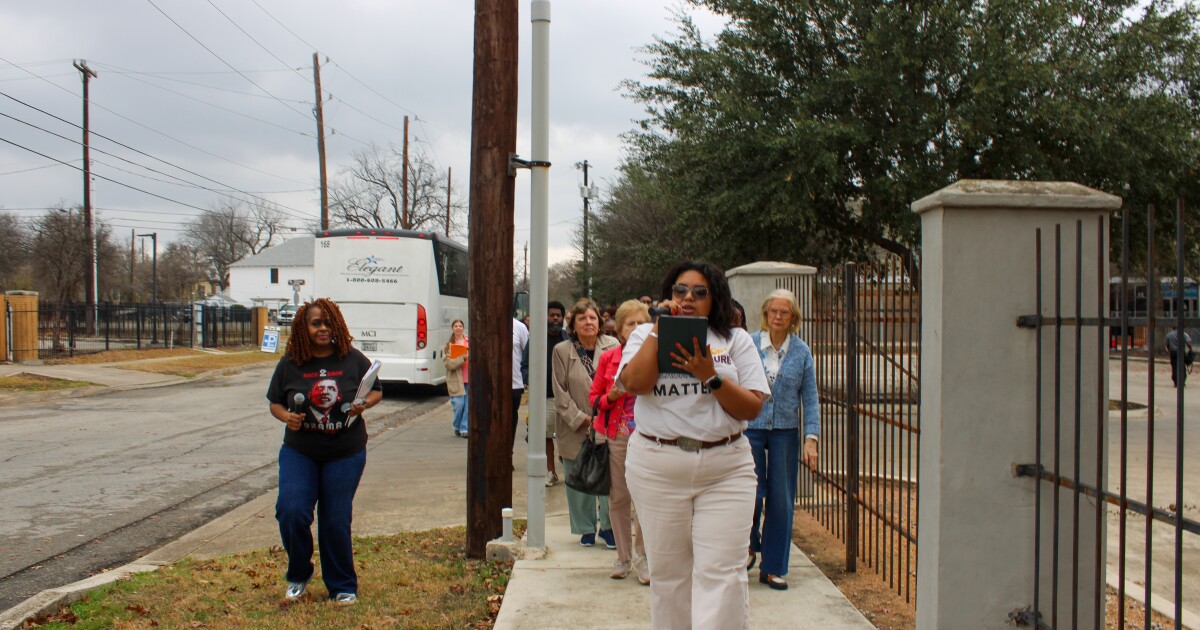
SAAACAM offers the tours at least once a quarter. During their tour in February, 31 guests settled into the charter bus and were greeted by Pesha Mabrie, SAAACAM’s education specialist.
“I don’t know if you know, but this is the 90th anniversary of the “Green Book.” It’s the 100th anniversary of Black History Month,” Mabrie said at the start of the tour.
The first site on the tour used to be known as Esquire Cleaners, a dry-cleaning business that welcomed Black customers. The building still stands on 212 Broadway; however, the business itself no longer exists. Although it was not Black-owned, it was recognized in the “Green Book” from 1950-1955 for treating Black customers with respect and dignity.
1 of 3
— Green Book Tour.jpg
What used to be known as Esquire Cleaners in the 1950’s is now an apartment complex.
Ivanna Bass Caldera / TPR
2 of 3
— Green Book Tour-20.jpg
The Carter Undertaking Company, founded by J.W. Williamson, in partnership with O.J. Carter, was not just a place of grief, but a trusted institution that offered dignity, stability and even organizing space during times of struggle for the Black community.
Ivanna Bass Caldera / TPR
3 of 3
— Green Book Tour-23.jpg
Guests got off the tour bus to see the Brackenridge Colored School up close.
Ivanna Bass Caldera / TPR
Other downtown locations on the tour included the Empire and Majestic Theaters. Originally, the Empire theater, located on 226 N. Saint Mary’s St., was segregated. The theater denied entry and services to people of color. In 1955 local chapters of the NAACP picketed against segregation. They wrote letters, led stand-ins and sit-ins, and finally by 1962, seating restrictions on Black customers stopped at the Empire theater. By the 1970s the theater was known for showing films that highlighted the Black experience.
The Majestic Theater is located on 230 E. Houston St., right at the corner of the Empire Theater.
While Black guests were allowed in, they were confined to seating in the top balcony, which had the worst view in the theater. The top balcony was accessible through a small elevator that people would cram into, or they would climb three flights of stairs.
Black San Antonians could not enter the Majestic Theater through the front of the theater; they had to go through the back on College Street. According to SAAACAM’s docent, Mya Jarmon, the original ticket box for the Black-only entrance is still in the building to this day.
1 of 3
— Green Book Tour-5.jpg
The Kress Grant building is now owned by SAAACAM.
Ivanna Bass Caldera / TPR
2 of 3
— Art7.jpg
Rudy Herrera’s mural on the back of the Kress building.
Centro San Antonio
3 of 3
— thumbnail_IMG_8727.jpg
Artist rendering of what SAAACAM’s museum will look like.
SAAACAM
A few stops later, Jarmon drew the attention of the passengers to a red neon sign that reads “Kress,” surrounded by windows turned into art installations with colorful patterned portraits representing African descendants in San Antonio. The Kress Grant building, located on 305-315 E. Houston St., was the first of eight San Antonio department stores to desegregate their lunch counters on March 16, 1960. Many San Antonian’s remember the building as being a beloved children’s museum in the early 2000s. Now, SAAACAM is transforming it into the third largest African American museum in the nation.
Jarmon said one of the most special parts of providing the tour is getting to hear stories from Black residents who remember not being able to sit at the lunch counter and seeing their joy today when they learn that SAAACAM now owns the building.
1 of 3
— Green Book Tour-62.jpg
St. Paul Square was a Black neighborhood during the Jim Crow era filled with Black-owned hotels, restaurants and beauty parlors.
Ivanna Bass Caldera / TPR
2 of 3
— Green Book Tour-52.jpg
During the 1940’s the Cameo Theatre, located across St. Paul Square, welcomed Black San Antonians to enjoy the latest films.
Ivanna Bass Caldera / TPR
3 of 3
— tour st paul.jpg
Guests follow docent Mya Jarmon around St. Paul Square during the Green Book tour.
Ivanna Bass Caldera / TPR
Tour guests are encouraged to ask questions to spark further conversation regarding Black history in San Antonio.
Carly Tompkins is from the Bay Area in California and is a graduate student at UT Health San Antonio.
When the tour stopped at the historic neighborhood of St. Paul Square, Tompkins noticed Interstate 37 was right next to the neighborhood. Tompkins asked how the construction of the highway impacted the Black neighborhoods. This question led to the conversation of how the placement of freeways displaced Black communities. Mabrie says this is the sort of detail that she wants people to examine.
“So when I talk about I-37 and the fact that there were at least 20 businesses, and now they’re demolished for a highway, you know, let’s talk about that. Let’s unpack that,” Mabrie said. “And so, it kind of begs the question of what is important and what’s not important when it comes to preserving.”
1 of 4
— Green Book Tour-6.jpg
This empty plot of land that sits on the East Side used to be Mrs. Jesse May Hicks Beauty shop, a business named in the Green Book from 1948 to 1953.
Ivanna Bass Caldera / TPR
2 of 4
— Love Is East Side-12.jpg
On 1416 East Commerce St. sits a building that once belonged to Hattie Briscoe, San Antonio’s only black female attorney for nearly 30 years.
Ivanna Bass Caldera / TPR
3 of 4
— Love Is East Side-15.jpg
The once Briscoe law firm now belongs to the Southwest Workers Union and has a mural on the side titled “Love is East Side.”
Ivanna Bass Caldera / TPR
4 of 4
— Mr-leonard.jpg
Mr. Leonard and his wife in front W.H. Leonard’s Pharmacy. The site of the pharmacy is one of the stops of SAAACAM’s Green Book bus tour.
UT San Antonio Special Libraries Collection. Cira 1932-1935
The tour brought to light the current gentrification of the East Side by showing empty plots of land that used to house Black-owned beauty parlors, pharmacies, and office spaces. Mabrie said that although the land is empty, the tour shows people the spaces that used to be safe havens for Black travelers and community members, because seeing their destruction demonstrates the lack of preservation of historic Black sites.
Mabrie said SAAACAM hopes to create workshops that help other cities develop their own “Green Book” bus tours to encourage the preservation of historic sites. She welcomes everyone to experience the “Green Book” bus tour in San Antonio. The next tour is on April 11, 2026, and tickets can be found on the SAAACAM website.