
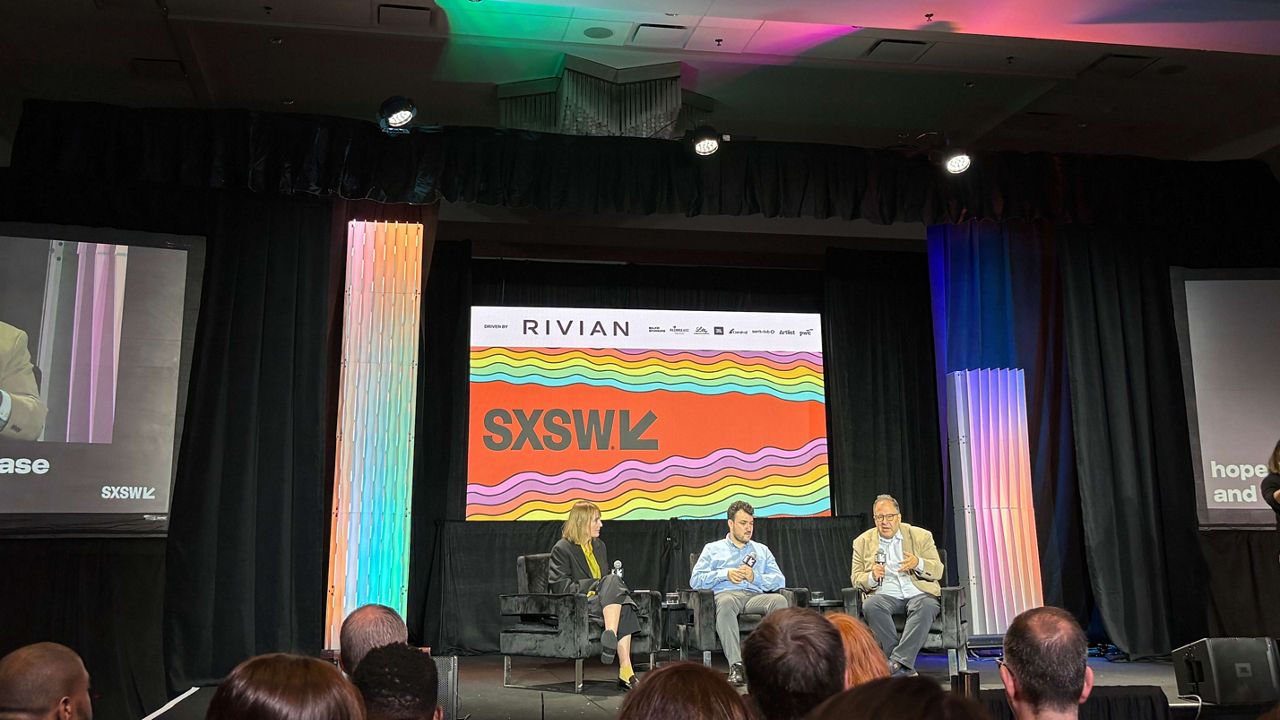
TEXAS — Pro-Palestinian activist and Columbia University graduate Mahmoud Khalil spoke on a South by Southwest Conference and Festival (SXSW) panel about free speech in the United States and the conditions for immigrants inside federal detention centers, almost exactly one year after he was arrested by U.S. Immigration and Customs Enforcement (ICE) agents and held in detention for 104 days.
In the Sunday panel titled “The Guardian in Conversation with Mahmoud Khalil on the Cost of Dissent”, Khalil was joined by his lawyer Baher Azmy, legal director of the Center for Constitutional Rights, for a conversation moderated by Betsy Reed, U.S. editor at the Guardian.
Khalil discussed the circumstances of his March 2025 detention, where he was one of the first people to be detained as part of the Trump administration’s targeting of pro-Palestinian activism on college campuses. Federal immigration agents arrested him outside his New York City apartment in front of his wife, who was eight months pregnant at the time. Citing a provision of the U.S. Immigration and Nationality Act, Secretary of State Marco Rubio deemed Khalil’s activism at the Columbia University encampment a threat to U.S. foreign policy.
“As an immigrant in this country, I never imagined the injustice in the immigration system as a whole,” Khalil said.
Khalil described being quickly moved from New York to New Jersey and then to Texas before landing at a federal detention center in Jena, Louisiana, where he would be held for the next three months. He said he shared one room with 70 other people, that the lights were always on and that “it was so normal to see people crying because they don’t know when this is going to end.”
“I never imagined that such injustices were happening on U.S. soil,” Khalil said.
He said that he is motivated to speak out about the conditions inside federal detention centers because he does not want to look back in twenty years and regret not doing more.
In 2026 alone, 12 detainees have died while being held in ICE custody, with four deaths occurring in Texas facilities. The most recent death occurred just one day before the panel on March 14. A 41-year-old immigrant from Afghanistan died at a Dallas hospital after being in ICE custody for less than 24 hours. An investigation into his death is ongoing.
Several Texas Democratic lawmakers have called for the closure of the largest detention facility in Texas, Camp East Montana, after it has received scrutiny for the living conditions. They have also raised concerns about the quality of life inside Texas’ only family detention center in the town of Dilley.
“This is a stain on the rule of law; this is a stain on the U.S. Constitution. No matter what we think about immigration, undocumented, legal, illegal, any of that, the fact that such horrendous conditions are for profit,” Khalil said.
There were no protests at the panel, though the initial announcement of Khalil’s presence at the festival drew criticism from Jewish student groups over allegations of antisemitism. The University of Texas student group, Longhorn Students for Israel, asked SXSW to reconsider its decision to feature Khalil on the basis that “SXSW must not platform voices connected to harassment and terror apologism.”
Austin Mayor Kirk Watson’s office received phone calls in protest of the panel, according to reporting from the Austin American-Statesman, though the mayor’s office plays no role in the selection of speakers.
Before the panel began, SXSW senior vice president of programming, Greg Rosenbaum, said that Khalil’s presence on the panel does not mean that the festival endorses his views, but that he has the First Amendment right to express them.
“We acknowledge that hearing perspectives different from one’s own can be uncomfortable, we ask that everyone remain respectful in the room, but as always at SXSW, we invite you to engage with the session and themes critically,” Rosenbaum said.
Khalil repeatedly condemned rising rates of antisemitism in the U.S. and said “the Palestinian freedom movement is a movement for justice for everyone regardless of their background.”
The panel discussed the battle over free speech and civil liberties that Khalil’s arrest kicked off, with Khalil saying that he worried the Trump administration’s crackdown on Palestinian student activists was just the blueprint for the silencing of any and all dissenting voices. He said he considers himself one of the “privileged Palestinians” who made it to the U.S., and therefore he must speak out on behalf of all those left behind.
“I was targeted because I represent a movement calling for freedom, justice and dignity for Palestinians,” Khalil said. “I felt I was not the story; the story is Palestine, the violence and the killing is happening in Palestine.”
Despite his status as a lawful permanent resident with no accusations of wrongdoing, the legal battle over the federal government’s attempt to revoke that status and deport Khalil remains ongoing, even after his release from detention. Khalili said he worries about the precedent losing this case would set.
“If the administration wins this case, that means that immigrants in this country cannot challenge their detention in ICE detention, which is very scary, no matter if you are a legal resident, illegal resident, naturalized citizen, they can weaponize this immigration against you,” Khalil said.