
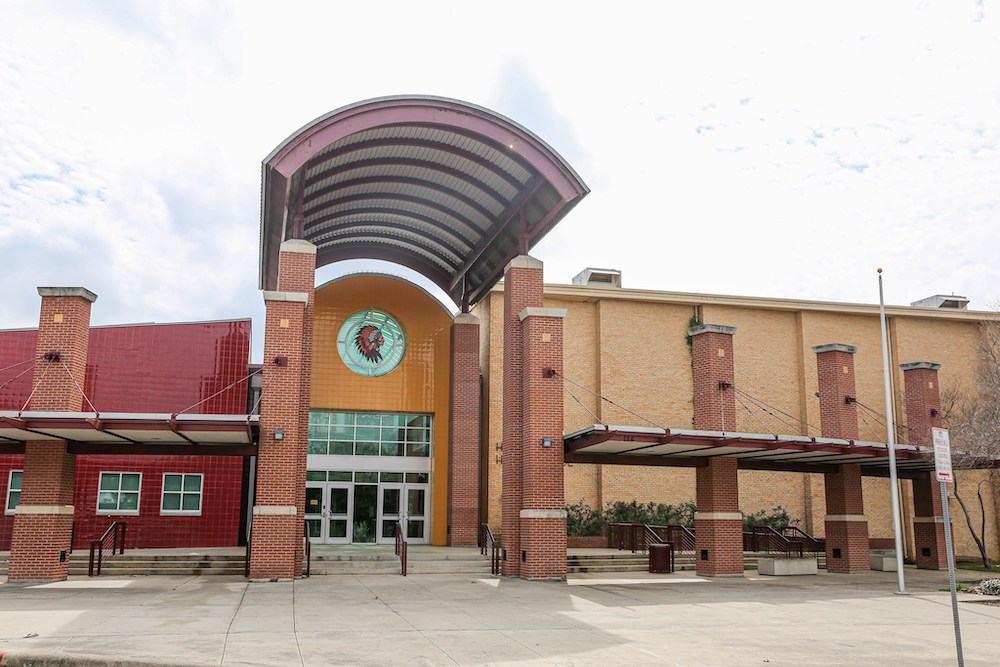
 Families in less-affluent San Antonio districts such as Harlandale have been applying for the state’s voucher program at lower rates than those in wealthier districts, data shows. Credit: Facebook / Harlandale High School_HISD
Residents of San Antonio’s wealthier school districts are significantly outpacing their poorer counterparts in applying for the state’s school voucher program, data from the Texas Comptroller’s Office shows.
For Joshua Cowen, a Michigan State professor who’s studied the effects of school vouchers nationwide, those numbers show the new program is working just as its Republican champions intended.
Gov. Greg Abbott and other voucher backers argued the program would give Texans of all incomes the opportunity to send their kids to private schools.
However, critics argue that claim was a smokescreen and that vouchers were always intended to help the wealthiest families offset the cost of tuition bills they’re already paying.
“We’ve known for 20 years that this is what happens,” Cowen told the Current. “[Voucher proponents] know this now too, because it’s showing up in the data.”
Indeed, recent reporting from the Current and other outlets found that just 24% of Texas’ school voucher applicants’ kids were in public schools when they applied for the program, meaning the vast majority of applicants had already enrolled their children in private schools.
“What’s undebatable is that school vouchers aren’t saving kids from failing public schools,” Cowen added.
The new, San Antonio-specific numbers suggest that low-income families here are likely too poor to be able to participate in the program, which distributes $10,000 coupons to cover each qualifying child’s private school tuition.
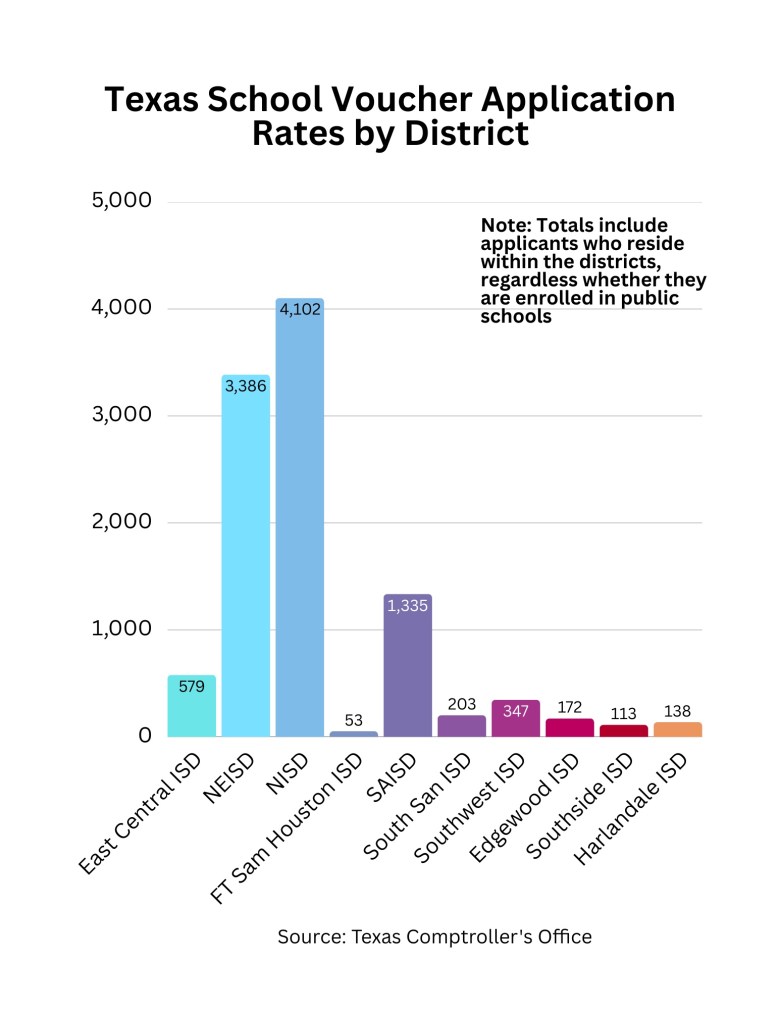
Of the 10,428 combined San Antonio public, private and home-school students who have applied for the voucher coupons, 5.9% reside in the boundaries of North East ISD. Another 4.1% are from Northside ISD.
The annual median family income in both of these districts is around $80,000.
The application percentages in those well-off districts are considerably higher than those for students living in districts with lower median income.
For example, just 1.2% of students living within the Harlandale ISD school district boundaries have applied for vouchers. That ratio stands at 1.8% in Southside ISD and 2.3% in Edgewood ISD.
The median annual family incomes those districts is below the Bexar County average, and those in Harlandale ISD and Edgewood ISD hover around $35,000.
‘Not true school choice’
State Rep. Diego Bernal, a San Antonio Democrat and a vocal opponent of Texas’ voucher program, said the numbers point out a major flaw in Texas’ recently enacted legislation.
Even if a low-income family receives a $10,000 voucher, the average private school tuition in San Antonio is about $12,000, according to Private School Review, an online comparison site.
That $2,000 difference still isn’t attainable for most low-income families, Bernal said. In other words, many of the families with kids in poorly performing schools still can’t afford to take advantage of it.
“One of the things I suggested [during the legislative session] was that if someone got a $10,000 voucher and their tuition was more than that, then the remainder of the tuition should be waived. But, [Republicans] said no,” Bernal said.
“It’s not really school choice at all,” the lawmaker added. “If the private schools can still charge whatever they want and exceed the value of the voucher and curate the student body any way they want, it’s not true school choice.”
Welfare for the Rich
Even if a state voucher covers the cost of tuition, low-income families still have to pay for school uniforms, activity fees, transportation, non-subsidized lunches and other expenses they don’t encounter in the public education system, according to experts.
So, even though pro-voucher lawmakers maintained the program would allow parents trapped in failing school districts to send their kids to better schools, it appears a majority of San Antonians simply may be too poor to afford to pay.
The numbers also support that theory statewide.
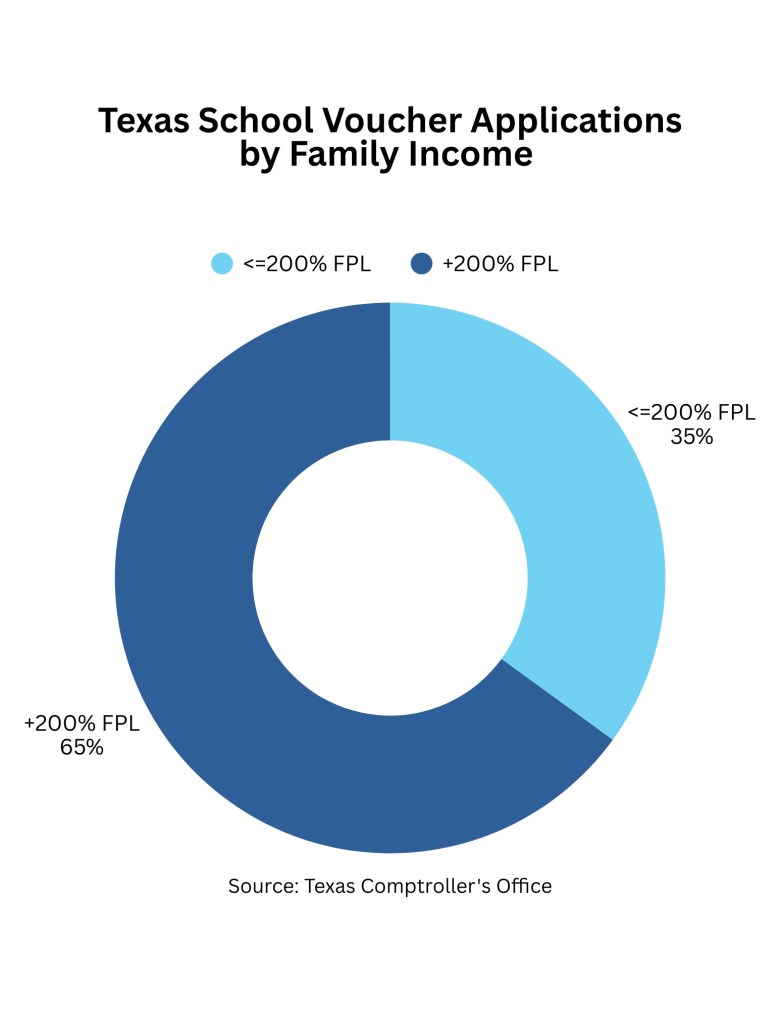
Of the Texas families who applied for vouchers, 65% are lower-middle income to upper income — or above 200% of the federal poverty line — according to the Texas Comptroller’s Office.
Only 35% of applicants so far are low-income, or earn less than 200% of the federal poverty line, according to state data.
Bernal argues the numbers prove Texas’ voucher program is welfare for the rich — or at least, welfare those who earn a comfortable living.
“Every time we have an opportunity to expand Medicaid or do something that helps poor people, Republicans always say no because they have a fear that people who don’t need it will get it,” Bernal said.
“With the voucher scam, it is not only known, but acknowledged, that people who don’t need the help, who can fully afford private school tuition, will get it anyway. That is not only corruption, but hypocrisy of the highest fucking order.”
Sign Up for SA Current newsletters.
Follow us: Apple News | Google News | NewsBreak | Reddit | Instagram | Facebook | Twitter | Or sign up for our RSS Feed
Related Stories
More than 200,000 students have applied for state money for private school. Most attended private school or home-school last school year, early data shows.
Both suits maintain the state is engaging in religious discrimination by cutting off state voucher money to Islamic private campuses.
The federal lawsuit argues Texas officials are engaging in religious discrimination by preventing Islamic private schools from accessing state voucher money.