

Dallas residents rely heavily on neighborhood libraries and overwhelmingly support increasing funding rather than closing branches, a new survey shows.
The results of a survey conducted by the Friends of the Dallas Public Library in partnership with the Dallas Public Library are out. About 4,000 residents responded to the survey Feb. 13-26.
The city is undergoing a process to shift to a regional model. If approved by the Dallas City Council, the library system would concentrate resources and services into fewer, larger regional libraries with expanded hours and programming, while closing several smaller neighborhood branches.
Related

Breaking News
Council members questioned the recommendations to close the Oak Lawn Branch, the Skyline Branch in the Buckner Terrace neighborhood, the Renner Frankford Branch in Far North Dallas and the Arcadia Park Branch in West Dallas, to free up about $2.6 million in annual operating costs.
After pushback from council members and residents, city staff has paused closure plans and will return with revised options at the Quality of Life, Arts and Culture City Council Committee on March 23. Part of the pause included conducting a survey to gather residents’ input.
Related

Manya Shorr, the Dallas Public Library director, said the survey shows that people who responded love their libraries, want their branches to stay open and want more days and hours offered.
“I think that no matter what the survey says, we have to remember that it is just one data point that we are using to collect feedback from the community about the proposed regional model,” Shorr said.
Shorr said her office was tasked by council members to seek community input on the historical significance of the branches, possible revenue options and a deeper look at public transportation options around the libraries. “All of it goes into consideration as we think [about] how to move forward.”
Who responded to the survey?
The survey was available in English and Spanish, online and in print at library locations. It was distributed on the city website, council members’ newsletters, on social media and the Friends of the Dallas Public Library network.
The survey was conducted as a feedback opportunity, said Nicole Paquette, chair of the Friends of the Dallas Public Library board of directors.
“We specifically call it an open link feedback opportunity,” Paquette said. “It’s not a formal, statistically valid survey, per se, because we were not going during the time window to be able to get a statistically valid sample size representative of all Dallas residents.”
A total of 71% of the respondents identified themselves as female, and 21.4% as male. The two largest age groups that took the survey were 65+ and 30-39.
More than half of the respondents identified as white, followed by Latino with 11.7%.
Respondents cited Renner Frankford as the most frequently visited by respondents. In second place was the Oak Lawn Branch, followed by the Lakewood and Audelia Road branches.
Borrowing books and materials is the most widely used service, according to the results. Libraries are not an occasional service; they are a routine part of life for many residents, according to survey respondents. About 85% of respondents use Dallas Public Library services at least once a month.

People work at the computer station in the Martin Luther King Jr. Branch Library, on Thursday, March 5, 2026 in Dallas.
Shafkat Anowar / Staff Photographer
Paquette said the survey showed that libraries are seen as multi‑role, essential civic hubs for all community members across the city.
Opposition to closing branches
The survey also found strong opposition to a proposal to close four branch libraries to expand services elsewhere, with 72% of respondents opposed.
City staff says the regional model is designed to streamline operations across the Dallas Public Library system by creating a network anchored by flagship facilities that offer enhanced services and are open seven days a week.
Under the regional model, the central library would continue to serve as the system’s primary anchor. Five flagship libraries in the first year, will be designed to operate as regional hubs open seven days a week and provide service in evening hours. There will be 24 neighborhood libraries that would remain open and continue providing their regular services.
Under the model, staff restructuring would take place and some employees would be reassigned to the flagship libraries while other positions would be eliminated.
“I think it’s unfortunate that the concept of flagship libraries is associated with possible closures,” Shorr said. “Because whether we close libraries or not, I would love to still be able to create flagships.”
Residents who participated in the survey say they prefer keeping neighborhood libraries open even if it means the branches provide fewer hours or services. About 53% would still oppose closures even if it meant reduced services citywide.
“What people don’t understand is that flagship libraries, even with all the neighborhood branches kept open, [the flagship model] will offer something they don’t have right now, which are libraries open every single day and into the evening with a concentration of programs and services,” Shorr said.
Shorr said she would continue to work with the city’s manager’s office to consider how to protect or reframe neighborhood branches while still achieving the benefits of the flagship concept.
Library budget
Residents want more investment in libraries. Nearly all respondents, 97%, say Dallas should maintain or increase funding for the public library system.
The library’s annual budget is about $43 million, accounting for about 3% of the city’s $2 billion general fund.
Despite population growth, technological advances and the addition of branch locations, the operating budget has remained flat since 2001. Although new libraries have been constructed with bond funding, they have not been funded for operations, according to the city.
Compared with Dallas, Austin has a budget of about $80 million and 22 locations. Fort Worth has 20 locations and a $31 million budget, according to the city staff.
Denise McGovern, the executive director of the Friends of the Dallas Public Library, said the Friends’ role is to continue advocating for the city to keep or increase the library’s budget.
McGovern said she hopes the effort of Dallas residents to save their libraries will push Dallas council members to restore the library budget to maintain all of their branches, services and operations without cutting staff or hours.
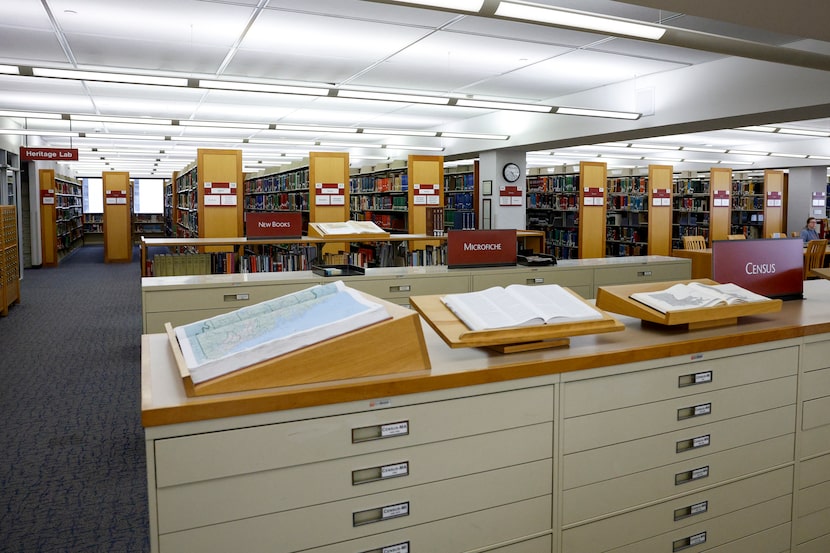
A view of the Genealogy & History department at J. Erik Jonsson Central Library, Thursday, March 5, 2026, in Dallas.
Elías Valverde II / Staff Photographer
She said the survey gave residents the opportunity to provide feedback on the budget and also what they want to see in their libraries.
“After the Quality of Life meeting, one of the big criticisms was that people didn’t have a way to give feedback,” McGovern said. “We got the call about partnering on a survey that same day and moved quickly to create an open-link survey so anyone who wanted to could take it.”
Neighborhood access
In the January meeting, council members questioned the data used to recommend the closures and asked why other factors were not considered, such as the use of libraries as voting locations, their role as informal community center and the cultural history of each branch.
Under the regional model, the flagship locations will be within a 10- to 15-minute walk of a bus stop, according to Shorr.
Council members questioned whether residents would be willing to travel to another location and what impact changes to the Dallas Area Rapid Transit system would have, given that the system is facing scrutiny and some suburban cities are holding elections to pull out of it.
The survey shows that people want libraries close to where they live. Nearly 40% of respondents say they would not travel to another library if their neighborhood branch closed.
And 25% of respondents would consider using public transportation to visit a library if travel time is 30 minutes or less.
The last section included an open-ended question. Paquette said the Friends received about 1,600 pages of open-ended response feedback.
She said the top responses for city leaders include: Libraries are vital to the community, keep libraries open and increase library funding.
“There was a lot there about travel and mobility, and ‘Please save my library,” Paquette said. “And, ‘Please don’t close my library.’”