

Colorado’s second-highest court agreed last week that a defendant’s critical statements toward an El Paso County judge were constitutionally protected and could not form the basis of a retaliation charge.
A three-judge Court of Appeals panel concluded that, in context, Ashley Hernandez’s brief confrontation with District Court Judge Diana May in a courthouse elevator did not contain “true threats” that fell outside of First Amendment-protected speech.
“Hernandez didn’t target Judge May. The encounter was coincidental,” wrote Judge Melissa C. Meirink in the March 12 opinion. “Though Hernandez’s statements were disrespectful and inappropriate, they weren’t true threats because no reasonable juror could find that the statements conveyed Hernandez’s intent to commit an act of violence.”
Case: People v. Hernandez
Decided: March 12, 2026
Jurisdiction: El Paso County
Ruling: 3-0
Judges: Melissa C. Meirink (author)
Jerry N. Jones
Katharine E. Lum
Prosecutors charged Hernandez based on a brief 2023 elevator ride at the Colorado Springs courthouse. May had presided over a criminal case, in which Hernandez’s romantic partner was the defendant. May eventually recused herself after she learned of the defendant’s jailhouse phone call to Hernandez, in which he claimed May was on “the compromised judge list.” May said she could no longer be unbiased due to the perceived threat.
Two months later, Hernandez and May got on the same elevator and Hernandez asked the judge to “comment why you were biased” on her partner’s case. May said she could not comment because “that would be unethical.” Hernandez replied that “you taking that case” was unethical, and “what’s inappropriate is you waking up next to a cop every day and going in there.”
May reported the encounter to security and prosecutors charged Hernandez with retaliation against a judge as an act of harassment. After Hernandez moved to dismiss on constitutional grounds, the district attorney’s office amended the charge to allege Hernandez made a credible threat against May.
The defense again moved to dismiss, citing the 2023 U.S. Supreme Court decision of Counterman v. Colorado. The stalking case, which originated in Arapahoe County, culminated in the Supreme Court’s recognition that prosecutors must prove a defendant was aware of the threatening nature of their statements. Otherwise, defendants could be convicted for constitutionally protected speech.
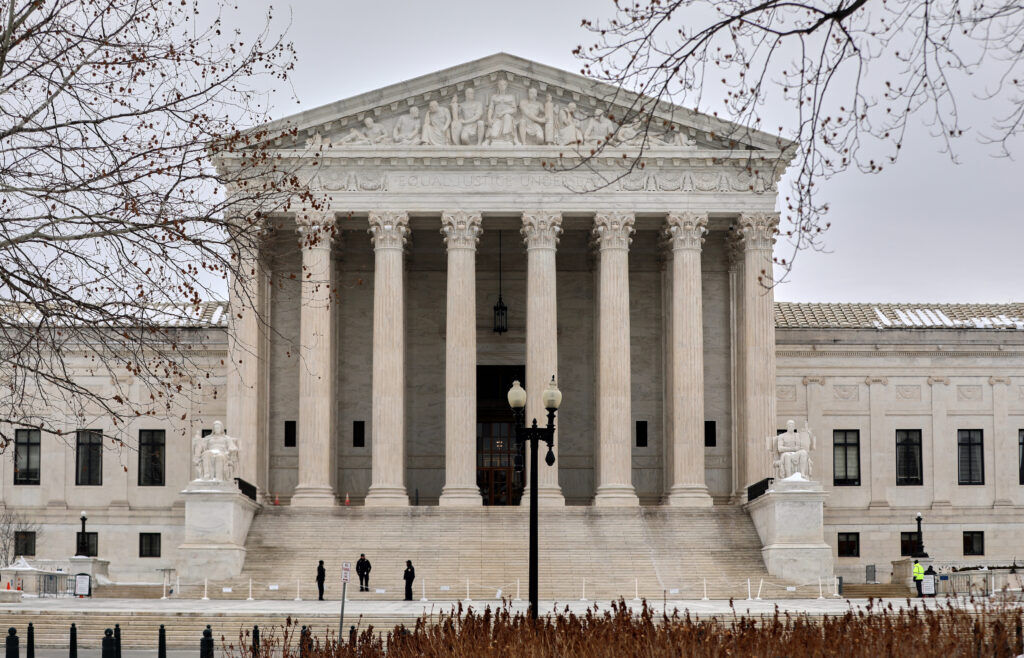 FILE – The Supreme Court is photographed, Feb. 6, 2026, in Washington. (AP Photo/Rahmat Gul, File)
Dinsmore Tuttle, a retired judge assigned to Hernandez’s case, found the evidence “falls far short” of establishing a threat because “no threats were uttered.”
“This does not mean to say that Ms. (Hernandez’s) attitude and words during the interaction were not inappropriate and disrespectful of Judge May, or that Judge May did not feel that she or her family were threatened,” Tuttle continued. “But those issues are not before the court in this criminal prosecution. Avoiding the overbroad chilling effect on one’s constitutional right to free speech is what the Court addressed in Counterman.”
The district attorney’s office immediately appealed her decision to the state Supreme Court, citing the requirement that the justices directly consider instances where trial judges declare laws unconstitutional. But the justices turned aside the appeal last year, noting Tuttle did not strike down a state law.
Turning to the Court of Appeals, the prosecution argued Tuttle disregarded the objectively threatening nature of Hernandez’s conduct, and ignored Hernandez’s boastful comments to her partner afterward about confronting May.
“In this case, the district court limited its analysis to an examination of the literal meaning of the words that Ashley Hernandez spoke to a judge, with no consideration of (1) the context in which the statements were made, or (2) Hernandez’s understanding of how her statements would be perceived by the judge,” wrote Senior Deputy District Attorney Doyle Baker.
The Court of Appeals panel disagreed.
“True, Judge May described Hernandez’s posture and demeanor as ‘aggressive’ and ‘stiff’ and her voice as ‘deliberate, (firm,) and commanding’,” wrote Meirink. “But, again, considered in context, Hernandez’s demeanor and tone reflected her frustration; that conduct doesn’t elevate her statements to a true threat.”
Meirink added that Hernandez’s reference to May’s husband in law enforcement was a criticism of May’s perceived bias and not a threat of harm.
Although Hernandez’s boastful statements afterward “may have demonstrated that Hernandez realized (or even relished) that she made Judge May uncomfortable,” Meirink wrote, “causing discomfort isn’t equivalent to making a threat, nor is it a crime.”
The case is People v. Hernandez.