

The North Harris County Regional Water Authority on March 3 moved forward on a final design for Project Series 39, a Spring-area project designed to help the district catch up with a mandated 60% groundwater reduction plan.
What’s happening?
As part of a regional effort to reduce groundwater usage, the Houston-Galveston Subsidence District, or HGSD, in 1999 mandated water providers to convert to primarily surface water sources to combat land sinking—otherwise known as subsidence.
The authority was required to have no more than 70% of its total water usage come from groundwater sources by 2010. By the end of 2025, the authority was supposed to have reduced total groundwater usage to only 40%.
However, NHCRWA officials said the agency has only been able to convert around 35%-38% of its total water users from groundwater since 2010—roughly 22% below the required 60% use reduction set for 2025.
“We actually achieved in the month of December a 38% conversion, which is not 60% where we were supposed to be,” NHCRWA Program Manager Amber Batson said at a March 3 board meeting. “However, on the positive side, it’s the highest month of conversion that we’ve had so far. So we’re going in the right direction,”
The board of directors approved moving forward on a design for Project Series 39–a $164.96 million project to construct over 11 new miles of distribution pipeline and 11 new water reclamation facilities.
“>
The cost
The NHCRWA supports over 750,000 water users and 330 municipal utility districts and cities, officials said. NHCRWA General Manager Jun Chang said the authority is responsible for overseeing conversion at each of the agencies.
The HGSD mandate requires the NHCRWA to meet several conversion benchmarks or face fees from the HGSD for every 1,000 gallons of groundwater used above the conversion rate.
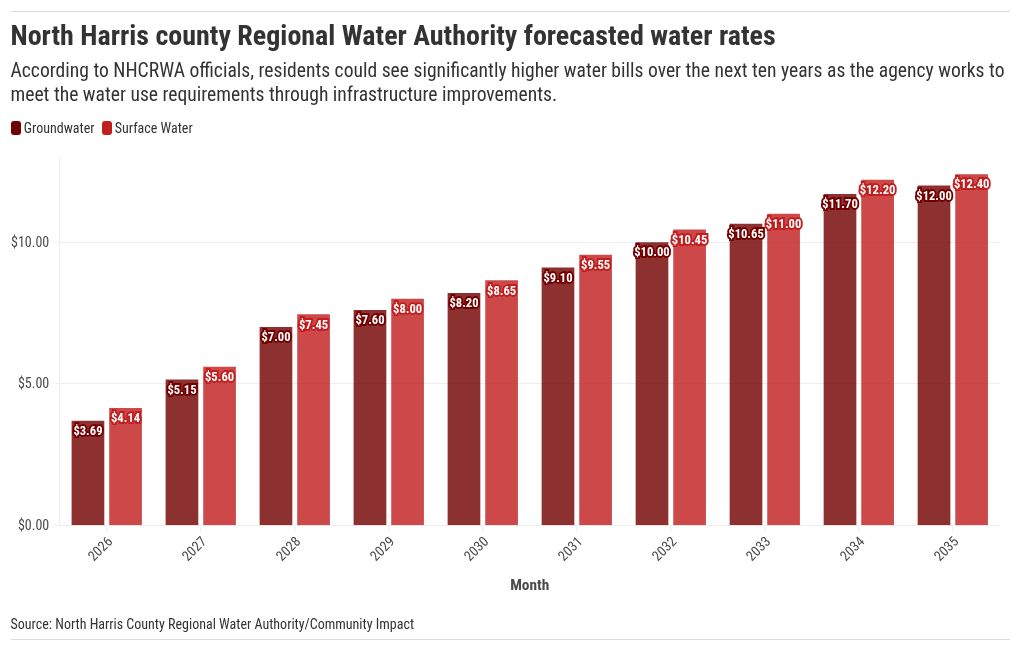
Batson said the effort to reduce groundwater usage from 30% to 60% is already a $2.4 billion initiative, which may not be achieved until 2031. In order to fund the improvements throughout northern Harris County, water fees will also likely see significant increases over the next decade.
However, several individuals expressed frustration with the projected rate increase, saying some MUDs have done more work on their end to meet groundwater reduction requirements as opposed to other areas.
“This seems punitive to everybody that follows the rules,” Harris County MUD 61 Director Jerry Owens said. “There’s a lot of reasons as to why people [and] districts use groundwater. … We need to put something else together to go after the low percentage of people who aren’t doing what they’re supposed to do.”
However, officials clarified that groundwater usage across the 330 MUDs and cities can vary due to several factors, including maintenance issues or having no available surface water sources to convert to independently of the NHCRWA.
“In April, we should see a substantial jump in water that goes out into the system, as we’ve got a lot of those 24 water plants hooked up,” Batson said.
Why it matters
The requirement to reduce the amount of groundwater used by local districts stems from the HGSD, which monitors the rates of sinking land due to groundwater pumping across the Houston region. According to data from HGSD, three major points of subsidence in the Houston area are within Spring—with two located within the confines of project 39’s boundaries.
In the area near the Grand Parkway and I-45, HGSD has recorded a total vertical displacement, or sinkage rate, of 31 centimeters over the course of 18 years.
“>
What’s next?
The design for Project 39 and a second project just east of the Hardy Toll Road in Spring will be presented to the public March 24 at Spring High School. During this period, residents will be able to comment and discuss the project’s potential impact on the area.
Batson clarified that roughly 24 water wells are set to come online across northern Harris County in March, which will then help increase the amount of surface water available to use locally.
Residents are encouraged to attend the public meeting to discuss potential future project impacts.
NHCRWA Community Engagement Meeting
March 24, 6-7:30 p.m.Spring High School, 19428 I-45 N., Spring