
The white-hot Texas economy may have recently cooled, but one of North America’s largest banks still sees significant upside — and is advising business leaders to take a more judicious approach in the current economic climate.
“For business owners, the implications are clear: opportunity remains abundant, but execution has become the differentiator,” wrote Bank of Montreal researchers Nick Salomone and Priscilla Thiagamoorthy in the bank’s new Texas Business Outlook report, published on Wednesday.
The researchers added that the Texas companies that are currently succeeding are “pairing expansion strategies with rigorous capital discipline,” while maintaining flexible balance sheets and investing selectively in new initiatives.
“I’ll give you the analogy of a stock market that’s really hot,” Tony Sciarrino, head of BMO’s U.S. Commercial Bank, said in an interview. “Like you can invest money, and you can just make money in pretty much anything, right?”
Business Briefing
But when the market isn’t as hot, you have to be more strategic and make better decisions, he added.
“And so that’s kind of where I see things right now — is that companies are thinking strategically on where to deploy capital, how to think about their business. And the biggest piece of this is how [artificial intelligence] is sort of affecting their businesses.”
The bank’s analysis is based on numerical research and BMO bankers’ insights from meetings in the state, and is intended mainly for an audience of Texas business executives.
The report comes as the state’s nearly $3 trillion economy has recently experienced a downshift. After adding jobs at a rate of around 2% annually, Texas’ job creation ground to a virtual halt last year, according to a Dallas Fed projection published early this year, due in part to struggles in the oil and gas industry and uncertainty from tariffs.
Related

Texas did still manage a growth boost, however, which analysts have attributed to increased efficiency as companies have begun introducing AI tools.
“AI is improving productivity,” Luis Torres, a Dallas Fed economist who authored that projection, told The News earlier this year. “[It’s] part of that story.”
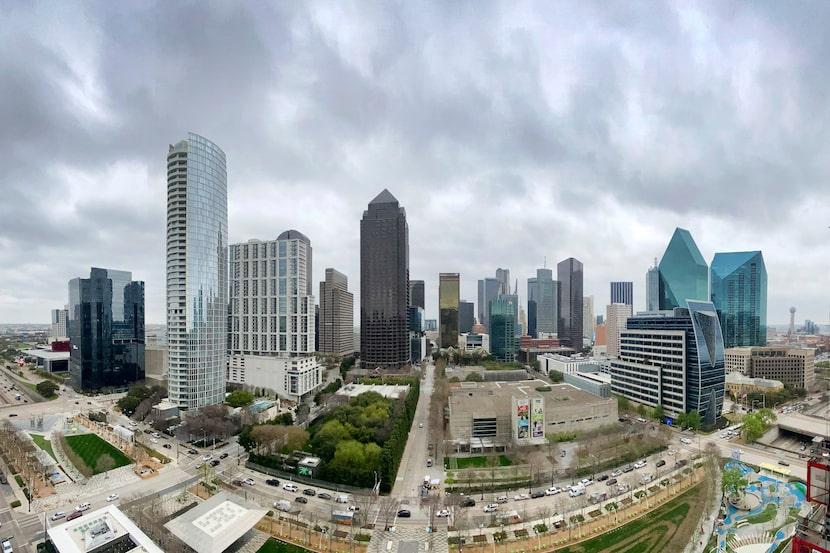
A panoramic view of the Dallas skyline from the new Bank of America Tower under construction across the street from Klyde Warren Park in Uptown Dallas, March 10, 2026. The unobstructed view is seen from the 16th floor.
Tom Fox / Staff Photographer
‘Betting all’ on Dallas-Fort Worth
This year economists are expecting job creation to pick up again, although at a rate below Texas’ traditional trendline.
Still, even in a climate of relatively cooler growth and widespread uncertainty, the BMO report assesses Texas as well positioned, citing the state’s “population growth, sustained business investment and resilient labor markets” and strong energy, industrials, technology infrastructure and financial services sectors.
Along with Houston’s energy industry and Austin’s tech sector, the report also cites Dallas’ financial prowess and an influx of talent and capital associated with the region’s numerous new corporate headquarters.
Sciarrino said he’s also encouraged by the region’s real estate rebound and strong local talent pipeline.
“I would say relative to some other cities in America, I’m more bullish on D-FW than I am in other places,” he said. “So if I’m cautiously optimistic [on a more macro level], I’m sort of personally betting all in in the D-FW geography.”
In the current economic climate, businesses across the state are rethinking strategies, the report added. That includes closely managing their capital as they get hit with higher inventory and labor costs, and “prioritizing investments with clear, near-term returns.”
The more moderate growth climate has also spurred more companies to pursue acquisitions, the authors wrote, in an attempt to strengthen their market positions.
Salomone and Thiagamoorthy also cited Texas’ relatively low unemployment and a statewide housing market that they see as regaining balance years after the pandemic drove explosive price hikes.
“Looking ahead, we remain cautiously optimistic about the economy,” they wrote. “Texas remains on track for a moderate, broad-based expansion, outperforming many states despite demographic and policy headwinds.”