
 Deputy HUD Secretary tours homeless “Super Hub”
A major federal partnership was finalized in Houston on Wednesday to tackle homelessness and power the city through disasters. U.S. Deputy HUD Secretary Andrew Hughes joined Houston Mayor John Whitmire for a tour of the new “Super Hub” in the Second Ward. FOX 26’s McKenna Earnhart has more.
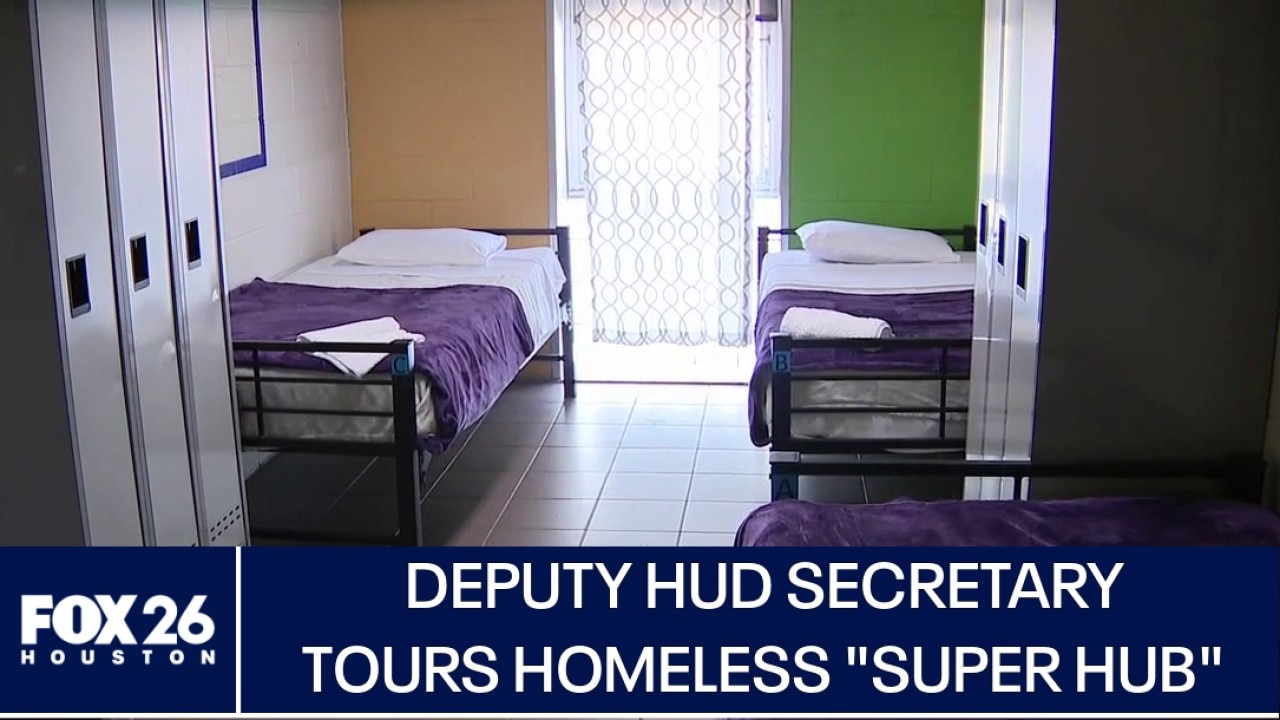
HOUSTON, Texas – Federal and city leaders gathered in Houston’s Second Ward Wednesday to tour a massive new “Transition Center” that they say will serve as a blueprint for ending homelessness across the United States.
The tour of the facility at 419 Emancipation Ave, led by Houston Mayor John Whitmire and U.S. Deputy HUD Secretary Andrew Hughes, served as the final step in securing a $314 million federal disaster recovery grant. While the bulk of the funds are earmarked for storm resilience, $41 million has been carved out to operate the “Super Hub” for the next three years.
“We’re goal-oriented, and it’s our mission to get the homeless off the streets of Houston… and out of our neighborhoods,” Whitmire said during the briefing. “This is a site that will be holistic… it’ll be a win-win for the citizens.”
By the numbers:
A Shift in Strategy
The facility represents a significant policy shift by the Trump administration away from traditional “Housing First” models. Hughes emphasized that the federal government is looking for “upward mobility” and “results.”
“It’s not ‘Housing First.’ It’s about getting people the wraparound services they need so they can get out of poverty and continue about their lives,” Hughes said. “We’re going to take inventory of the success and obviously if the results are what we think they are, we’re going to obviously try to duplicate that in other areas around the country.”
The center expects to house up to 320 people at a time, with a goal of transitioning 1,000 individuals annually into permanent housing and employment. To encourage participation, the site includes a climate-controlled kennel for pets—removing a common barrier for those who refuse to leave their animals behind.
Dig deeper:
Safety and Resilience
To address neighborhood concerns in the Second Ward, the Mayor announced a permanent security presence. A specialized HPD outreach team, consisting of eight officers and a Sergeant, will be based inside the building 24/7.
The project is also tied to a $100 million “Resilience” initiative. The city plans to install industrial backup power at the Hub and 100 other sites across Houston to ensure services continue during a grid failure.
“This building… will be a resilience site for the neighborhood,” Whitmire added. “It’ll have backup power… where even if the grid goes down, we’ll have lights and we’ll have a kitchen.”
What they’re saying:
The Funding Controversy
Despite the optimism from officials, the project has faced sharp criticism from local advocacy groups. Texas Housers and other organizations have argued that the $41 million in CDBG-DR funds was originally intended to repair the homes of low-income seniors damaged during the 2024 storms.
Critics argue that “reprogramming” these funds leaves thousands of storm victims on waiting lists for roof and structural repairs. At City Council, some members also raised concerns about the long-term sustainability of the site once the federal “carve-out” expires in three years.
Whitmire defended the move, stating that the Hub itself serves as a disaster ‘Resilience’ site that will protect the city’s most vulnerable populations during future storms.
The facility is expected to be fully operational by June 2026.
The Source: John Whitmire, Mayor of Houston, Andrew Hughes, U.S. Deputy Secretary of HUD, Official City of Houston Briefing, U.S. Department of Housing and Urban Development (HUD) Grant DR-2, Houston City Council Records