
Amanda McCoy
amccoy@star-telegram.com
In his homeschool curriculum, 12-year-old Luke Lunday is learning about Section 504, a cornerstone of disability rights.
Championed by disability rights activist Judy Heumann, Section 504 of the Rehabilitation Act is responsible for what’s known as the integration mandate, which requires that people with disabilities have access to services in their homes and communities, rather than an institution.
It enables Luke, who has a rare genetic disorder and requires the daily aid of a nurse, to live at his Trophy Club home with his parents.
A lawsuit filed by the state of Texas is challenging this cornerstone of disability rights; advocates say it could eliminate the kinds of services that people like Luke rely on for basic needs.
The end result of the suit, disability advocates say, is that people with disabilities could be at greater risk of being institutionalized, and might lose the right to receive services in their homes and communities.
In its lawsuit, Texas v. Kennedy, Texas argues that updated rules for Section 504 are unconstitutional, and that the integration mandate “exceeds statutory authority and conflicts with federal law.” The state argues that the updated rule “creates a regime that is impossible for any State to fully comply with.”
Disability rights groups throughout the country have voiced their opposition to the lawsuit. The Arc of Texas, which advocates for Texans with intellectual and developmental disabilities, sent a letter to Attorney General Ken Paxton in February asking him to withdraw from the suit.
The Attorney General’s Office did not respond to a request for comment.
“We have expectations about [people with disabilities] living in the community, being part of the community, having supports,” said Claudia Center, the legal director for the Disability Rights Education and Defense Fund. “This is an attack on that whole foundational understanding.”
‘He’s fighting the same fight’
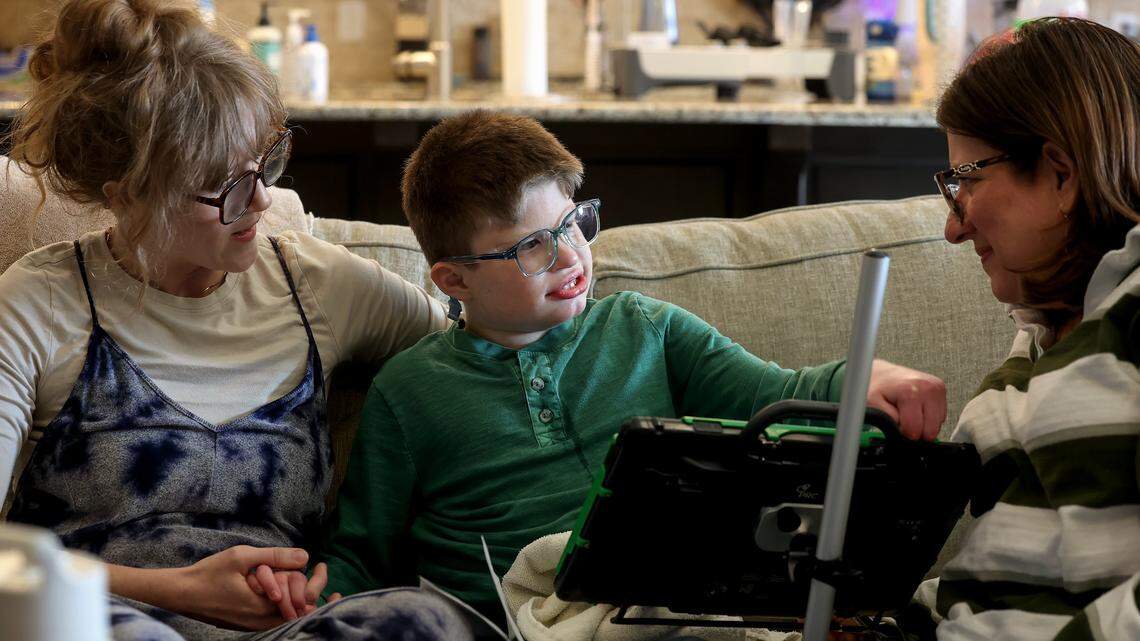
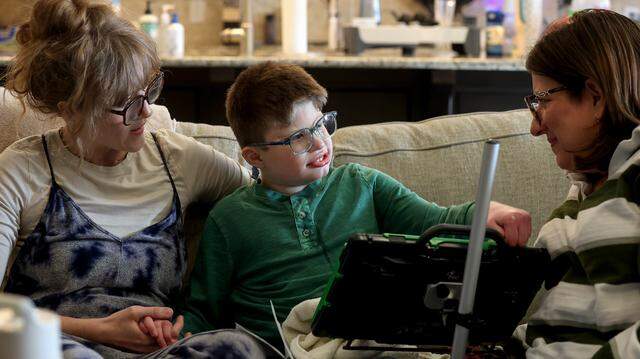
Luke, a sixth-grader, uses an augmentative and alternative communication device to talk by clicking buttons on the screen to select words. Through the device, he said the lawsuit made him feel embarrassed, worried and lonely.
 Luke Lunday, 12, uses an augmentative and alternative communication device to talk about how he feels about a Texas lawsuit that is threatening to take away services he needs to live at home on Friday, March 13, 2026, in Trophy Club. Luke was born with a rare genetic syndrome. Amanda McCoy amccoy@star-telegram.com
As Luke learns about the history of disability rights and the advocacy of people like Judy Heumann, he and his family see their opposition to Texas v. Kennedy reflected in Heumann’s advocacy nearly 50 years ago.
“He’s fighting the same fight Judy had to fight for years ago,” said Beth Ward, his respite provider and homeschool teacher.
The original suit, first known as Texas v. Becerra, was filed in 2024. At the time, the Biden administration updated various rules for Section 504, including a reaffirmation of the integration mandate. The administration also added gender dysphoria as a protected disability. The gender dysphoria distinction prompted 17 states to sue, arguing all of Section 504 — not just the gender dysphoria section — was unconstitutional.
In 2025, the Trump administration published a proposed rule that says people with gender dysphoria cannot have a disability under Section 504. That change, in addition to considerable advocacy from the disability community, caused eight states to drop out of the lawsuit, said Sabrina Gonzalez Saucedo, the director of public policy and advocacy for the Arc of Texas.
But in January, the remaining states, including Texas, effectively filed a new complaint, asking the court to overturn all of the Biden administration’s updated rules for Section 504, including the integration mandate.
“Our grave fear is that when Section 504 and the integration mandate are being attacked, that the result will be further institutionalization of people with disabilities, and particularly those with intellectual and developmental disabilities,” Gonzalez Saucedo said.
How 504 lawsuit could affect Medicaid waivers
Luke is preparing to star as Kurt in “The Sound of Music,” through Casa Manana’s all abilities theater program. Luke is able to participate in the program thanks to the support of Ward, his respite provider. Together, the two practice Luke’s lines, work on his communication skills, and go out into the community.
“There’s not a lot that we don’t do together,” Ward said. “We’re kind of a little catch-all team.”
Ward’s respite nursing services are paid for by a Medicaid waiver program. Without the Medicaid waiver, Luke’s parents would be without support he needs to access the community.
For kids like Luke, a change to the Medicaid waiver program would limit their opportunities to live their daily lives. For some disabled people, a change to the Medicaid waiver program would leave them totally reliant on friends and family for care, a resource not everyone has. That means some of them would have to turn to institutions for the support they need.
“For people with significant disabilities, waivers are how people live in the community with supports,” Center said.
If Texas were to win its lawsuit, it could mean that Medicaid waivers paying for these services are no longer required under the integration mandate, Center said. Without Medicaid waivers paying for these services, more disabled people could end up in institutions, disability advocates say.
Luke’s mom, Michelle Lunday, said her son and others with disabilities deserve “to live the life they choose.
“They may need supports and services to do that, but they are a person too, just like any other Texan out there, and they deserve the same right that everyone else gets, to have a life of dignity, and not just a life that someone else tells them to do,” Lunday said.
 Luke Lunday, 12, was born with a rare genetic syndrome that requires additional support to live at home. A Texas lawsuit is threatening Luke’s right to receive these services at home. Amanda McCoy amccoy@star-telegram.com
 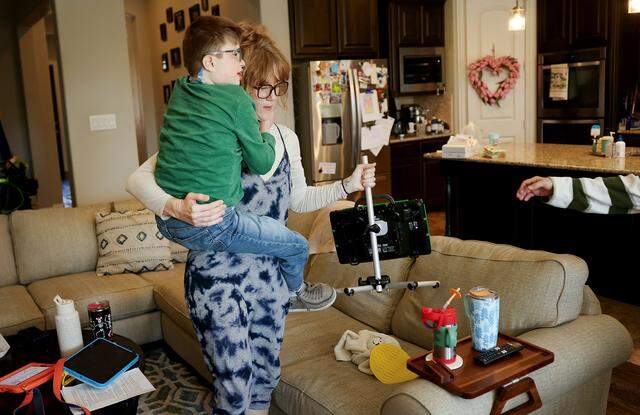 Respite provider Beth Ward carries Luke Lunday, 12, and his augmentative and alternative communication device while helping to care for him at his Trophy Club home on Friday, March 13, 2026. Amanda McCoy amccoy@star-telegram.com
This story was originally published March 18, 2026 at 10:48 AM.

Fort Worth Star-Telegram
Ciara McCarthy covers health and wellness as part of the Star-Telegram’s Crossroads Lab. She came to Fort Worth after three years in Victoria, Texas, where she worked at the Victoria Advocate. Ciara is focused on equipping people and communities with information they need to make decisions about their lives and well-being. Please reach out with your questions about public health or the health care system. Email cmccarthy@star-telegram.com or call or text 817-203-4391.
Fort Worth Star-Telegram
Amanda McCoy is a visual journalist that produces daily and documentary videos. Before moving to Fort Worth in 2018, she spent 11 years telling the stories of the Mississippi Gulf Coast, including the recovery from Hurricane Katrina and the BP oil spill. She is a native of Michigan and graduate of Michigan State University.