
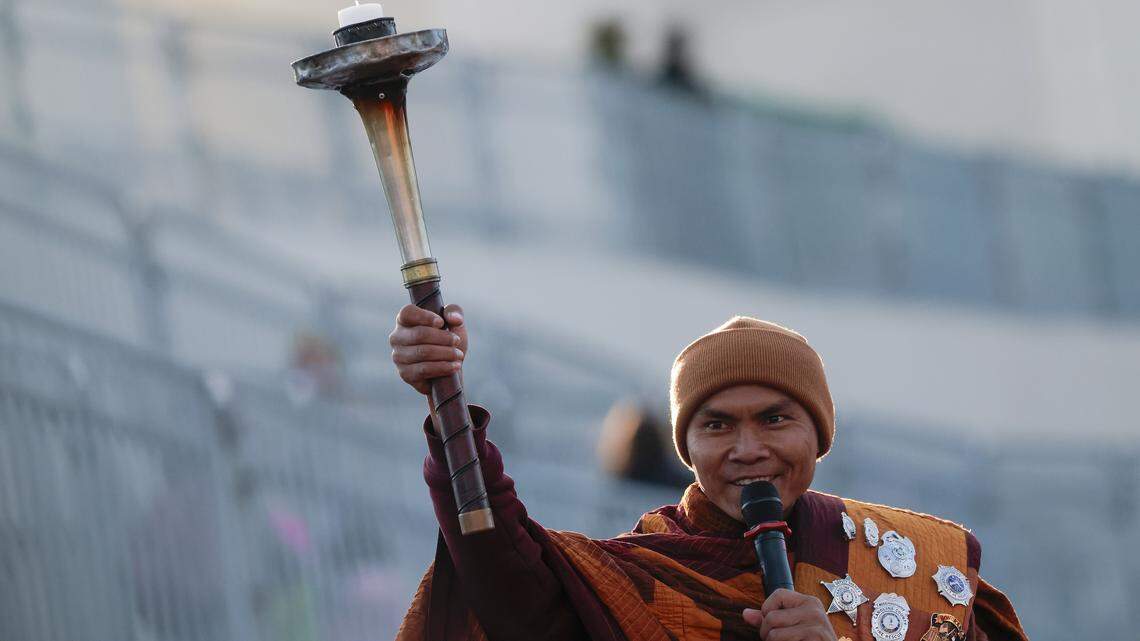
Bhikkhu Pannakara broke down in tears as he stepped onto the Lincoln Memorial, the final stop of his 2,300-mile Walk for Peace.
Thousands of people gathered outside the Washington National Cathedral on Feb. 10 to witness as Pannakara and 18 other Buddhist monks arrived in the U.S. capital to complete the final stretch of their mission to raise awareness of peace and healing.
Pannakara, 44, the vice president of the Hương Đạo Vipassana Bhavana Center in Fort Worth, told the Star-Telegram that it was a special moment for him at the Cathedral as interfaith leaders came together to support their mission. He called it “historic.”
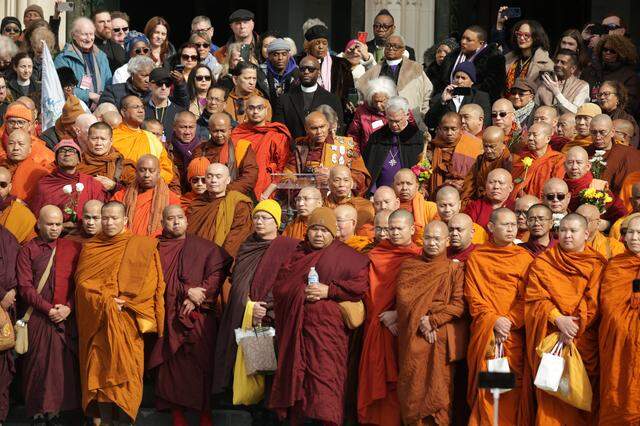 Venerable Bhikkhu Pannakara speaks during an interfaith ceremony after the monks arrived at the Washington National Cathedral on Feb. 10 in Washington, D.C. A group of 18 monks began a 2,300-mile march on Oct. 26 in Fort Worth, Texas, to raise awareness of “peace, loving kindness and compassion” in the United States and the world. Alex Wong Getty Images
“We were not walking physically anymore. Everybody was walking together in spirit, but somehow I felt like there was nothing left in me,” he said. “That’s why I say the emptiness started from there until I got home, and I still had that feeling for three or four days after. I didn’t feel happy; I didn’t feel sad. It was just normal.”
Pannakara said he had been carrying lots of things on his shoulders through the 109-day journey as he led the 18 other monks, and when they finished “letting it all down, that’s probably the reason why I felt empty.”
It all started in Fort Worth
When the COVID-19 pandemic hit, Pannakara said, many people were struggling with their state of mind. Seeing so many people suffer, he began asking himself what he could do as a Buddhist monk to help.
“I came up with a Walk for Peace — just a walk, basically — hoping people would slow down and look at us,” he said. “In doing so, they can let go of everything for a moment, come back within themselves and feel a sense of peace. That’s how I started this walk.”
Months before the walk began in October 2025, the calculations began, he said.
He planned the journey by daily distance — roughly 20 to 30 miles per day and sometimes up to 35 miles. The total number of days was calculated based on that mileage plus extra time for stops, talks, and events along the route, he said.
Day one of the walk started on Oct. 26 as Fort Worth community members lined up outside the Hương Đạo Vipassana Bhavana Center on East Rosedale Street, scattered rose petals on the road and bid farewell to the 19 monks. Two RVs with volunteers, who prepared food for the monks, rode along on the journey.
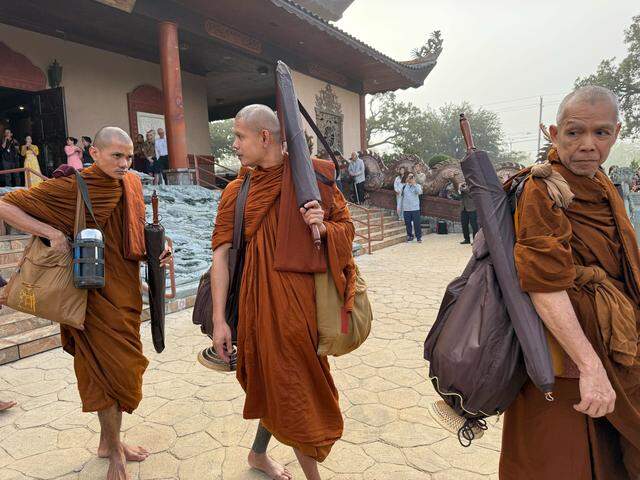 Nineteen Buddhist monks begin a 2,300-mile walk from Fort Worth to Washington, D.C., promoting national healing, unity and compassion on Sunday, Oct. 26. Shambhavi Rimal srimal@star-telegram.com Winter storm challenges the monks
In the beginning, Pannakara said, it was difficult to find volunteers. There were long stretches when no one had signed up, and they simply had to keep walking.
But along the way, more people began following their journey on social media. The official Walk of Peace accounts now have more than 2 million followers on Facebook and 1.3 million on TikTok, where some videos have been watched over 15 million times.
As more people heard about the walk, they started joining in — some for three days or a week — and volunteers were rotated in groups all the way to the end, Pannakara said.
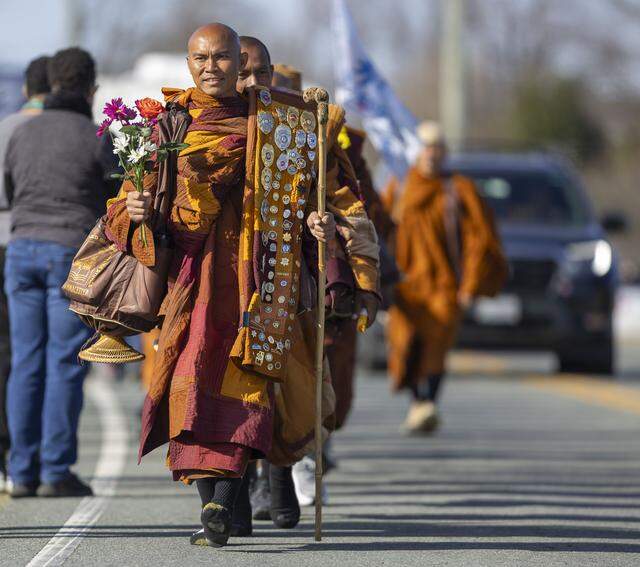 Buddhist monks traverse S. Greensboro Street during the Walk for Peace on Jan. 21 in Liberty, North Carolina. Robert Willett rwillett@newsobserver.com
 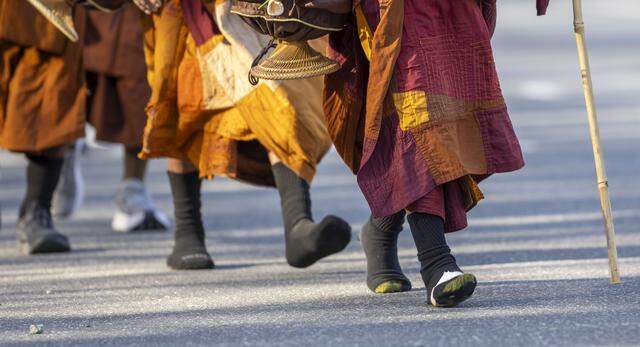 Buddhist monks, in stocking feet, walk along U.S. 421 in Randolph County, North Carolina, during the Walk for Peace on Jan. 21. Robert Willett rwillett@newsobserver.com
The walk brought its own challenges, including a setback in December near Houston when one of the monks, Bhante Dam Phommasan, was hit by a car while walking and had to have his leg amputated.
“We just took two days off to make sure that our brother monk is well taken care of and safe — after we continued our journey,” Pannakara said.
“When we take on this mission, we set aside our lives. Anything could happen,” the lead monk said, adding that it did not scare him or his team.
When they reached Louisiana, the temperature was freezing. At night there was so much cold moisture that it built up inside their tents. “We slept outside, so we were soaking wet in the freezing cold,” he said.
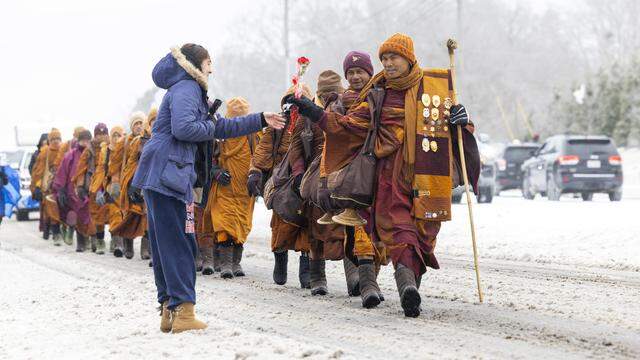 Despite winter weather conditions, a procession of Buddhist monks walks along Buffaloe Road on Jan. 25 in Raleigh, North Carolina. The monks made a 2,300-mile pilgrimage from Texas to Washington, D.C., as part of the Walk for Peace, an effort to promote peace, compassion and national unity. Travis Long tlong@newsobserver.com
Pannakara said the conditions were especially difficult in Virginia during a snowstorm, when icy roads made walking dangerous. Those were some of the toughest days, he said, because their fingers and feet felt frozen.
“For our bodies, we wear thermal layers underneath, so that helps a little,” he said. “But breathing is hard. When we cover our noses, we can’t get enough air. We need a lot of air when we walk, and when the cold hits our lungs, we end up coughing a lot.”
“We are in pain every day — bleeding, all kinds of injuries,” he said. “When it hurts badly, of course we react a little but for me, when I walk, I just pay full attention to my walk and cultivate on the breathing.”
The monks did not waver in their commitment to continue walking, Pannakara said. “Even if we sacrifice our lives, we are going to finish this journey,” he said. “That is our goal and our determination. Whether it’s freezing or not, we will keep walking and do our best in that weather.”
.JPG "RAL_012426-MONKS-KLM-04 (1).JPG") A person holds a bouquet of flowers while awaiting a procession of Buddhist monks at Dorothea Dix Park as a part of the Walk for Peace on Jan. 24 in Raleigh, North Carolina. Kaitlin McKeown The News & Observer Healing people as they moved
A person holds a bouquet of flowers while awaiting a procession of Buddhist monks at Dorothea Dix Park as a part of the Walk for Peace on Jan. 24 in Raleigh, North Carolina. Kaitlin McKeown The News & Observer Healing people as they moved
As the walk continued, hundreds of people waited for a glimpse of the monks. Adults and children, as seen in social media videos, lined the road to greet the travelers with food offerings, flowers and even treats for Pannakara’s dog Aloka.
Pannakara said he never expected a large turnout and when the crowd grew, it was sometimes overwhelming.
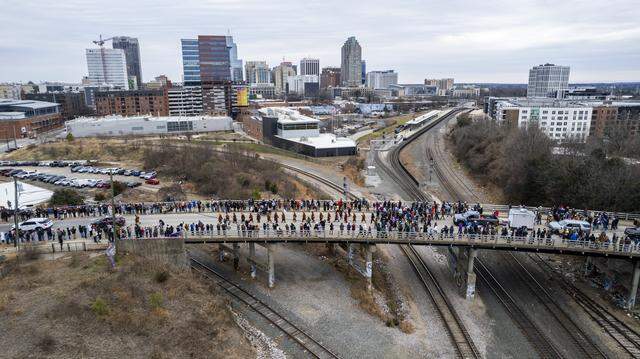 A procession of Buddhist monks walks across Boylan Bridge in downtown Raleigh, followed by hundreds of well-wishers on Jan. 24. The monks made a 2,300-mile pilgrimage from Texas to Washington, D.C., as part of the Walk for Peace, an effort to promote peace, compassion and national unity. Travis Long tlong@newsobserver.com
Even when the monks arrived late, they were greeted by people standing in the cold for hours waiting for them. “Seeing people like that just gave me more strength,” Pannakara said.
“And that is the reason why sometimes we walk very fast to try to get there, so people don’t have to wait,” he said. “We were happy because people were coming out to support us and show love and hospitality, but it also told me that people are deeply suffering. That’s why so many of them came out for this mission.”
The people who stood out to Pannakara were the ones who came to him and said, “you saved my life,” he said. “We just walked, we didn’t do anything — but somehow it’s giving them hope to stand up again.”
All the love along the way was also met with some criticism.
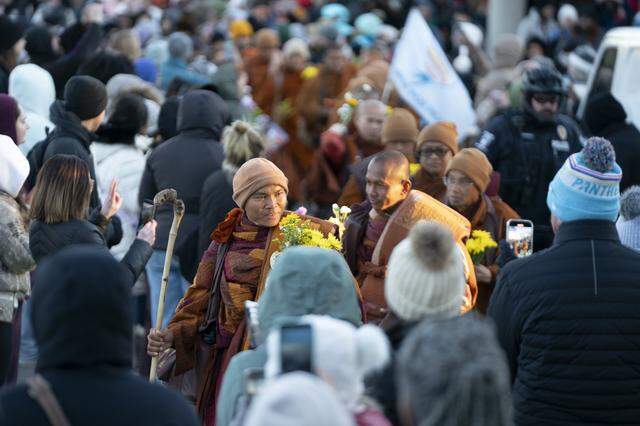 The venerable Bhikkhu Pannakara leads Buddhist monks as they continue the Walk for Peace on Jan. 15 in Charlotte, North Carolina. The monks walked from Fort Worth, Texas, to Washington, D.C., spreading a message of mindfulness, unity and kindness while requesting that Vesak, Buddha’s birthday, be recognized as a U.S. federal holiday. Sean Rayford Getty Images
There were days when they were followed by protesters, Pannakara said.
Pannakara said he felt that because of suffering and hatred, the protesters did not see anything else despite explaining that the mission was not about religion, conversion or politics, it was “purely just peace, and we just want to raise awareness of peace because people suffer,” he said.
“I always said, may you be well, happy and peaceful, and gave them a smile and continued my walk,” he said.
A loyal companion: Aloka the peace dog
Aloka is a very special dog, Pannakara said. During a similar walk in India, many dogs followed the monks but would stop after a few days. Aloka stayed.
“I name him Aloka, (which means) light — hoping that he will find the light of wisdom to liberate all kinds of suffering, to attain the honor, to become enlightenment,” Pannakara said.
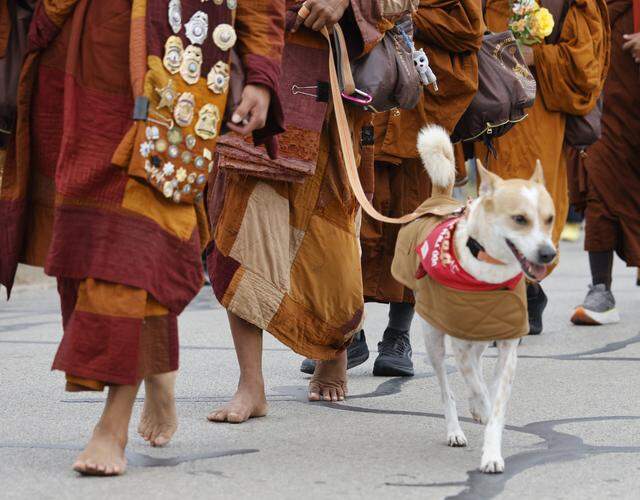 Aloka the peace dog walks with Buddhist monks who traveled 2,300 miles to Washington, D.C., for peace as they arrive back at the Hương Đạo Vipassana Bhavana Center in Fort Worth on Feb. 14. Bob Booth Special to the Star-Telegram
The dog was a steady companion for the monks as they traveled across states including Texas, Alabama, Georgia, South Carolina and North Carolina. All the way through the completion of their walk to Washington, D.C., the pup gathered his own social media fans with over 1 million followers on his personal Facebook account.
Pannakara said he believed that Aloka came to this world and had a duty. The monk shared his plans to set up Aloka Foundation, a charity in the dog’s name to support animals around the world.
The homecoming
On Valentine’s Day, after the monks completed their almost four months’ walk, they returned to Fort Worth in a charter bus. Community members cheered as they welcomed the monks home.
Among the millions of people following the monks’ journey online, hundreds traveled from as far as Oklahoma and Wisconsin to Fort Worth to attend the final homecoming.
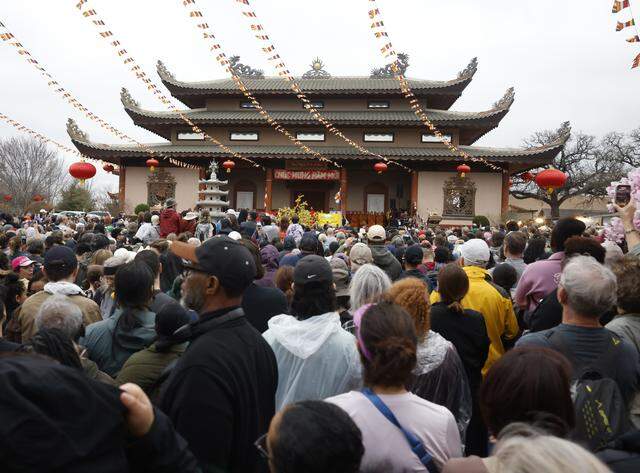 More than 1,200 people fill the grounds to celebrate with the Buddhist monks who walked 2,300 miles to Washington, D.C., for peace as they arrive back at the Hương Đạo Vipassana Bhavana Center in Fort Worth on Feb. 14. Bob Booth Special to the Star-Telegram
 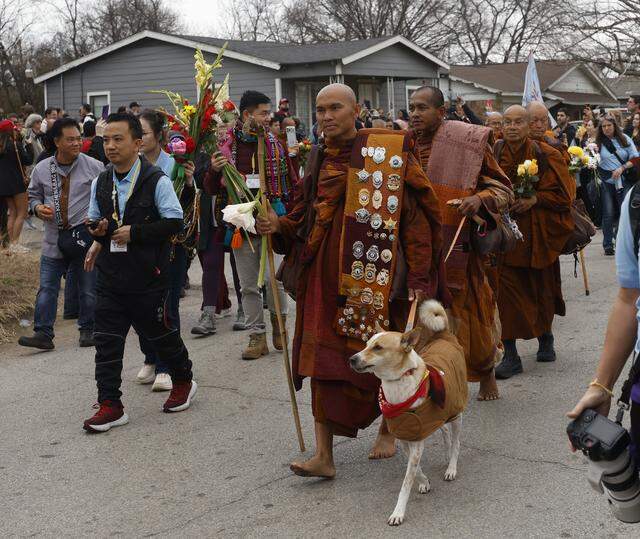 Buddhist monks who walked 2,300 miles to Washington, D.C., for peace arrive back at the Hương Đạo Vipassana Bhavana Center in Fort Worth on Feb. 14. Bob Booth Special to the Star-Telegram
Rain poured as Pannakara and his team reached the Hương Đạo temple, but people shared their umbrellas, stood together and stayed to hear his final message.
“Today is going to be my peaceful day — that statement is very simple yet, but it’s very, very strong and very powerful,” Pannakara said.
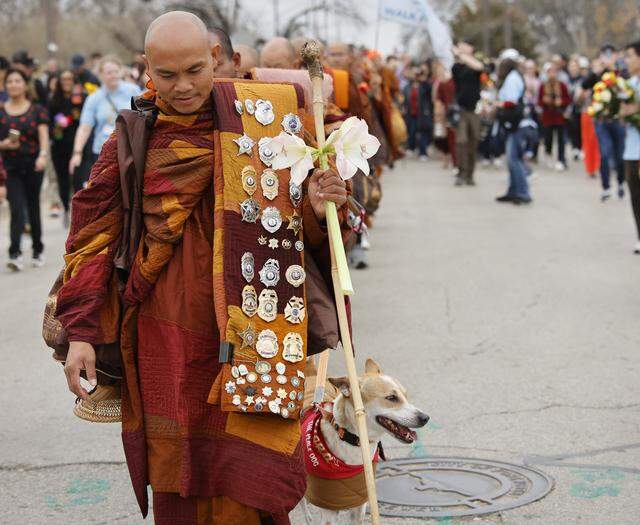 Buddhist monks who walked 2,300 miles to Washington, D.C., for peace arrive back at the Hương Đạo Vipassana Bhavana Center in Fort Worth on Feb. 14. Bob Booth Special to the Star-Telegram
Related Stories from Fort Worth Star-Telegram

Fort Worth Star-Telegram
Shambhavi covers crime, law enforcement and other breaking news in Fort Worth and Tarrant County. She graduated from the University of North Texas and previously covered a variety of general assignment topics in West Texas. She grew up in Nepal.