
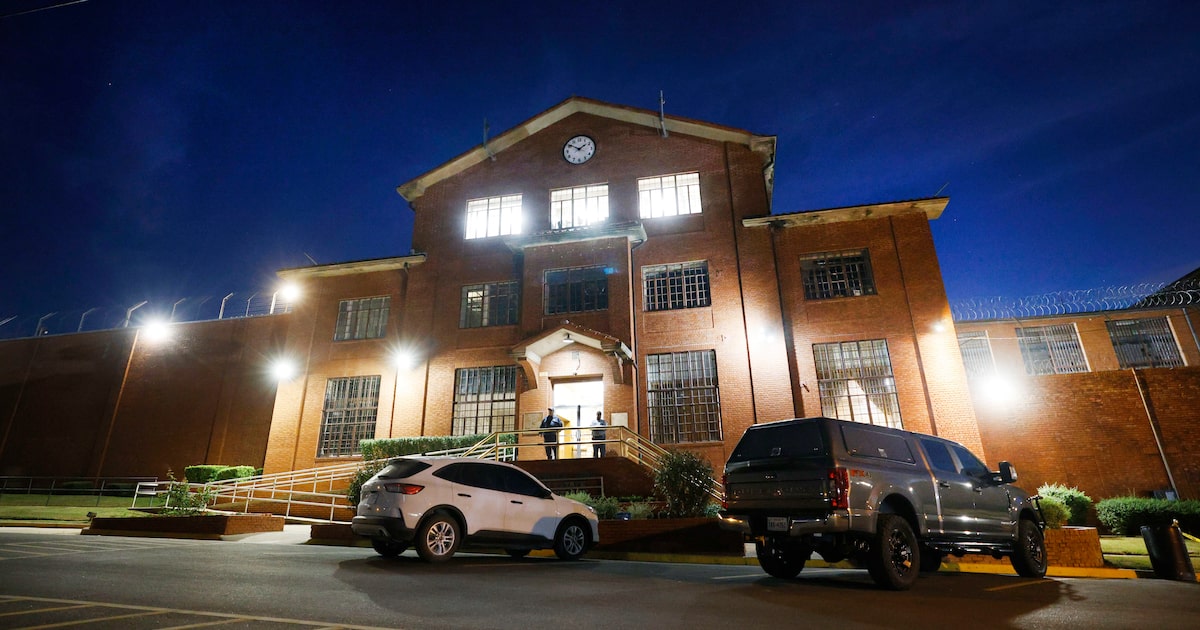
A month out from James Broadnax’s execution date, another man has admitted to pulling the trigger during the deadly 2008 robbery that landed Broadnax on death row, according to court documents — and a written confession — obtained Wednesday by The Dallas Morning News.
Broadnax, 37, is scheduled to be put to death by lethal injection on April 30 in Huntsville. He was condemned by a Dallas County jury in 2009 for the deaths of Stephen Swan, 26, and Matthew Butler, 28, outside their Garland music studio.
Broadnax, formerly of Texarkana, was 19 at the time of the murders. According to previous reporting from The News, Broadnax and his cousin, Demarius Cummings, had set out to rob Swan and Butler, but left with only $2 in cash and a 1995 Ford.
Cummings and Broadnax were both convicted of capital murder in separate trials. Broadnax, who was tried as the triggerman, was sentenced to death, while Cummings was sentenced to life in prison without the possibility of parole.
Breaking News
“This new evidence fundamentally undermines the State’s case for Mr. Broadnax’s conviction and death sentence,” Broadnax’s lawyers wrote in a petition sent Wednesday to the Texas Court of Criminal Appeals. “Neither Mr. Broadnax’s conviction for capital murder nor his death sentence would have occurred had the jury known that Mr. Cummings, and not Mr. Broadnax, shot the two victims.”
Related

In a written declaration signed March 11, Cummings said it was his idea to rob Swan and Butler on June 19, 2008, and that he obtained the pistol that was used during the shooting.
“Following the crime, James and I spoke about the story we would tell,” Cummings, 37, wrote. “I persuaded James to take the blame for shooting the two victims.”
Cummings explained that part of his reasoning was that he had already been convicted of other crimes, including burglaries, while Broadnax had no criminal record other than a charge pertaining to marijuana possession.
Cummings said he has maintained that narrative for more than 15 years, until a meeting late last month with Broadnax’s lawyer, Steven Herzog, in which Cummings was informed that his cousin’s execution date had been set.
“The fact that James received a death sentence for these crimes, while I was the one who shot the victims, has been weighing on my conscience, particularly as I have become more spiritual during my years in prison,” Cummings wrote.
Cummings said the fact only his DNA was found on the murder weapon — not Broadnax’s — is proof he’s telling the truth.
According to court documents, Broadnax’s DNA was never found on the gun or the victims, while Cummings’ DNA was found on both.
“I want to clear my conscience and do not want James to be executed for shooting two people when I was the one who committed those acts,” he said, adding: “It was my decision to come clean.”
Broadnax’s legal team has also written to Dallas County District Attorney John Creuzot asking his office to join in the effort to stay Broadnax’s execution.
Broadnax, a Black man, has long argued his trial infringed on his constitutional rights, namely the 14th Amendment’s guarantees of equal protection and due process.
Before the Texas Court of Criminal Appeals, Broadnax has claimed prosecutors used race as a basis to strike prospective jurors, leaving him with a nearly all-white jury. He has also contested the use of rap lyrics as evidence of his danger to the public.
In Texas, jurors in capital murder cases determine whether the defendant will be sentenced to death or life without the possibility of parole.
To do so, they must decide whether there is a probability the defendant would commit criminal acts of violence that would constitute a continuing threat to society.
This is a developing story and will be updated.
Travis Scott among artists fighting use of rap lyrics in Dallas County death penalty caseThey were exonerated in shaken baby cases. Can their podcast help save Robert Roberson?