
Dominic Anthony Walsh/Houston Public Media
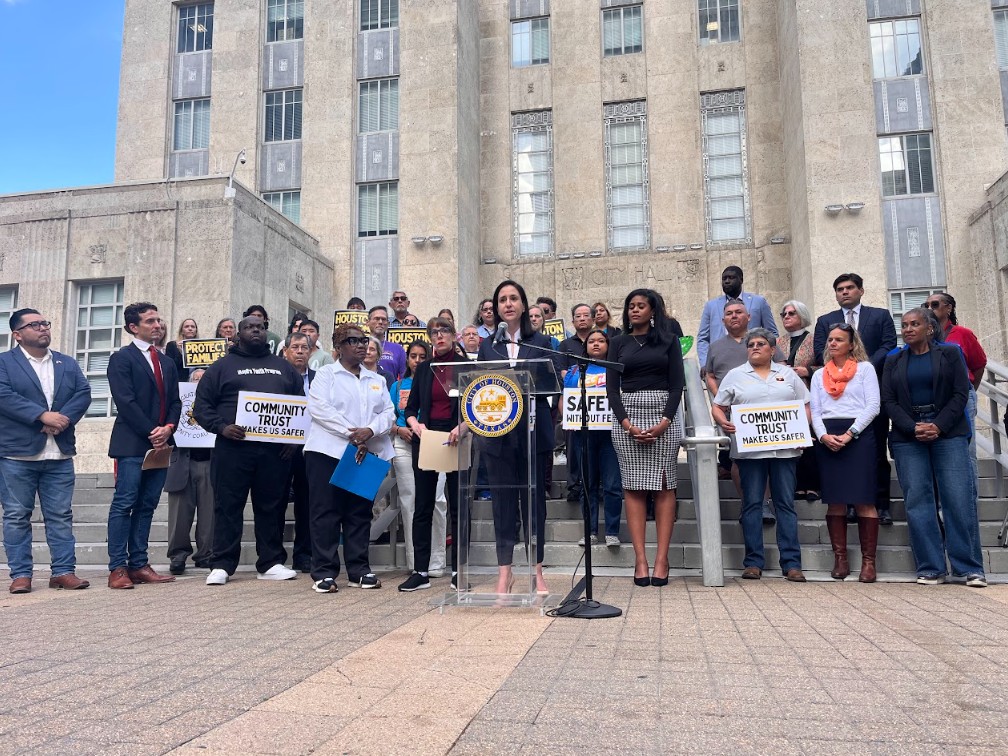
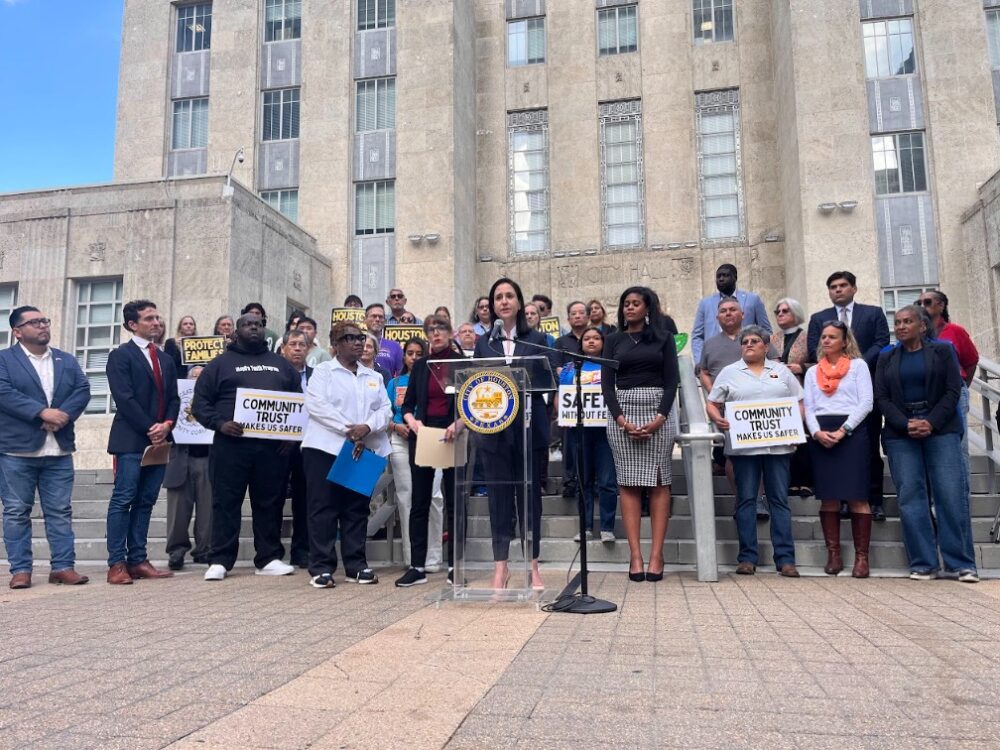
Houston City Council member Alejandra Salinas, at podium, speaks on March 19, 2026, about a proposed city ordinance intended to reduce the number of calls about immigration warrants from the Houston Police Department to U.S. Immigration and Customs Enforcement.
In an unprecedented show of opposition to one of Mayor John Whitmire’s policies, members of the Houston City Council are pushing for an ordinance intended to reduce coordination between the Houston Police Department (HPD) and U.S. Immigration and Customs Enforcement (ICE).
Under current policy, HPD officers are required to contact ICE when they encounter individuals who have certain immigration warrants. The proposed ordinance would give officers discretion over whether or not to contact the federal agency.
The proposal comes after a series of Houston Chronicle reports revealed a ramp-up in coordination between HPD and ICE. Responding to the coverage last week, Houston Police Chief Noe Diaz confirmed officers turned over 85 people to ICE in 2025.
Sign up for the Hello, Houston! daily newsletter to get local reports like this delivered directly to your inbox.
The measure faces political and legal hurdles. Whitmire has vociferously defended HPD’s actions — and raised the spectre of a state or federal crackdown on Houston should city officials take steps to curtail collaboration with ICE.
Click here for more inDepth features.
Dominic Anthony Walsh/Houston Public Media
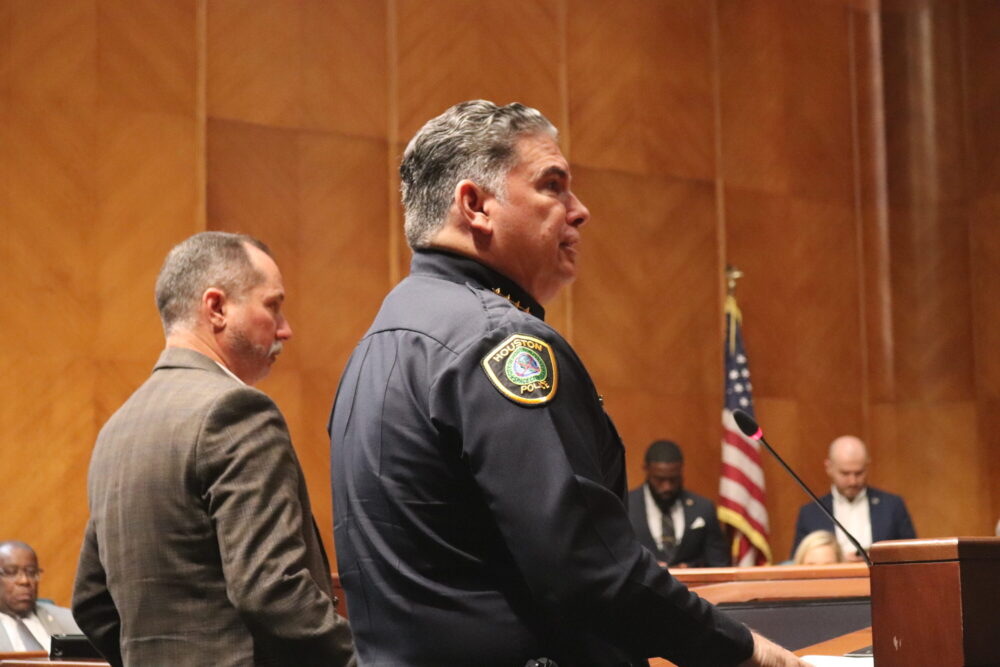
Houston Police Chief Noe Diaz, right, and Houston Police Officers’ Union president Douglas Griffith speak at a Houston City Council meeting on Wednesday, May 21, 2025.
City council members wield new policymaking power
In a letter to the city secretary Wednesday morning, city council members Alejandra Salinas, Abbie Kamin and Edward Pollard took the first step to place the new policy on the agenda for formal consideration.
Their ordinance would change HPD’s approach to “administrative” immigration warrants. Unlike criminal warrants signed by a judge or magistrate, administrative warrants are issued by ICE itself and are civil, not criminal.
According to HPD, ICE added more than 700,000 administrative warrants into the National Crime Information Center database used by officers last year — expanding its dragnet to capture more people wanted for alleged violations of immigration law.
The proposed ordinance would give HPD officers discretion over whether or not to contact ICE about individuals with immigration warrants, walking back the current policy requiring them to do so.
The new ordinance would also explicitly tell officers they “may temporarily detain an individual only as long as reasonably necessary to complete the legitimate purpose of the initial stop or investigation,” adding, “An ICE administrative warrant is civil in nature and, alone, does not justify a stop, arrest, or continued detention by local law enforcement, like HPD.”
Salinas, Kamin and Pollard are able to get the proposal on the city council’s agenda for consideration under a relatively new power granted by Proposition A — an amendment to the city’s charter overwhelmingly approved by voters in 2023. Before the amendment passed, the mayor held sole authority over agenda items considered by the city council during its weekly meetings. The charter update allowed three or more council members to add items to the agenda.
Macie Kelly / Houston Public Media
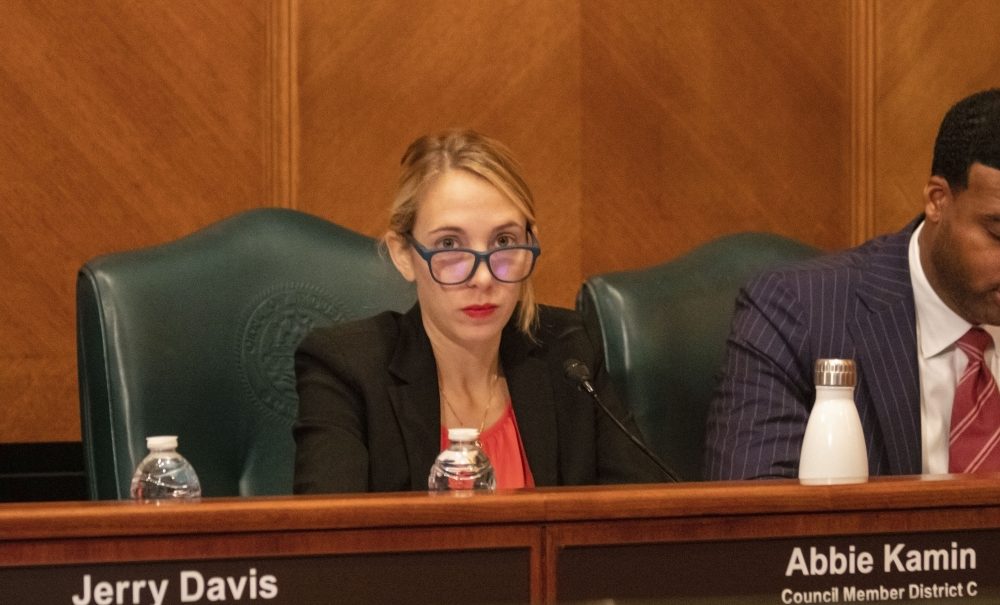
Houston City Council member Abbie Kamin at a council meeting on Jan. 15, 2020. At right is fellow council member Edward Pollard.
Their proposal marks the first major challenge to Whitmire’s policies by city council members using the new powers.
Whitmire has consistently defended HPD’s coordination with ICE, arguing the city’s approach is both required by state law and politically necessary to avoid the type of crackdowns seen in Minneapolis and other cities.
“We’ve been very smart in Houston,” Whitmire told Houston Public Media last week. “I would like to think part of it is the tone that I set. I did not politicize the immigration or even the ICE involvement. But I was very clear and consistent. We are HPD — we enforce city laws, state laws. We follow Senate Bill 4, which says you have to let ICE operate. So the fact that we are not being confrontational, we’ve actually protected the undocumented community.”
ICE did not immediately respond to a request for comment.
A coalition of more than two dozen advocacy groups and labor organizations — including the Houston Federation of Teachers and the local branch of the League of United Latin American Citizens — penned an open letter in support of the proposed ordinance.
After review by the city’s legal department, the proposed ordinance is expected to appear on the city council’s agenda in April.
Lack of clarity about existing policy
At a news conference last week, Diaz announced Houston police officers were “receiving a directive designed to ensure consistency and clarity in every situation, effective immediately.”
“When an officer receives a hit for an administrative immigration warrant, a sergeant will be called to the scene to review the circumstances, confirm the facts and verify the existence of the warrant. This ensures that any decisions made in the field are carefully reviewed and supported by a supervisor,” Diaz added. “Also, there will be a 30-minute window for federal law enforcement to respond to the scene if they choose to.”
The update came after the Houston Chronicle revealed officers had transported individuals with administrative warrants to ICE officers — a revelation Whitmire characterized as “a violation of Houston Police Department policy” during an interview with Univision Houston. During the news conference last week, Diaz revealed such transportation occurred at least 17 times in 2025.
Lucio Vasquez / Houston Public Media
Pictured is Houston City Attorney Arturo Michel at a city council meeting in 2021.
In a brief interview on Wednesday, Houston City Attorney Arturo Michel argued the policy outlined in the directive circulated to officers takes into account the Fourth Amendment — which prohibits “unreasonable searches and seizures.”
Houston Public Media: The 30-minute wait for administrative warrants related to ICE — I’m hearing conflicting claims about whether or not that’s constitutional under the Fourth Amendment. What’s your perspective?
City Attorney Arturo Michel: Well, the circular states, I think more towards the beginning, that HPD will comply with all laws, constitutional, and specifically references the Fourth Amendment. And under the Fourth Amendment, local law enforcement can only hold someone for the period of time needed to investigate and process a state law violation. So, my understanding is HPD will — they selected the 30 minutes because typically that’s how long it takes, but if they finished at minute 29, then the person would be free to go.
HPM: So, the policy is actually once the traffic stop is concluded, the person’s free to go regardless of the administrative warrant?
Michel: Yes. The law would require that once you finish your state law processing or investigation, then at that point, we don’t have the ability to hold them under the Fourth Amendment.
A copy of the circular directive shared with Houston Public Media by Salinas’ office conflicted with the policy described by Michel.
In a brief reference to the Fourth Amendment, the circular states the update “seeks to ensure we are handling these incidents as expeditiously as possible and in continued compliance with all local, state and federal laws, including the 4th Amendment of the U.S. Constitution.”
But it goes on to say that even in the absence of local criminal charges, an HPD supervisor “will ensure that the (ICE) agent arrives to take custody within 30 minutes of the warrant verification.” The circular continues: “If the timeline cannot be met, the officer shall release the individual …”
It did not explicitly tell officers that they must release individuals if there’s no reason to hold them outside the administrative warrant.
HPD deferred comment to Michel and the mayor’s office, which did not respond to requests for clarification.
A legal gray zone
In interviews with Houston Public Media, legal experts presented conflicting perspectives on police officers’ legal obligations during encounters with individuals who have administrative immigration warrants.
“If this is a temporary traffic stop, meaning it’s not an arrest situation, the police cannot lengthen the length of the attention for unrelated purposes,” said David Kwok, director of the Criminal Justice Institute at the University of Houston Law Center. “In the case of a civil, non-judicial warrant — if that’s all they have, is that enough, or does it become unconstitutional for them to continue to hold someone while they contact ICE and ICE comes out to pick up that person? This is a relatively untested area of law.”
Civil rights advocates, including attorneys with the Texas Civil Rights Project and ACLU, argued the matter is black-and-white. Because administrative warrants are civil and not signed by a judge, in their eyes, officers cannot prolong traffic stops to wait for ICE agents to respond. In a letter to Whitmire and the city council this week, they argued the department’s current policies could “violate clearly established laws.”
They pointed to case law decided under the Fourth Amendment, which prohibits unreasonable searches and seizures.
“The issue with the administrative warrants is that they are a platypus,” said Tom Hogan, professor of law at the South Texas College of Law in Houston. “Nobody’s quite sure exactly what they are. They’re not the same thing as a judicial arrest warrant, but they’re more than a subpoena. So, nobody’s exactly sure how to deal with them on the day-to-day law enforcement on the street side.”
Hogan said the question of what police officers can and cannot do when they encounter someone with an administrative warrant “is certainly something that is going to be finally resolved in a courtroom somewhere.”
The matter is further complicated by state law. Senate Bill 4, passed by the Texas Legislature in 2017, outlawed local municipalities from curtailing police department collaboration with ICE. Seth Chandler, professor of law at the University of Houston Law Center, said the type of policy change being considered in Houston could draw scrutiny from the state government.

JORGE SANHUEZA-LYON / KUT
Demonstrators gather at the Capitol to protest Senate Bill 4.
“I think a number of blue cities would prefer not to cooperate with ICE here because they believe that ICE is enforcing unjust immigration policies, and so what we have here is really shadowboxing,” Chandler said. “If I were (Attorney General) Ken Paxton or someone like that, I would say that making it compulsory for the police to do something if there’s a counterfeiting claim or another warrant against you, but making it optional if it’s just an immigration administrative warrant, that that might constitute a material limitation on the enforcement of immigration laws.”
Paxton’s office did not respond to a request for comment.
Michel, the city attorney, said he can see both sides of the argument.
“We’re in the process of seeing what other cities are doing with that, but I think the issue that arises with that is you can look at discretion as not limiting — not materially limiting cooperation that SB 4 requires,” Michel said. “On the other hand, when you get a hit and it asks that you contact ICE … giving the officer the permission not to call could be seen as materially limiting.”
Houston’s current policy runs parallel to those in San Antonio and Austin.
In San Antonio, officers are required to contact ICE about individuals with administrative warrants. Department policy does not specify if or how long officers should wait for agents to respond.
The Austin Police Department requires officers to contact their supervisors about administrative warrants, and they have discretion over whether or not to contact ICE. Officers cannot “unreasonably prolong a detention to contact ICE.” In order to hold someone while ICE responds, officers must obtain permission from even further up the chain of command.
The proposed change would bring Houston in line with Dallas, where officers have discretion about whether or not to call ICE and are prohibited from prolonging stops to wait for officers to respond.
Whitmire’s office did not immediately respond to a request for comment on the proposed ordinance.