
Wendy Watson loved the students at the University of North Texas: bright, diverse and often the first in their family to go to college. The job, which included teaching political science and advising students, was demanding, but rewarding. Each year, Watson convinced hundreds of students they had what it took to be lawyers.
Watson, 56, came to UNT in 2005, and put down roots. Bought a house. Adored the neighbors.
Then, in 2023, Texas leaders started cracking down on diversity, equity and inclusion programs at public colleges. They deemed the institutions as overtaken by liberal bias. They accused professors of indoctrinating students. They proposed extending the DEI ban into classroom instruction.
Watson, who uses they/them pronouns, watched it unfold with growing worry: the shuttering of the gender and sexuality employee group Watson was part of, the removal of “race” and “equity” from dozens of course titles, even though no law required it.
The Education Lab
Related
It left Watson convinced school leaders would not stand by students and faculty if state laws restricted what could be taught in classrooms. They half-expected to see an email appear in their inbox saying their “Gay Rights in the Constitution” class had been axed.
Watson didn’t wait around to find out.
For some Texas professors, the overhaul of higher education, spearheaded by conservative state leaders, has taken an emotional toll. Some professors are making drastic career choices, leaving the profession or, like Watson, fleeing the state, and heading for roles where they say they no longer live in a climate of fear.
Related
After 2023, the workload suddenly felt unbearable. Watson constantly looked over their shoulder. They couldn’t keep food down, nibbling on protein bars for months, and underwent gallbladder surgery. Before they walked into the classroom, they prayed that a turn of phrase or thorny discussion wouldn’t cost them their job.
“It felt like we were going to have to sanitize to the point of lying,” Watson said. “It would be a sin of omission.”
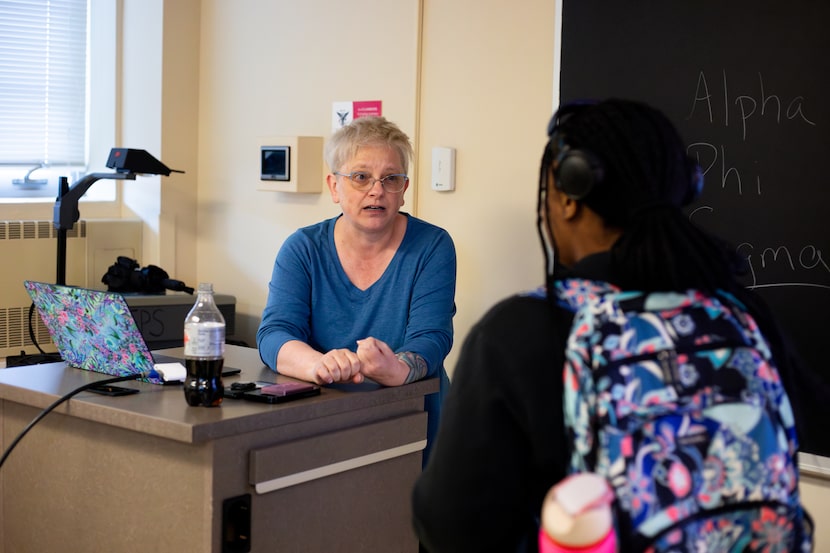
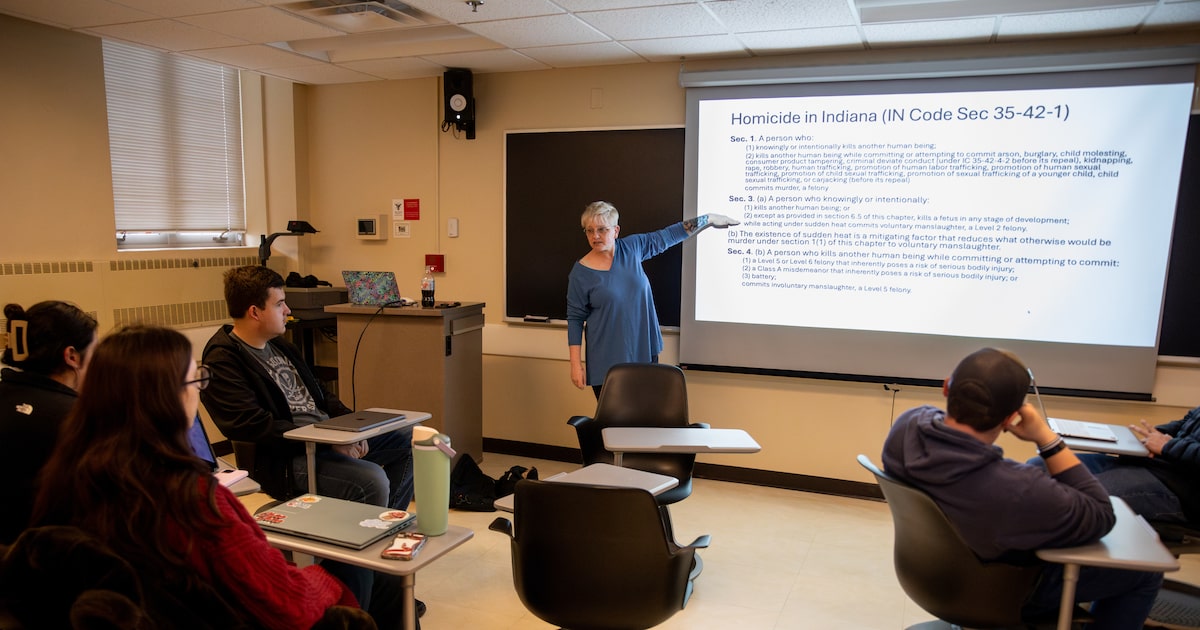
Dr. Wendy Watson, a professor at Ball State University, teaches in North Quad on Friday, March 13, 2026 in Muncie, Ind. Kaiti Sullivan for Dallas News
Kaiti Sullivan
An internal struggle followed. If Watson left Texas, it might seem like a white flag. If Watson stayed, the stress could kill them.
Watson ultimately decided to take the first teaching job that got them out of the state.
A spokesperson from the University of North Texas did not respond to multiple requests for an interview about faculty retention and recruitment.
‘Unnecessary chaos’
For years, Texas’ public universities have been hotspots for the state’s larger culture wars, from debates over DEI programs to free expression. Now, under increasing pressure from state leaders to address a perceived liberal bias in the classroom, campuses are ensnared in battles over the very purpose of higher education.
Related
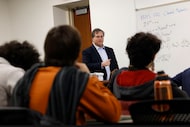
“It’s a battle for the heart and soul of universities and colleges: an open learning environment,” said Brian Evans, president of the Texas Conference of the American Association for University Professors.
The fight, often between academics and Republican leaders, isn’t just impacting what can be taught in classrooms, but who remains to teach it.
For some, these professors’ career-changing decisions warn of a brain drain — a mass exodus of Texas’ most intellectually capable. The result could be years of tumultuous recruitment and retention of educators and researchers. Democrats and professors have warned that an exodus of the best and brightest faculty would weaken the caliber of education offered at state universities, threaten Texas’ cutting-edge research and undercut students’ workforce readiness.
Related

“It impacts everything,” Evans said. “It’s our welders, our nurses, our social workers, our lawyers. It’s affecting all the skills that students learn to get ready to be successful in the workplace and be engaged citizens in our society.”
Public data on how many Texas professors have left or are eyeing exits is sparse, making it difficult to determine the extent of departures.
“I still believe there are people who are going to want to come to some of the premier institutions that we have here. I don’t believe it’s going to just fail,” said state Rep. Donna Howard, D-Austin, vice chair of the Committee on Higher Education. “But it means we’re going to have some struggles and some years of uncertainty that don’t need to be there. It’s unnecessary chaos.”
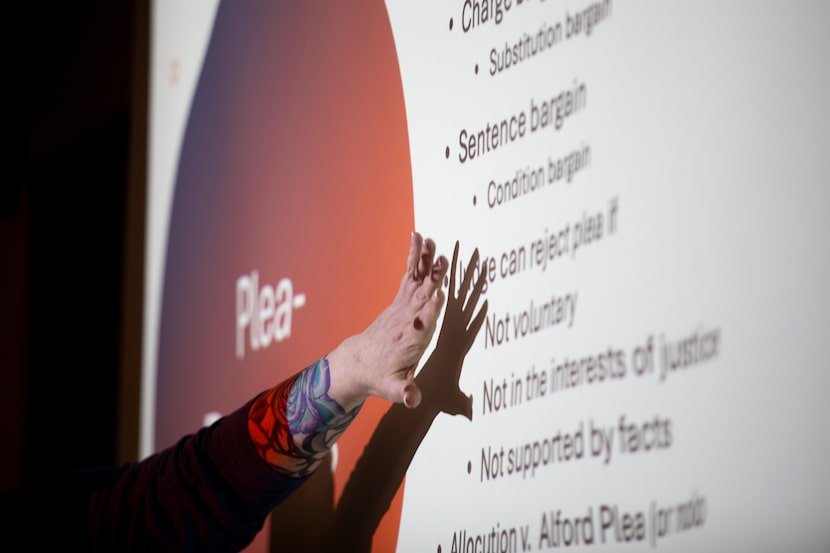
Dr. Wendy Watson, a professor at Ball State University, teaches in North Quad on Friday, March 13, 2026 in Muncie, Ind. Kaiti Sullivan for Dallas News
Kaiti Sullivan
Supporters of higher education reform have pushed back on such predictions, arguing that addressing ideological biases and aligning universities with workforce needs will attract more professors, students and jobs to Texas.
“We’re just not seeing [a brain drain],” said state Rep. Matt Shaheen, R-Prosper, and a member of the Committee on Higher Education. “The state of Texas is very purposeful and very serious on developing our next workforce and providing opportunities for our students. I think that is highly attractive to individuals that are in education, because they want to invest in students and do what’s best for them.”
Texas Tech University System Chancellor Brandon Creighton said the system is seeing record-high faculty interest amid “the momentum” in Texas. Creighton is a former senator and the architect of recent conservative laws reshaping higher education.
“Across the Texas Tech University System, we’re seeing the opposite trend,” Creighton said in a statement. “We’re experiencing record applications and growing interest from top-tier faculty nationwide who are choosing Texas because of our world-class institutions, commitment to merit and focus on impact.”
He added that national search firms are bringing “exceptional candidates” who recognize that “innovation is supported, excellence is rewarded and faculty can do their best work for students and the future” at Texas’ universities.
Gov. Greg Abbott has prioritized increased oversight of taxpayer-funded universities, saying it is necessary to hold professors who push “woke agendas” accountable.
“Texans are going to college to look for a profession and to become skilled and to be able to get a job. … We don’t believe that universities are places where students learn to identify ideologically or categorize themselves by their political identity,” said Sherry Sylvester, a distinguished senior fellow at the Texas Public Policy Foundation, a conservative think tank. “So there’s a shift in the culture. We’re just beginning to see it. The faculty see it, and some are not happy.”
A 2025 AAUP survey of southern faculty, including around 1,100 Texas professors, found that about a quarter of Texas respondents said they have applied for out-of-state higher education jobs in the last two years. More than a quarter said they intend on searching for such positions soon.
Faculty cited the state’s broad political climate as the top reason they wanted to leave for another job. Many Texas professors who said they had applied for an out-of-state job cited the political climate, academic freedom, shared governance and DEI issues.
A majority of Texas respondents, around 60%, said they wouldn’t encourage graduate students or faculty colleagues to seek a job here.
Sylvester pushed back on the idea there is a “mass exodus” of faculty from Texas campuses.
“I have no doubt that professors have many conversations saying, ‘I’m going to leave and I wouldn’t invite anyone to come to Texas,’” Sylvester said. “… But the fact is teaching jobs are coveted positions, and Texas has some of the biggest and most well-resourced universities in the country.”
Howard said her office is planning to propose lawmakers study the impact of recent state laws on faculty and student retention and recruitment ahead of the 2027 legislative session.
‘I only had so much energy’
In fall 2025, Watson moved to Muncie, Indiana, to teach criminal law at Ball State University.
“I bailed. I felt awful leaving my students, but I only had so much energy. I couldn’t fight on all those fronts,” Watson said. “I just couldn’t.”
The days are less stressful now. The crushing anticipation of suddenly losing their job has mostly dissipated, even as Indiana’s public universities face similar restrictions from state leaders as Texas’ schools.
“I feel like I got out of the front lines of battle,” Watson said. “And now I’m in a place where the issues are still happening but they feel a little less dire.”
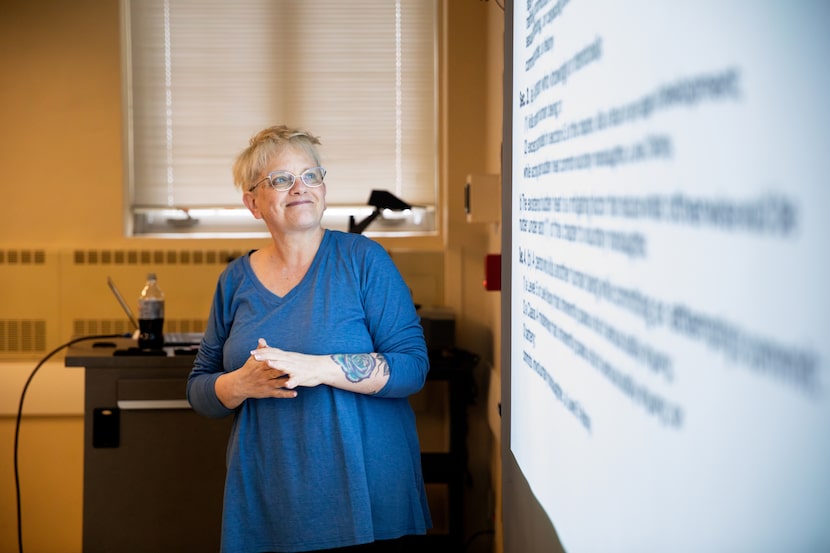
Dr. Wendy Watson, a professor at Ball State University, teaches in North Quad on Friday, March 13, 2026 in Muncie, Ind. Kaiti Sullivan for Dallas News
Kaiti Sullivan
Watson tells nervous colleagues, “I know it feels bad, but it’s worse in Texas.”
Still, leaving meant giving things up. They get misty-eyed talking about their former students. A political scientist by training, Watson sometimes feels out of place in Ball State’s criminal justice department.
The move also meant taking a $20,000 pay cut. It was the price to pay for some peace of mind, Watson figured, making it the right choice.
‘When will it end?’
For others, such as Kathleen Kearney, the increased political pressure has brought about an early end to their academic careers.
Before she resigned in September, Kearney, 47, taught nursing ethics and jurisprudence at the Texas Tech University Health Sciences Center’s School of Nursing for more than 16 years.
Kearney began her career as a pediatric nurse, where she was troubled by the inequities she saw — how uninsured children often received worse care, how babies born intersex underwent controversial surgical procedures. So she enrolled in law school in 2002, and then graduate school to teach nurses. In 2009, she was hired by TTUHSC’s school of nursing.
It was her dream job. She worked 30 hours a week, teaching remotely from Dallas, and kept her law practice.
She taught her students that they didn’t just advocate for individual patients, but for communities. Raised Catholic, she believed that faith without good deeds wasn’t enough. That belief, she suspected, was why she became a nurse in the first place.
“You’re trying to do what’s best for the world,” she’d tell her students. Kearney expected to spread that message until the day she retired.
Related
But as lawmakers fanned the flames of anti-DEI sentiment at Texas’ public universities, Kearney grew upset. In early September, nursing professors were told their courses would soon be reviewed for compliance with state law, according to Kearney. She worried she would have to stop talking about topics like gender identity or health equity. If she was required to do so, it would betray her values.
Then conservative activist Charlie Kirk was fatally shot at a university in Utah, and Texas officials called for removing students and teachers who criticized Kirk or cheered his death.
Related
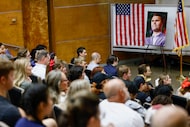
Texas Tech made headlines after a student was arrested and expelled after mocking Kirk at an on-campus vigil. University leaders condemned the behavior and stood by the arrest and expulsion. Critics and free speech advocates raised concerns that the punishment violated free speech protections.
“During sensitive times, it is especially important to remember our higher calling,” then-Chancellor Tedd Mitchell wrote in a September message to the system. “We must be mindful of our words and actions, considerate of one another, and respectful of our colleagues, friends and classmates.”
The dean of the school of nursing similarly sent professors an email that said while “we deeply respect the personal beliefs and values of each individual,” educators at a public institution must remain “compliant with state and federal law.”
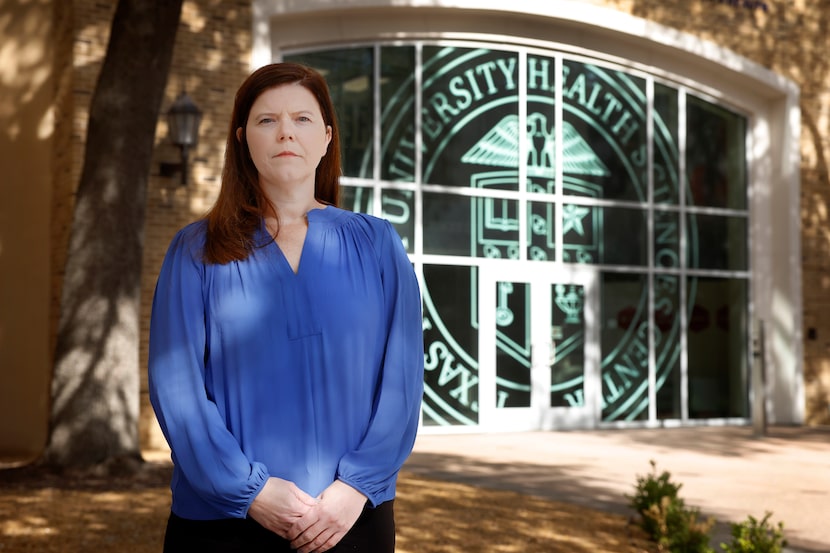
Kathleen Kearney is a nursing law/ethics professor who recently resigned from the Texas Tech University Health Sciences Center. She is photographed at the TTUHSC Dallas campus, January 12, 2026.
Tom Fox / Staff Photographer
“When will it end?” thought Kearney, who increasingly felt that university officials were trying to control what she could say, both in the classroom and in her personal life.
She was sure she wouldn’t make it to the end of the year without being fired. She wanted to go out on her own terms.
So on a Friday afternoon in September, she sent her resignation email to the dean of the school of nursing.
“I hereby resign as Associate Professor effective December 31, 2025,” she wrote. “I believe in the Constitution of the United States of America and all amendments.”
These days, Kearney focuses solely on her law practice. She is haunted by the fact that, sometimes, it feels as though Abbott and conservative lawmakers won. Another progressive professor pushed out, she thinks, to be replaced with a right-wing educator.
She wonders how Texas moved so far right, how to get it back to a place where it seemed like leaders cared for its residents.
“I never considered myself some far-left-winged person,” she said. “I just try to do good, and we try to teach good, and we’re trying to educate nurses to be competent and safe practitioners — caring for others. It seems that something’s wrong about that.”
‘Walking on landmines’
Charles Chear, 42, believed his move to North Texas from New Jersey would be the start of a new chapter.
It was July 2025, and he and his wife were expecting their first child by the end of the year. The region seemed like a good place to raise a kid: diverse communities, affordable neighborhoods and warm weather. Chear moved to start as a clinical associate professor of social work at UNT. His wife planned to follow.
Within weeks, however, Chear was on edge.
He watched professors at Texas State University and Texas A&M University lose their jobs over viral videos that showed them discussing gender identity and socialism. A fellow professor was thrust into the spotlight after the attorney general asked UNT to investigate after a student was allegedly kicked out of class for denouncing Charlie Kirk’s killing. University leaders, including at UNT, called for sweeping audits of their course catalogs, some with an eye toward how gender identity is taught.
Related
Chear wondered how he was supposed to teach social work, a field that is committed to advocating for vulnerable communities, and avoid talking about racism or gender identity.
“It was like walking on landmines,” he said. “I felt like I could lose my job anytime. That was really tough, especially expecting to have a family.”
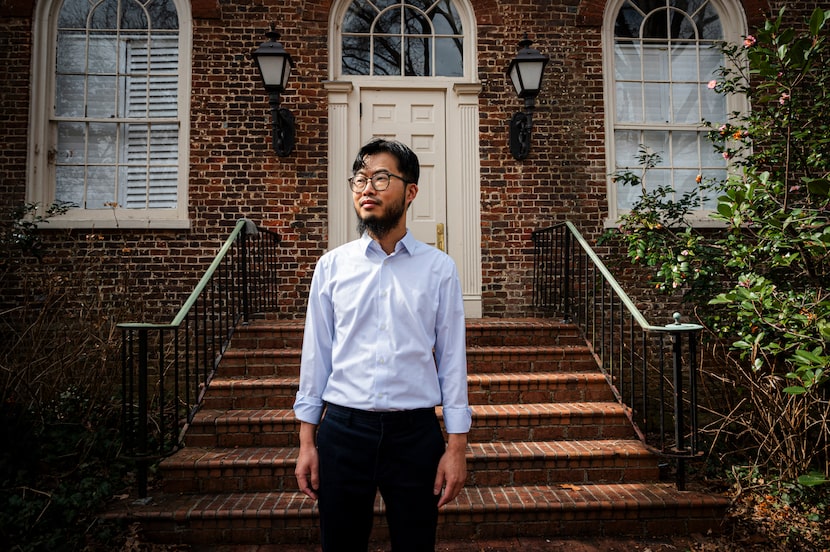
Charles Chear poses for a portrait in front of Person Hall at the University of North Carolina campus in Chapel Hill, NC on February 19, 2026.
Andrea Ellen Reed / Andrea Ellen Reed for The Dallas Morning News
Chear’s social work practice class, which had a community service component, presented another dilemma. His students were required to volunteer in K-12 schools and provide targeted support and mentorship to at-risk students. But a sweeping new state law, SB 12, that banned diversity, equity and inclusion activity in K-12 schools, such as referencing LGBTQ identities in conversations, had just kicked in.
Related
Suddenly, Chear was fielding questions from his students about whether they could get in trouble if a K-12 student wanted to discuss their sexual orientation or use their preferred name and pronouns.
“I don’t want to get kicked out of school,” his students told him. “I don’t want to be on the news.”
“It’s just as new to me as it is to you,” Chear responded, trying to turn the law’s vague language into a teachable moment.
But in exasperated conversations with administrators and colleagues, he asked, “What is it that I can and cannot say?” No one had an answer. The National Association of Social Workers had not yet released guidance on navigating the new law. Chear felt as though students — and faculty — were being set up to fail.
A UNT spokesperson did not respond to a request for comment about how the university provides guidance to faculty regarding compliance with state laws.
By October, four months after arriving in Texas, Chear was applying to jobs out of state.
Republican leaders “talk about how a lot of this was really to improve civic discourse and to end discrimination against conservatives,” Chear said. “But I felt they were just doing what they were accusing the other side of: excesses in terms of censorship.”
Lawmakers’ tightening grip on Texas’ schools were not the only reason for his departure. Chear, who is Muslim, was also growing fearful as state officials and Republican leaders intensified their anti-Muslim rhetoric.
On a Friday in October, Chear knelt on a mat tucked under a tree, praying with a dozen other Muslim UNT community members. A man with a bullhorn began circling the group, yelling a version of the Lord’s Prayer as he held out his phone to film the worshippers.
“Lead us not into temptation, but deliver us from Islam,” the man can be heard saying on a video recording, replacing “evil” with “Islam” in the prayer.
“I felt really vulnerable in so many ways,” Chear said. “He didn’t touch us. But he was really pushing it. He was inches away from people’s faces.”
A life in Texas, he realized, would mean the threat of harassment, nevermind the threat of losing his job, creeping constantly behind him. He liked UNT’s students, the campus and his colleagues. He even liked the dining hall’s food. But the reasons to leave — and to raise a child elsewhere — kept mounting.
“I left with a lot of reluctance,” he said. “It wasn’t an easy choice.”
He now holds a similar position at the school of social work at the University of North Carolina at Chapel Hill. His son, Shuayb, was born in December. His wife never made it to Texas.
With his baby boy crying in his arms, he thought about what would have to change to bring him back to Texas. Maybe, he said, a real initiative for civil discourse in higher education.
“I want it to be genuine, and I don’t think it is now,” he said. “Less violent rhetoric. Less threats. Turn that down and I think we could make a path forward.”
The DMN Education Lab deepens the coverage and conversation about urgent education issues critical to the future of North Texas.
The DMN Education Lab is a community-funded journalism initiative, with support from Bobby and Lottye Lyle, Communities Foundation of Texas, The Dallas Foundation, Dallas Regional Chamber, Deedie Rose, Garrett and Cecilia Boone, Judy and Jim Gibbs, The Meadows Foundation, The Murrell Foundation, Ron and Phyllis Steinhart, Solutions Journalism Network, Southern Methodist University, Sydney Smith Hicks, and the University of Texas at Dallas. The Dallas Morning News retains full editorial control of the Education Lab’s journalism.