Welcome to From the Archive, a look back at stories from Dwell’s past. This story previously appeared in the March/April 2003 issue.
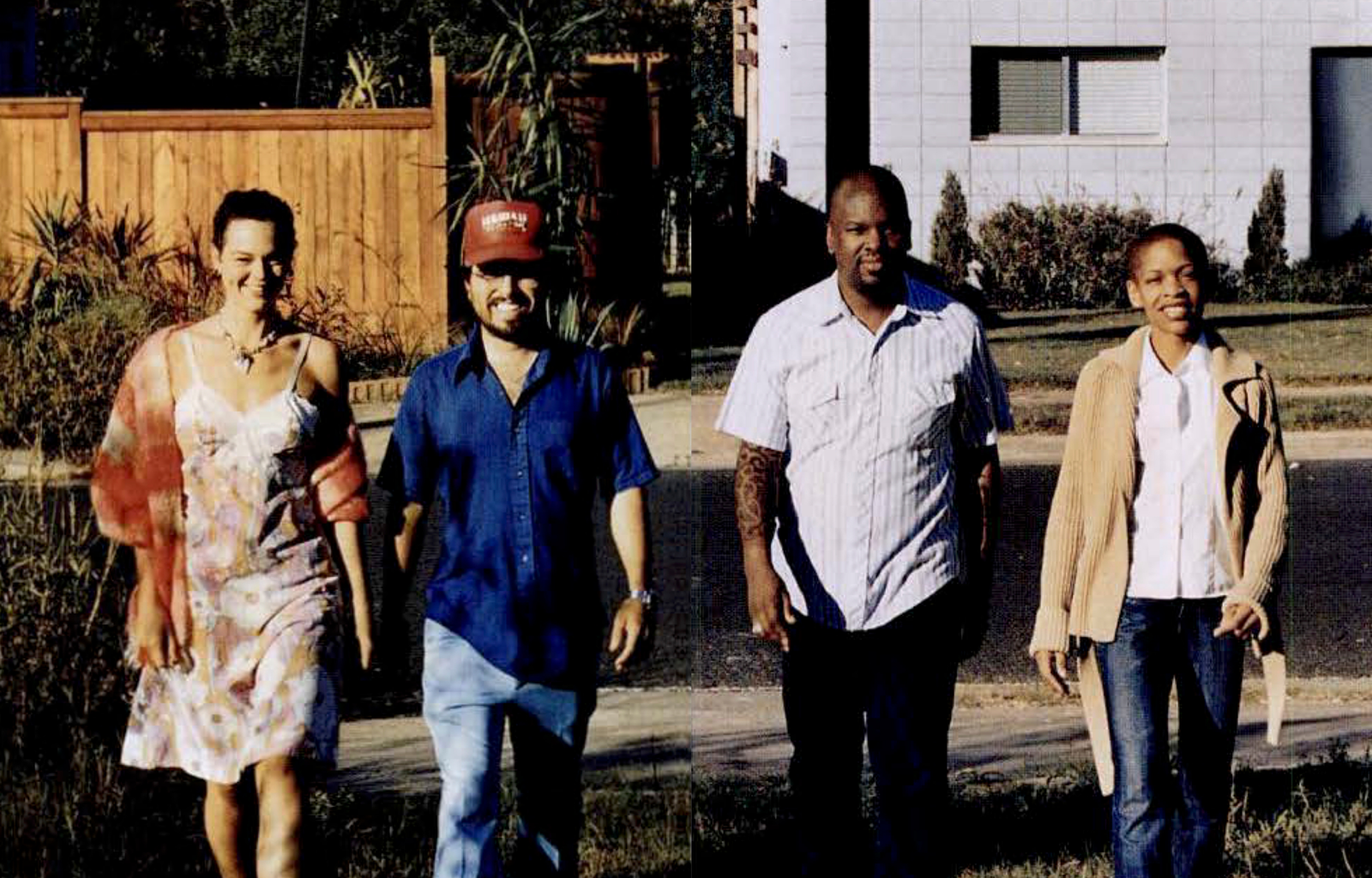
“All we wanted,” Chia Guillory says, “was an amazing house.” And is that such an outrageous demand, even in Austin, Texas? After all, Guillory, a self-employed clothing and accessories designer, and Javier Arredondo, a musician and DJ, are both part of the newly defined “creative class”—the very essence of what’s putting Austin on the international map as a hip city of the future, one built on the new ideas and creative capital that its artists, educators, engineers, performers, architects, writers, and scientists produce.

But here’s the conundrum: It’s precisely the growth fueled by innovative types like Guillory and Arredondo that has sent the real estate market through the roof, leaving them out in the cold as first-time home buyers.
Still, it didn’t keep Guillory and Arredondo from hoping. And looking. The native Austinites (a rare thing in this city of transplants) had a neighborhood pegged, one they had grown deeply attached to. For years, the couple had rented in East Austin, the traditionally African-American and Latino neighborhood filled with modest bungalows, historic churches, and generations-old family-owned barbecue restaurants—and also blessed with unrivaled access to Austin’s happening downtown. But East Austin is also vexed with an aging housing stock and the potent political cocktail brought on by the clashing forces of gentrification and the needs of its modest- to low-income population.
“We were resigned to finding a real fixer-upper so that we could do the work ourselves,” says Guillory. “But re-leveling a foundation and building a roof on our own? That left us with not much to consider. Things looked really hopeless.”
Which is why, when Arredondo took an exploratory route home from his day job at a record store last summer, he couldn’t quite believe what he saw as he cruised through the Chestnut Street section of East Austin: the foundations and framed-out beginnings of two sleek modern homes.
“The architect’s renderings on the For Sale sign alone sold me,” says Arredondo. “I knew right away it was the house for us.” And it was within their price range. Arredondo and Guillory made an offer on the house within days.
Credit Chris Krager and Christopher Robertson for making Guillory and Arredondo’s dream come true. The two architects, who met at the University of Texas School of Architecture, had solved a seemingly unsolvable architectural dilemma in Austin: They found a way to build affordable modern housing in a central Austin neighborhood—at a profit.
For Krager, 34, and Robertson, 33, such a project was a matter of principle. “Austin has a lot of upscale yet very homogenous ‘soft lofts’ being built downtown by developers who receive substantial incentives from the city,” says Krager, who originally hails from Detroit and worked as a manager of a mortgage brokerage firm before heading to architecture school. “But those types of projects don’t address the huge need for well-designed, affordable housing in Austin.”
So one day two summers ago, over a game of golf, the two decided to take charge of change. Forming KRDB (Krager Robertson Design Build), they set out to build beautiful, affordable urban homes. Their guiding principle? “Give the general public credit when it comes to their desire for good design,” says Robertson, a Houston native who interned at Renzo Piano’s Building Workshop in Genoa, Italy.
After looking at dozens of empty lots, Krager and Robertson settled on a neighboring pair on Cedar Avenue, paying $15,000 for each. The corner of Cedar Avenue and East 14th Street, with a convenience store and a handful of retail buildings, had all the right New Urbanist buzz words going for it: mixed-use, walkable, compact, urban. Urban amenities aside, the intersection has weathered many storms. Though Daniel’s, an air-conditioning and car repair shop, continues to hold onto the northeast corner, as it has for years, a music store recently came and went and other storefronts remain unoccupied. Several houses on the street have been abandoned or torn down altogether. And there are persistent problems with drugs and crime. Still, Krager and Robertson felt the location was perfect for the kind of houses they wanted to build. “We saw a vitality to the neighborhood,” says Krager. “And so we sought to respond to that kind of active urban fabric and create houses that are not static in their relationship to the street.”
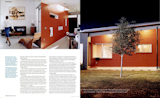
On one lot KRDB built a 1,000-square-foot, two-bedroom, one-bath home, which Guillory and Arredondo bought for $105,000. Next door they placed a 1,250-square-foot, three-bedroom, two-bath house with a butterfly roof, which was purchased by Dawna Ballard, an assistant professor of communication studies at the University of Texas at Austin, and Joe Harper Jr., a barber, for $122,000—a whopping 23.7 percent less than Austin’s $159,900 median house price.
So how did KRDB do it? First, they built on spec, opting to buck the usual client-commissioned, architect-as-designer-only model that architects tend to espouse. “Collapse the hierarchy into an integrated design/build mode, and you don’t have to await invitation to effect change,” explains Krager. Second, they did so under two publicly funded programs: Austin’s Small Builder Program, which provided them with no-interest construction loans, and the SMART Housing Program, which offers down-payment assistance to first-time home buyers making 80 percent of Austin’s median income. This meant Krager and Robertson could market their houses to exactly the underserved clients they wanted to. Once completed, the Cedar Avenue houses netted Krager and Robertson a Citation of Honor in the 2002 AIA Austin design awards. And now, their office has plenty of work on the boards, including four commissions for houses priced at $150,000 or less, and an entire residential subdivision near Waco, Texas.
The two young designers take issue with the notion that good architecture only occurs at the behest of a client, and their recent projects bolster that argument. “Well, there really was a client from the beginning,” says Robertson with a shrug. “After all, we were conceiving of houses for a couple or a small family who had a specific financial profile and who wanted to embrace life in the center of Austin.”
Kind of like Ballard and Harper. The two native Californians had lived in Austin only a year when, tired of the city’s high rents, they started house hunting. They looked at downtown condos built in converted commercial buildings, new homes, and anything in the city center, but they still couldn’t find anything they liked or could afford—until they saw the Cedar Avenue homes on the Internet. “Both of us grew to love the midcentury-modern houses of Palm Springs and other places in California,” says Harper, a die-hard design fan who confesses to having stockpiled a decade’s worth of design magazines. “It was a type of architecture we knew and loved. The design of these houses made sense to us.”
The L-shaped Cedar Avenue houses mirror each other. Particular attention was given to solar orientation of both: The two structures maximize natural light while minimizing the impact of the blistering hot Texas sun by having limited windows on the south and west facades. Two-by-six studs in the exterior walls left room for extra insulation, and outside laundry hutches on the porches curb energy expenses by keeping heat- and humidity-generating appliances out of air-conditioned spaces.
Krager and Robertson, with the help of project team member Eric Standridge, made the most of the relatively small square footage with open, flexible floor plans, and they stuck with low-cost materials: concrete block, Hardiboard siding, concrete floors, laminate countertops, fiberboard cabinetry. Yet astute design touches give each house an elegantly minimalist vibe. Ceilings soar to 11 feet in the great rooms. Narrow vertical and horizontal windows punched out of various walls offer surprising views. Bathroom tile runs up to the ceiling in the shower stalls and some window ledges are trimmed with smooth-cut Lueders limestone, a subtle yet luscious native Texas material.
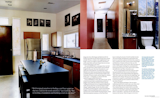
Thoughtful window placement washes the interiors of both homes with natural light. Guillory and Arredondo’s house features a 56-foot-long gallery-like hallway with a continuous lighting cove running the entire length. “From dawn to dusk, we almost never use artificial light,” says Guillory, who uses the second bedroom as her studio workspace. “Even when I’m working in my studio.” And at Ballard and Harper’s, two skylights grab natural illumination and diffuse it through an interior window to the master bathroom. The extra cost for such a dramatic feature? “About $3oo for the skylights and installation,” says Krager.
KRDB’s creative interior details are a perfect complement to all that efficient design. At Guillory and Arredondo’s, for example, a Formica kitchen island rotates around a steel leg and doubles as a table. A vertical street-facing window is covered by a panel of back-lit awning fabric. During the day, it offers some privacy; at night, an interior light makes it glow. And at Harper and Ballard’s, a pergola frames a view to the backyard.
“This isn’t the house we thought we’d be able to afford at this stage in our lives,” says Guillory. Which, to her, is amazing.