
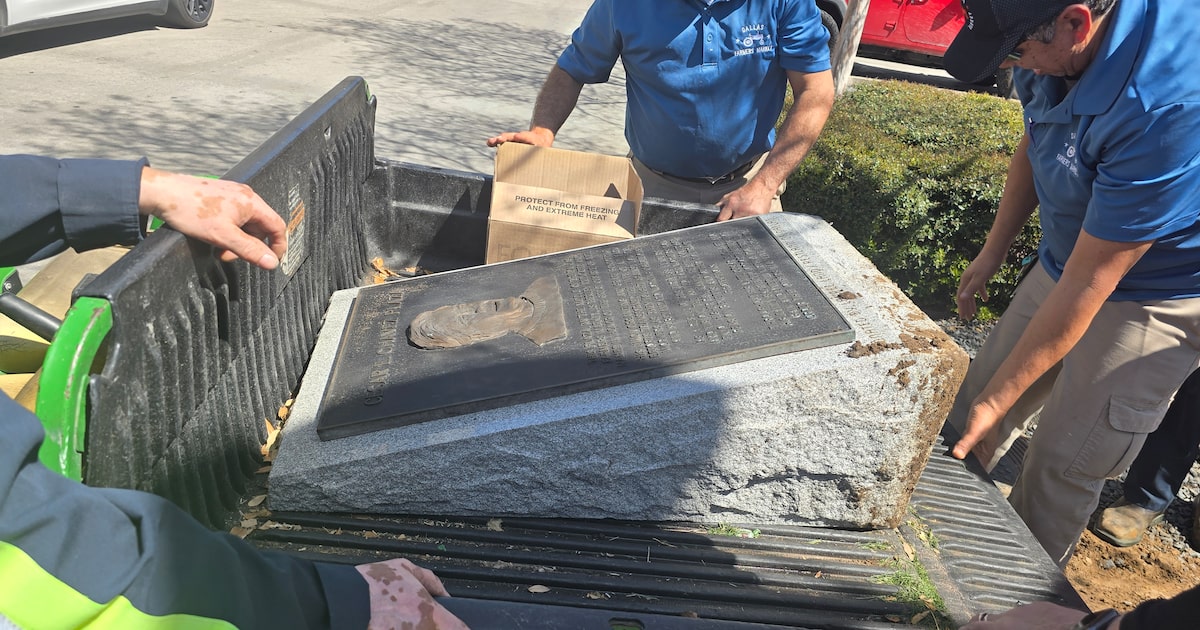
Workers removed a statue of labor leader Cesar Chavez at the Dallas Farmers Market on Thursday, raising questions from vendors about the speed of the decision and whether the public had any input.
Sana Syed, president of the Dallas Farmers Market Stakeholders Association, said she contacted Dallas City Council member Jesse Moreno after reading a report published Wednesday detailing allegations against Chavez of sexual abuse involving women and minors.. She said members of the community and her organization expressed urgency in addressing Chavez’s recognition in the area.
“We don’t want the street named after a pedophile,” Syed said.
Syed said the association plans to meet Monday with Moreno and Downtown Dallas Inc. President Jennifer Scripps to discuss next steps, including a possible street renaming.
She also contacted Farmers Market owner Brian Bergersen, who told her the statue would be removed.
Business Briefing
“Within hours, he said it was coming down and that he was no longer there,” Syed said.
Michelle Espinal, co-owner of RX Tea Shop, a small pop-up vendor located at the Farmers Market, said she and her husband, James Embler, first noticed workers attempting to remove the statue Wednesday.
“They were trying to dig it up and pull it out, and they were struggling,” Embler said. “This morning it was covered with a trash bag, and they came back with a Sawzall and cut through the base.”
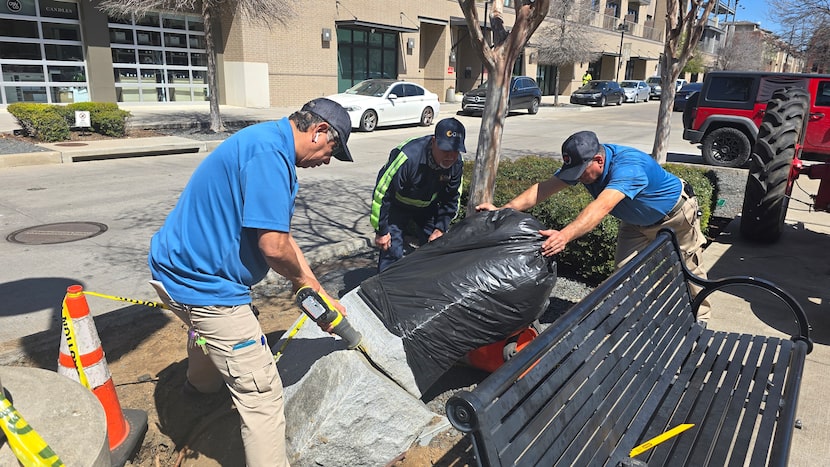
A worker uses a reciprocating saw to remove a statue of Cesar Chavez Thursday at the Dallas Farmers Market near downtown Dallas.
Michael Cuviello
By Thursday, four workers with the Farmers Market dismantled the statue and loaded it into a small utility vehicle after earlier efforts to remove it failed.
The removal drew attention from vendors and visitors, many of whom said they were unaware a Chavez statue had been at the market.
In response to the allegations, several Dallas City Council members have called for reconsidering the city’s recognition of Chavez, including the naming of Cesar Chavez Boulevard, which runs near the Farmers Market and was established in 2010.
Gov. Greg Abbott said Wednesday that Texas will no longer observe Cesar Chavez Day and he plans to ask lawmakers to remove the holiday from state law.
In Dallas, City Council member Adam Bazaldua said the city should rethink its recognition of Cesar Chavez Day on March 31 and Labor Day.
But Espinal questioned how quickly action followed and how that response compares to other figures.
“It is very curious how quickly the response went into action for a brown man who represented working people,” Espinal said. “There are people who had very strong reactions to preserving statues of slave owners, people we know factually did terrible things, and those were defended as history.”
“They had zero hesitation to take his signs down,” she added. “But there were protests to keep statues of people who didn’t represent our community at all.”
“For me, the shock is how uneven the response has been,” Espinal said. “It is the right thing not to celebrate people who have done harmful things. But why isn’t that same standard applied to everyone?”
While she questioned how quickly action was taken, Espinal said she supports holding public figures accountable.
“Always believe women,” she said.
“There should be public input on whether there’s a statue or a street name in your community,”
Embler said he was also struck by how quickly the statue was removed.
“They were already taking it down before it was even widely on the news,” Embler said. “That’s what blew me away.”
He said decisions involving public symbols should follow a clearer process.
“There should be some kind of standard operating procedure, investigation, verification and public input,” Embler said. “We have public input for rezoning and development. Why not for something like this?”
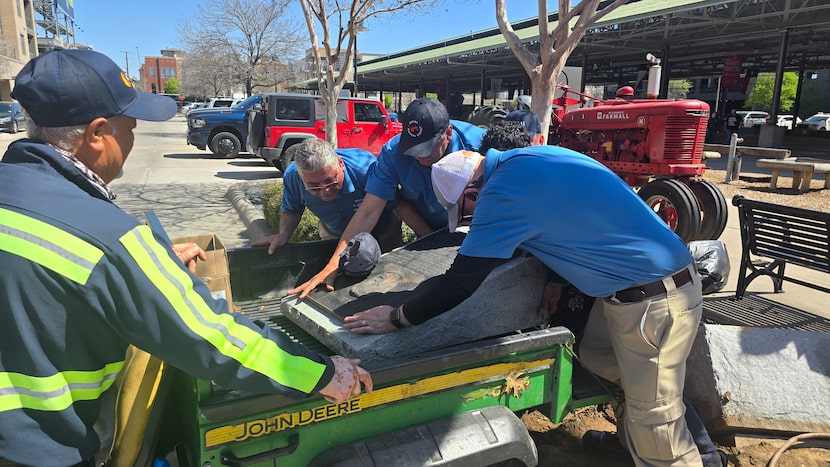
Workers with the Dallas Farmers Market near downtown Dallas load a statue of Cesar Chavez into a utility vehicle on Thursday afternoon.
Michael Cuviello
Embler said the removal raises broader questions about Chavez’s legacy in Dallas.
“I remember when they named the street, when they named the plaza,” he said. “Now it feels like all of that could go away.”
Staff writer Devyani Chhetri contributed to this report.