
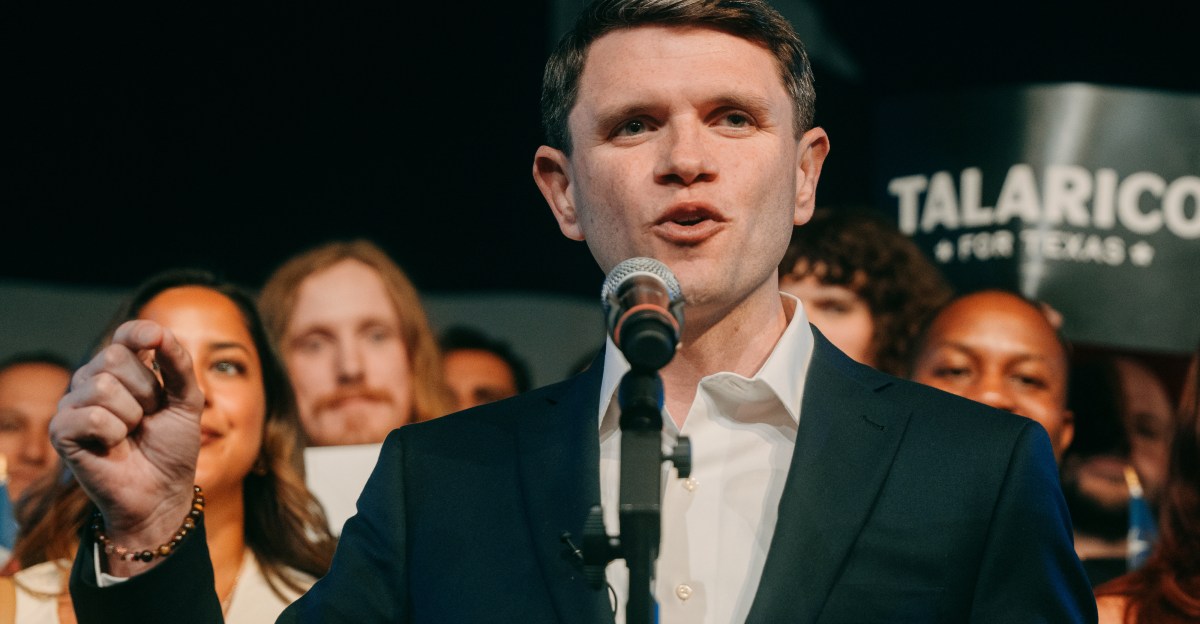
Earlier this month, Texas state Rep. James Talarico eked out victory in a heated race to become Texas’s Democratic nominee for the US Senate race this November. Texans haven’t elected a Democrat to the Senate since 1988, and a lot of hopes are riding on Talarico’s longshot campaign to change that.
But this week, an unexpected video from Talarico’s past resurfaced that caused so much uproar he issued a hefty rebuttal within 24 hours.
The video didn’t revolve around the typical political scandal fodder, like allegations of an affair or bribery. In the eyes of his opponents, it would seem, he had committed a far graver offense: Talarico had endorsed…veganism.
For the record, Talarico has never claimed to be vegan himself, but at a 2022 fundraiser event in support of strengthening animal abuse laws, he said that his campaign — at the time for reelection in the Texas House of Representatives — had officially become a “non-meat” campaign. Talarico stated that the campaign would only buy “vegan products from our local vegan businesses,” and mentioned a local plant-based pizzeria. He said it was an existential matter to try to reduce meat consumption because “it’s necessary to fight climate change” but also as a means to “respect animals in all aspects of society.” The crowd cheered.
In advocating for plant-based eating, Talarico joined a handful of other politicians: New Jersey Sen. Cory Booker, former New York City Mayor Eric Adams, and Maryland Rep. Jamie Raskin, among others. But the message hit different in Texas, which raises more cattle than any other state by far, and where the mascot of the state’s second largest university is the longhorn steer.
The responses to the resurfaced post have been fast and furious. Texas Sen. Ted Cruz called Talarico a “freak” who wants to “ban BBQ” (Talarico has said no such thing). Texas’s other senator, John Cornyn — who Talarico might face off against in November’s election — urged Texans to vote this November because “the steaks couldn’t be higher” (get it?). Voices on the political left and right agreed his election bid might just be cooked, as the kids say.
But within 24 hours, Talarico’s campaign responded with a “press release” that was just a picture of him wearing a Texas flag button-down shirt while taking a bite out of a hunk of meat, though it’s hard to tell if it was meant to reassure voters he doesn’t pose a threat to the state’s identity, a satirical bit, or both.
We’ve seen this movie before. In 2021, Colorado Gov. Jared Polis proclaimed March 20 as “MeatOut” day, encouraging Coloradans to give plant-based eating a try. Like Talarico, Polis eats meat, too. Nonetheless, Colorado’s livestock lobby was incensed, and to appease them, Polis designated another day as “Colorado Livestock Proud Day” and shared his own brisket rub recipe.
It doesn’t take a political strategist to conclude that Talarico’s “non-meat” campaign announcement was a potentially reckless move for a Texas politician and that it could’ve easily come back to haunt him if his political ambitions were to grow beyond the greater Austin area, which they now have. But the response to the 2022 video highlighted how, despite years of evidence mounting about the depravity of the US meat industry, Americans on both sides of the aisle are still unable to have a nuanced, honest debate about meat’s role in our diets, culture, and politics.
Why Americans can’t seem to have an open conversation about meat
If you look long and hard enough at how meat gets to our plates, Talarico’s 2022 campaign position was a sensible response.
The vast majority of the 10 billion animals raised for meat in the US are kept on factory farms, where horrific practices — which would be illegal if done to a pet cat or dog — are business as usual: ripping out piglets’ testicles without anesthesia, cramming hens and pigs in tiny cages, starving breeding chickens, burning out calves’ horn buds (also without anesthesia).
Americans of all political stripes overwhelmingly oppose these bedrock practices of US meat production, but they remain legal because industry lobbyists and their allied politicians keep it that way.
While beef cattle tend to have higher welfare than pigs, chickens, and turkeys, undercover investigations into some Texas cattle operations have revealed stomach-churning cruelty. And to be sure, Texas’s livestock industry is a lot more than just cows; it’s also a top producer of eggs and chicken meat, industries notorious for terrible treatment of animals.

A cattle feedlot near Lubbock, Texas, USA. Richard Hamilton Smith /Design Pics Editorial/Universal Images Group via Getty Images

A chicken factory farm in Alabama. Carol M. Highsmith/Buyenlarge/Getty Images
On the climate change front, more than 200 agricultural and environmental scientists surveyed in 2021 concluded that rich countries need to reduce their consumption of animal products to meet global climate targets. But even those unconcerned with climate change still have plenty to worry about; meat production is a leading cause of America’s water and air pollution, contributing to the declining quality of life in rural areas.
But most Americans would rather not think too long or too hard about where meat, milk, and eggs come from. Meanwhile, many politicians, pundits, and special interest groups seek to turn anyone who does into an example. They often resort to childish insults and hollow platitudes about how meat is essential to be a real American (or Texan) instead of seriously grappling with what our meat-heavy diets have done to our land, our air, our rivers and streams, and billions of animals who can suffer — and experience a range of other emotions — just the same as our cats and dogs.
They also narrow the window of debate. While some might argue Talarico is guilty of this, too, by staking out an explicitly non-meat campaign policy, in actuality there’s a whole range of options to address the ills of meat production beyond the binaries of all-out veganism and full-throated defense of the status quo. Some lawmakers push for bills to ban particularly cruel practices on farms, or to reduce air and water pollution from the trillion pounds of manure generated by livestock. Others try to expand plant-based food choices in schools.
There’s more to Texas than beef
Change is even afoot in cattle country. Austin and Houston are home to some of the finest plant-based cooking in the US, and some of the best vegan jerky I’ve ever tasted came from a small company based an hour’s drive north of Dallas. But perhaps no one shatters the self-image of Texas as an immutable BBQ-loving monolith more than Renee King-Sonnen and Tommy Sonnen.
For years, the husband and wife operated a cattle ranch near the Texas Gulf Coast. But over time, Renee formed emotional bonds with their animals and grew increasingly distraught by the sound of the mother cows wailing as their babies were hauled off for sale. She eventually became vegan herself and launched a fundraising campaign to turn their ranch into an animal sanctuary. Today, more than 100 rescued livestock — cows, but also turkeys, goats, and pigs — live out their much more natural lives there.

Rowdy Girl Sanctuary resident “Stormy” is petted by Renee King-Sonnen. Steve Gonzales/Houston Chronicle via Getty Images
That might amount to heresy to some Texans, but it shows that many Texans’ — and Americans’ — views about animals are too complex to condense into a snarky tweet. The Sonnens’ story also reminds me of some of Talarico’s most stirring messages about compassion, love, personal transformation, and protecting the vulnerable — messages that helped to launch him onto the national political stage.
America clearly isn’t yet ready to put animals, especially the ones we eat, into that narrative, or to openly and clearly argue the merits of factory-farming 10 billion animals each year. But I hope one day we will — and that politicians will be able to turn down the temperature and engage in honest discourse, too.
You’ve read 1 article in the last month
Here at Vox, we’re unwavering in our commitment to covering the issues that matter most to you — threats to democracy, immigration, reproductive rights, the environment, and the rising polarization across this country.
Our mission is to provide clear, accessible journalism that empowers you to stay informed and engaged in shaping our world. By becoming a Vox Member, you directly strengthen our ability to deliver in-depth, independent reporting that drives meaningful change.
We rely on readers like you — join us.

Swati Sharma
Vox Editor-in-Chief