
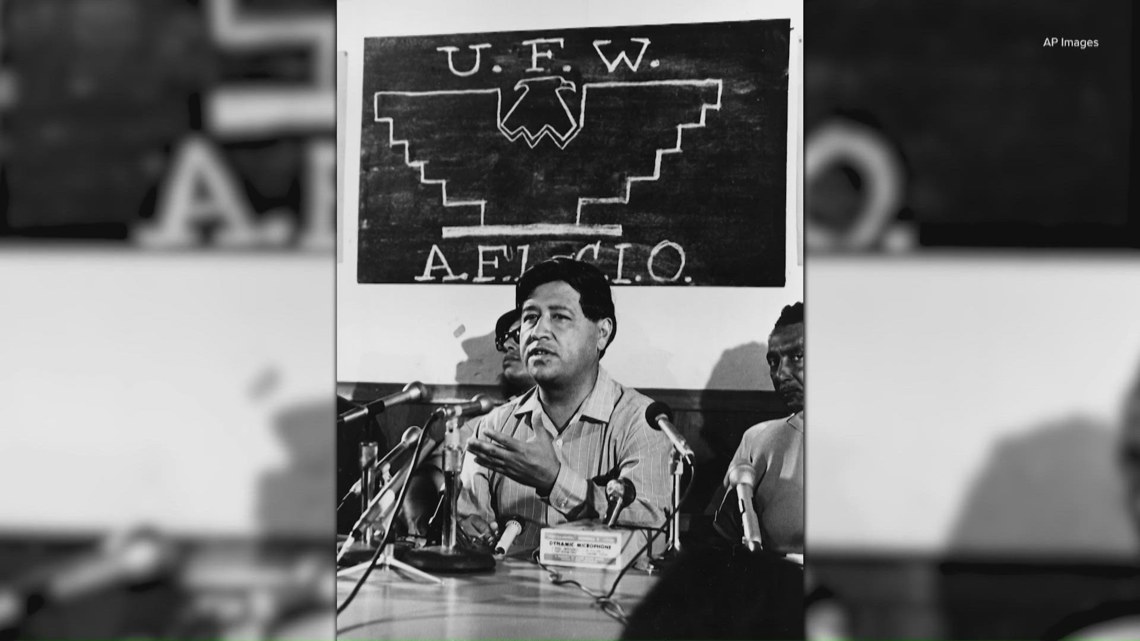
Abbott said he would work with lawmakers in the next legislative session to remove the holiday altogether.
AUSTIN, Texas — As Austin city leaders weigh a potential name change for César Chávez Street after sexual abuse allegations against the late labor and civil rights activist, Texas Governor Greg Abbott said the state will no longer observe César Chávez Day.
In a social media post and statement on Wednesday, Abbott directed the heads of state agencies to comply and said there would be a broader effort to remove the holiday from state law.
“Reports of the horrific and widely acknowledged sexual assault allegations against Cesar Chavez rightfully dismantle the myth of this progressive hero and undermine the narrative that elevated Chavez as a figure worthy of official state celebration,” Abbott said in a statement.
Several cities, including Austin, have canceled “César Chávez Day” celebrations following a multiple-year-long investigation into the labor leader who died in 1993 by the New York Times, released on Wednesday.
“It certainly was a gut punch to our community,” State Rep. Cassandra Garcia Hernandez (D-Farmers Branch) said.
According to the New York Times, Chávez allegedly abused and molested multiple women over the course of decades, including some underage girls.
One of the alleged victims was activist Dolores Huerta, who co-founded the United Farmworkers Union with Chávez.
“It has just been really heartbreaking for so many of us in the community who have been mentored by Dolores, who’ve looked up to her,” Hernandez said. “It was just something that hit really hard and hit home in particular for a lot of women who even share similar stories as well.”
The Times said it interviewed more than 60 people regarding the allegations and used union records, emails and other documents to corroborate the accounts.
Huerta said she remained silent for decades about what happened to her because she feared speaking out could harm the movement she and Chávez worked to build. She described two encounters with Chavez, one where she was “manipulated and pressured” and another where she was “forced against my will.” She said Chavez sexually assaulted her in two incidents that led to pregnancies.
“I carried this secret for as long as I did because building the movement and securing farmworker rights was life’s work,” Huerta said.
As she condemned Chavez’s actions, Huerta emphasized the cause extended beyond any one individual.
“The farmworker movement has always been bigger and far more important than any one individual,” Huerta added in her statement. “Cesar’s actions do not diminish the permanent improvements achieved for farmworkers with the help of thousands of people. We must continue to engage and support our community, which needs advocacy and activism now more than ever.”
It is a sentiment echoed by Garcia Hernandez.
“We wanted to make sure to keep intact what this movement stands for. It’s not anything that is based on the success of one man,” Garcia Hernandez said. “There were many men and women, including Dolores, who are really the champions, and now is the opportunity for us to uplift those voices and make sure that in the future, whenever we have movements like this, that we lift all voices, not just one person.”
Those who have idolized and supported his work are now forced to reckon with Chavez’s legacy.
“We don’t want, obviously, to discredit the great work that has come out of this particular movement, and certainly under the leadership of Dolores, and the countless others, we want to make sure that we continue to recognize that history, but we also need to recognize the painful history as well that has just come to light,” Garcia Hernandez said. “We cannot sugarcoat what has happened.”
The Mexican American Legislative Caucus called the allegations “deeply disturbing” and said it is ready to lead efforts to remove the Cesar Chavez holiday.
“We all, as a community, need to recognize that these are the type of things that we should not tolerate,” Garcia Hernandez said. “We should not be okay with this, but we also need to recognize that this is an opportunity for us to make sure that we have robust protections for people, that we give people the resources they need. If something like this happens, and we encourage people to feel safe and to have safe spaces to be able to come forward and let people know that these are the type of things that are happening.”
Since 1999, Texas has recognized Chavez’s birthday, March 31, as an optional state holiday. It is an optional holiday for state employees, not a paid holiday for all employees. Since it is an optional holiday, state agencies remain open, but staffing may be minimal.
It is also recognized in at least nine other states. In most places, it is an optional holiday or a day of service, as in Texas, but in California, it is a state holiday, and some government offices and schools close.
In 2014, President Barack Obama designated March 31 as a commemorative federal holiday, though it is not a paid holiday for federal employees.
Abbott said when state lawmakers return to the Capitol for the 90th Texas Legislative session in January 2027, he plans to work with state lawmakers to “remove César Chávez Day from state law altogether.”
“Movements are always centered on fighting injustice, well, this is an injustice that happened in this particular movement, and it is our job and our responsibility to right that wrong,” Garcia Hernandez said.
The MALC and others are calling for the holiday to be replaced by one honoring other labor leaders, such as Huerta.
“In this particular instance, and certainly amongst a lot of us Latinos and Latinas, we certainly lift up and admire Dolores Huerta for all of the work that she’s done as well,” Garcia Hernandez said. “I think this gives us a great opportunity to reflect on that and recognize that there are other people who also have done the work and would be phenomenal people to lift in this instance.”
Garcia Hernandez said it has also been a learning experience, and the revelations have given her pause because people can turn out not to be who they seem.
“I think we always need to be careful in recognizing individuals as being the forefront of a particular movement or organization,” Garcia Hernandez said. “I think maybe what we should start doing more is just recognizing all of the individuals that contribute to that. “
From coast to coast, cities and people are now reconsidering events and spaces named in Chavez’s honor, as part of a nationwide reckoning.
“People understand the gravity of this situation and to what level that no matter what party politics that we can come together and recognize that this is truly an injustice that we should stand up against, not only in this particular instance, but in all instances where we see people in power using that power to inflict harm and hurt on people,” Garcia Hernandez said. “We should speak out. We should say no. We sure as hell shouldn’t be celebrating them.”
Ahead of the release of the investigation, the United Farm Workers distanced itself from its co-founder and said it would not participate in any César Chávez Day activities.
Council members Jose Velasquez, Vanessa Fuentes and Chito Vela, along with Travis County Attorney Delia Garza, issued a joint statement on Wednesday saying they support changing the street name honoring Chávez in South Austin. The City of Austin changed First Street to César Chávez Street in the months following his death in 1993. Chávez had ties in Austin from rallies at the Capitol and the Chicano Huelga labor strike.
Efforts to rename streets dedicated to him or stop events in his honor are also underway in San Antonio and Dallas. In Houston, organizers canceled a planned march along Cesar Chavez Boulevard next weekend.