
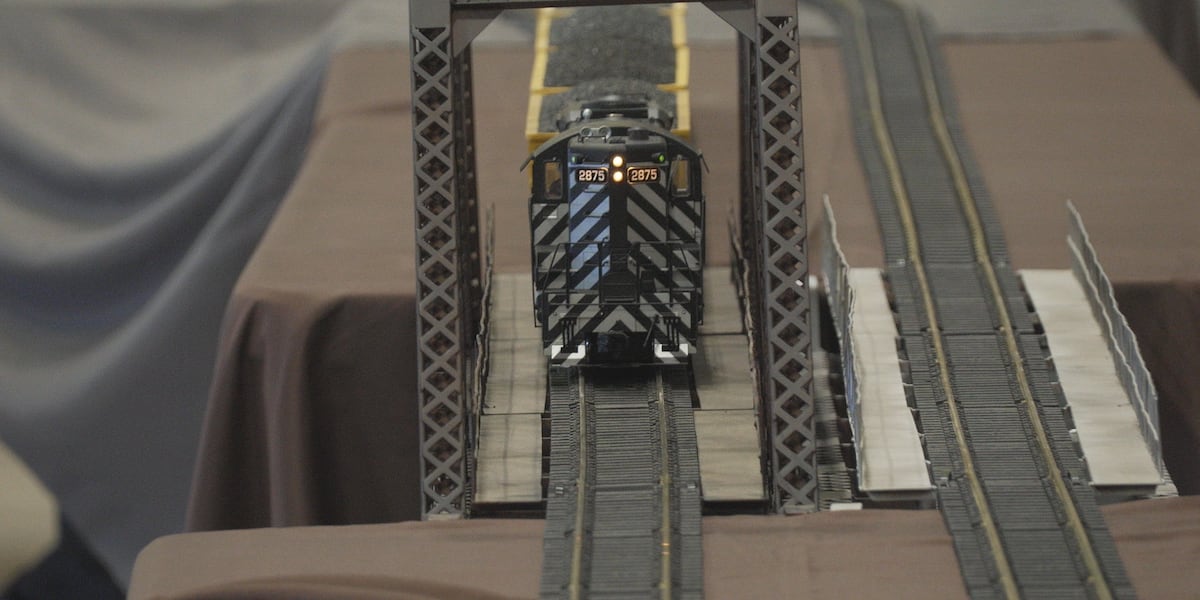
LUBBOCK, Texas (KCBD) – Lubbock is celebrating the engines which built America this week. A model railroad show is recognizing the engineering while a Slaton staple preserves the culture.
Nearly halfway through its 250-year history, the invention of the locomotive ushered in an era of rapid expansion and industrialization across the United States.
Once a month, a group of engineers takes over a back room of the American Windmill Museum. They swap stories, ideas, schematics, paint jobs and environment ideas for their fully functioning trains. While the materials and scale are different, the ingenuity and innovation are the same.
The Lubbock Model Railroad Association honors and celebrates the history of trains big and small on the South Plains. The first steam engines came to Lubbock 125 years ago, connecting families and freight from Brownwood to Clovis.
“The passenger train was just like a car to us, probably, that was your choice,” said Patrick Pritchett, an engine enthusiast. He’s a member of the Lubbock Model Railroad Association and showed us around the layouts at the windmill museum.
Pritchett said most of the towns across the South Plains popped up to support the railroad, which is represented as millions of dollars worth of model tracks and trains.
“Back in the day of steam engines they were only used about a hundred miles. A hundred miles took them most of their day,” Pritchett said. “You can’t believe how hard these guys worked.”
Those long, hard days included harsh maintenance for big engines carrying even bigger cargo at up to 60 miles an hour.
“That makes that drive wheel going around six-and-a-half times a second,” Pritchett said. “You think about that much steel moving, you can see how after a hundred miles they needed to check the parts.”
Slaton served as the division point for the rail in the area, meaning its workers had hands on every train that passed through.
The Harvey House, one of hundreds lining America’s railways, is where passengers would take a break.
Cynthia Jones helps preserve Slaton’s Harvey House. Established in 1912, it was a well-oiled service machine.
“They would telegraph ahead to this Harvey House, each person’s order, so that when they pulled in they came sat at the counter told the Harvey Girls exactly what they wanted to eat, the food was hot and served immediately because they only had 20 minutes to get off the train, eat and get back on,” Jones said.
The house in Slaton now serves as a museum, helping preserve the legacy of the railway from the men who built it and ran it to the Slaton residents who protected it. For Jones, it’s a generational job keeping the Harvey House running.
“It would be great if everybody could have that experience of riding on some type of train,” Jones said.
Back in Lubbock, the layouts honor history and the engines serve as a way to spark interest in everything from engineering and art to critical thinking and problem solving.
Pritchett said he often reflects on what different generations think when they see a train.
“It wasn’t just something people got mad at at the crossing, it was like, when the train came to town, it was important,” Pritchett said.
The future of the locomotive is still bright, Pritchett said.
“Technology can move this all on its own, so it’s going to be interesting,” Pritchett said.
While passenger service in and around Lubbock ended about 60 years ago, each day its lines still rumble with heavy freight serving almost every modern industry in America.
The Lubbock Model Railroad Association’s spring show runs through Saturday at the American Windmill Museum. Its historical layouts can be seen at the museum year-round. The Harvey House also serves as a bed and breakfast, available for booking year-round.
You can find more of our stories celebrating 250 years of American ingenuity and progress here.
Copyright 2026 KCBD. All rights reserved.