

Editor’s note: This is the first in a series of stories that will cover historical events, buildings and people that have made Arlington the place it is today while celebrating the city’s 150th anniversary.
For city manager Trey Yelverton, driving down Division Street in the early 1990s evoked a sense of sadness when he’d see a specific building.
“I can remember that Vandergriff Building being boarded up, sitting there on the corner,” he said. “And it was always just sad to me that this old historic building was boarded up.”
Yelverton came to Arlington as a UTA student in 1985. He said he would think to himself, “If I ever worked for the city, I was going to work to try to help get that fixed.”
A once bustling building owned by one of the most important families in the history of the city sat with mismatched boards lining it, just a shroud of the past. It wasn’t until years later that the building was bought, and newer uniform boards meant a change was coming — a new life for the building.
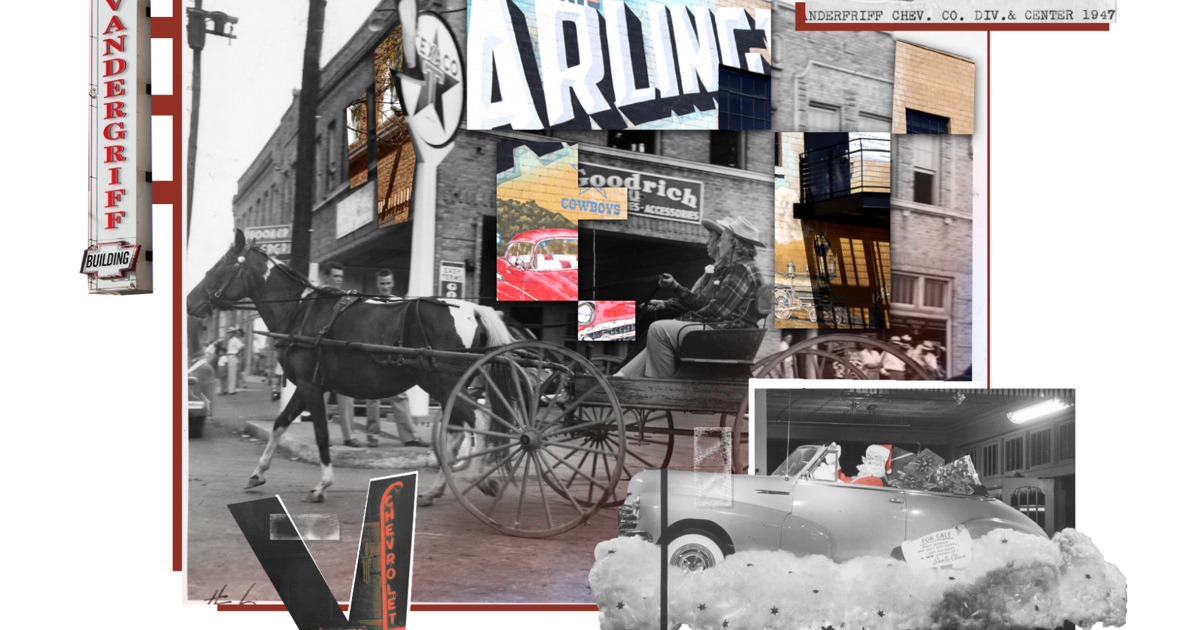
With a rich history of almost a century, the Vandergriff Building, named after former mayor Tom Vandergriff, in downtown Arlington has seen a lot of change over the years and continues to make an impact on the city it calls home.
Constructed in 1928, the building started as a car dealership in a booming part of town and continues to serve Arlington residents as office space for various tenants.
Originally designed by Harve Withers and built for J.C. Thannisch, a local automobile dealer, in what was then known as the “auto isle” of Arlington, the two-story commercial-style building was originally designed to appear like the École des Beaux Arts in Paris, France. The building sat along the Bankhead Highway, one of the nation’s earliest transcontinental highways.
“It went from Washington, D.C., to San Diego, California,” said Geraldine Mills, Fielder House Museum director. “It was called ‘The Broadway of the Southwest.’”
William “Hooker” Vandergriff purchased the building in 1938 with the intent of operating his own Chevrolet dealership, marking the beginning of the Vandergriff family’s tenure in Arlington.
Though Thannisch is considered a pioneer of automobile sales in Arlington, Hooker Vandergriff and his family made the market boom. When Tom Vandergriff became mayor of Arlington in 1951, the city was a small town of around 7,000 people.
Through new ideas and steady leadership, Arlington turned into something almost unrecognizable. Tom Vandergriff brought General Motors to the city through the Buick-Oldsmobile-Pontiac Assembly Division in 1954, and with it a slew of jobs. By 1960, the population had grown to 44,775.
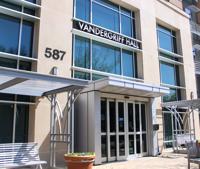
Vandergriff Hall sits on Spaniolo Drive March 15. The hall is named after a former Arlington mayor Tom Vandergriff.
Mills said the market General Motors brought in gave the Black community its first chance to have decent-paying jobs, allowing them to potentially buy houses in the area.
With the unprecedented growth came a shift where people were living in the city. Mills said the city began to move south, and the Vandergriff family along with it.
Their business moved from what’s now known as the Vandergriff Building to a larger facility to the east in 1966. This period marked the beginning of the end of the first iteration of the building.
Wooden boards of all shapes and sizes adorned the building by the late 20th century.
“It was boarded up in a very tacky way,” Yelverton said. “The boards didn’t match, there was kind of graffiti-ish stuff on it.”
In the 1990s, there was an initiative to revitalize downtown Arlington, led by several city leaders. Ralph Shelton had purchased the Vandergriff Building from the city, which had previously purchased it to preserve it and prevent it from being demolished. The building sat vacant for 20 years, and when Shelton’s plans for the building fell through, it passed into another’s hands.
In 2003, the empty building was bought by Gary Walker, president and founder of Skywalker Property Partners. One of the first things Walker did was reboard it uniformly.
Yelverton said it felt like the building was being prepped and cared for, as opposed to being an afterthought.
“It’s not going to just need to sit there and wither away over time,” he said. “It’s actually got a plan and a capability now to sustain it.”
The renovation process was lengthy and difficult, largely due to the restrictions on what they could do and the costs of renovating, Walker said. Originally, he said, they wanted to do lofts upstairs and office space downstairs, but the regulations were strict, and at the time, few lived in downtown Arlington, so there was a question of demand.
Walker said that ultimately, it was decided that the entire building would be offices. They preserved as much of the original building as possible, including steel windows, wooden flooring and a metal-door safe.
During this time, they also submitted the paperwork to have the building recognized as a historical landmark.
Walker said buildings like the Vandergriff Building have a unique appeal and a feel of character.
“The historical commission types would say they illustrate our history,” he said. “But I think people, the public tenants, just enjoy the uniqueness.”
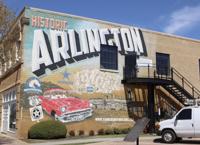
The Vandergriff Building sits on North Center Street on March 14 in Arlington. The Vandergriff Building was constructed in 1927.
Though Walker purchased the building in 2003, it wasn’t until around 2008 that renovations finished and it was ready to be inhabited.
“It’s easier to build a brand new building than restore a building,” Walker said. “We built brand new buildings several times, and this was a lot more challenging.”
Now the building serves as a rentable office space — a far cry from the car showroom it originally was, but it’s found its place in a modern version of downtown Arlington.
The century between what was and is has not lessened the impact of this building on its surrounding area. As one of the oldest buildings in Arlington, the Vandergriff Building was acknowledged by the U.S. Department of the Interior and put on the National Register of Historic Places.
Maggie Campbell, Downtown Arlington Management Corp. president and CEO, said Arlington has not had the best track record of preserving its historical assets, but much of that came because of rapid growth and different values compared to now.
However, down Center Street, the Vandergriff Building and the Arlington Music Hall, a theater building built in 1949, sit as reminders of an era of Arlington that is gone but not forgotten.
“It’s all about the story,” Campbell said. “We connect with people because we bring our stories to life downtown, whether they’re stories of what happened here at the turn of the century or they’re stories about what new and innovative things are happening here today.”
“I think having that, it’s part of the fabric that makes the experience rich, but it also is what gives us our roots. ”
@wall035203 @atclements03