
Let’s straighten out a couple of things.
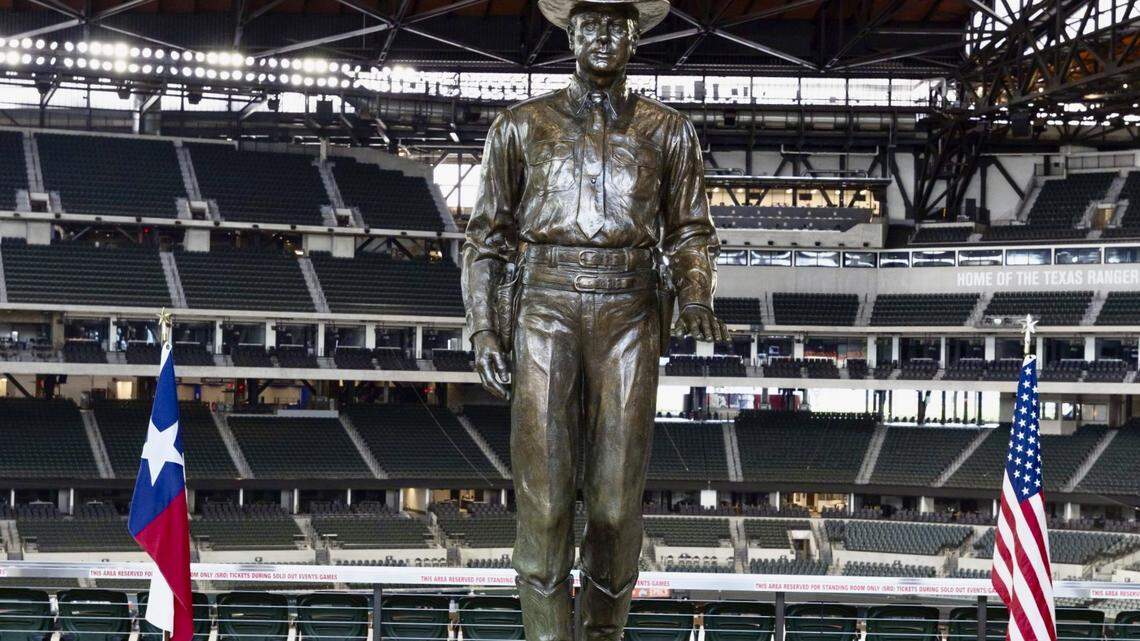
● The 65-year-old statue of a Texas Ranger lawman, recently unveiled by the Texas Rangers baseball team at Globe Life Field, is not named “One Riot, One Ranger.”
● It is not a statue of former Rangers Capt. Jay Banks. He was one of six Rangers lawmen at the 1956 Mansfield Crisis, where three local Black students were denied their legal right to enroll in all-white Mansfield High School.
This is a generic statue of a tall, sturdy Texas Ranger. San Antonio-based sculptor Waldine Tauch used Banks as a model, but she changed features so it wouldn’t look like any single Ranger.
● And it was not Banks who defied federal law in 1956 or kept Black students out of their hometown school.
It was Gov. Allan Shivers. He sent the Rangers to calm a near-race riot by 300 white people hanging Black students in effigy, and he also told school officials to order Black students transferred out to preserve “peace and orderly conduct.”
The crisis is an eternal shame for Mansfield.
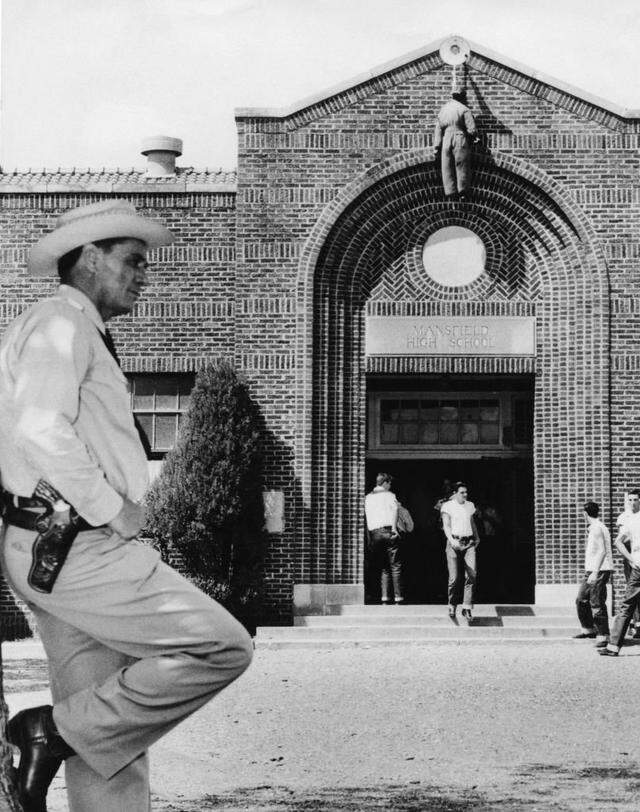 To protest against having Black students register for Mansfield High School, an effigy is suspended above the school entrance with Texas Rangers Sgt. Jay Banks on hand to maintain calm on Nov. 23, 1956. – UNITED PRESS PHOTO/AFP via Getty
School officials coldly didn’t even bother to take down the effigies of Black students hanged from above the school door and from the flagpole.
So by any name, bringing this statue into Globe Life Field is a really sorry idea.
Even though it isn’t meant to depict Banks, the statue is a 65-year-old throwback to the shameful Jim Crow-era of segregation in Texas.
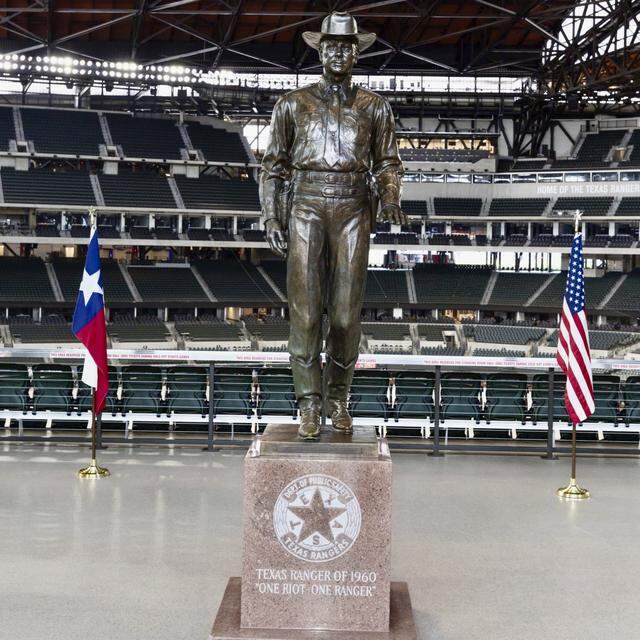 The 1961 statue “Texas Ranger of Today,” removed from Dallas Love Field, has been moved to Globe Life Field despite its model’s connection to the ugly Mansfield Crisis school desegregation incident in 1956. Coirtesy of the Texas Rangers Baseball Club
When the statue was originally dedicated at Love Field Airport in 1961, stores still had “white” and “colored” facilities. Dallas and Texas were still mired in the spiteful and bitter Jim Crow era.
A 12-foot-tall statue of a law officer reaching for his gun was always a really strange way to welcome Texas visitors.
Is that any way to greet baseball fans?
What does it mean? “Hold it right here, pardner. Now git yourself on over to the Pluckers Wings stand”?
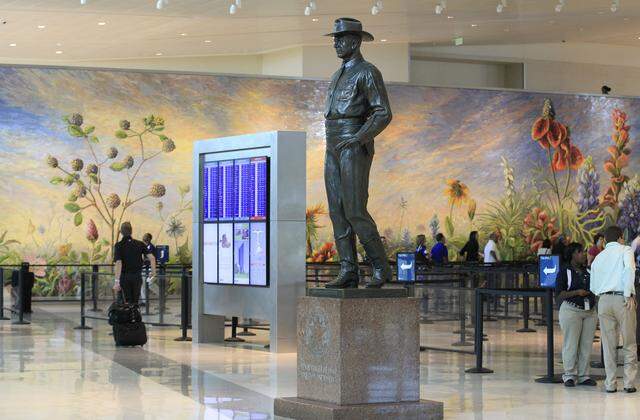 The 1961 “Texas Ranger of Today” statue of a Texas Ranger stood in the Love Field terminal in Dallas on Thursday, Sept. 26, 2014. Ron T. Ennis Star-Telegram archives
The Rangers installed the statue quietly.
I mean really quietly.
The team published only a vague announcement labeled “new addition to the concourse.”
The stadium website at globelifefield.com gives the wrong name for the statue. Then it goes on to say it honors “public safety professionals” as a “symbol of our team’s origin.”
But as recently as 2020, the team disowned that origin.
“While we may have originally taken our name from the law enforcement agency, since 1971 the Texas Rangers Baseball Club has forged its own, independent identity,” the team’s statement said then.
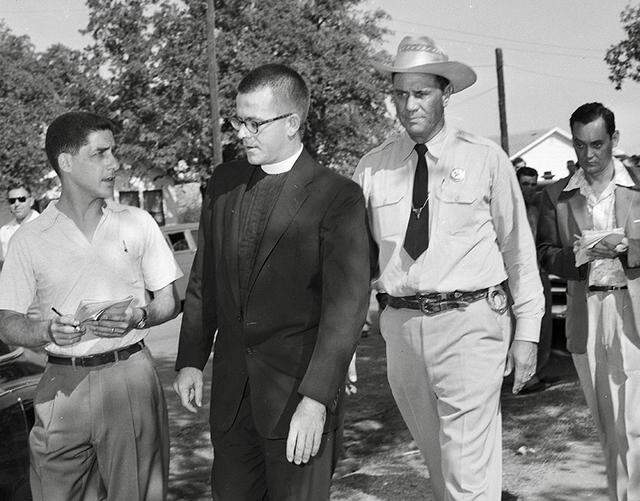 The Rev. D.W. Clark of St. Timothy’s Episcopal Church is escorted away from the mob at Mansfield High School after he was shoved on Sept. 4, 1956, during the Mansfield school desegregation incident. Texas Ranger Jay Banks of Dallas is escorting Clark. Wilburn Davis Fort Worth Star-Telegram Collection/UT Arlington Special Collections
“The Texas Rangers Baseball Club stands for equality. We condemn racism, bigotry and discrimination in all forms.”
Now, the Rangers have pivoted like a second baseman turning a double play.
The team brought in a statue from a cruel era when Texas defied the rule of law.
Look, I love Texas’ Old West imagery.
The statues in the Fort Worth Stockyards area show the real West — Black rodeo stars like Bill Pickett, Comanche war chief-turned-rancher Quanah Parker, pioneers like the unnamed Vaquero de Fort Worth.
I’ve always thought the baseball team was named for the Texas Rangers of that era. Those were the frontier lawmen known since 1896 for the boast, “one riot, one Ranger.”
For years, the Rangers team even used theme music on TV, radio and in the stadium from the 1936 Paramount movie, “The Texas Rangers.” It’s considered one of the all-time classic Western soundtracks.
That was an era of horrendous brutality but also incredible heroism.
The 20th-century law enforcement Rangers are heroic crimefighters nabbing bankrobbers, tracking serial killers and busting up organized crime.
We are very proud of the Texas Rangers.
But no Ranger can be very proud of this statue.
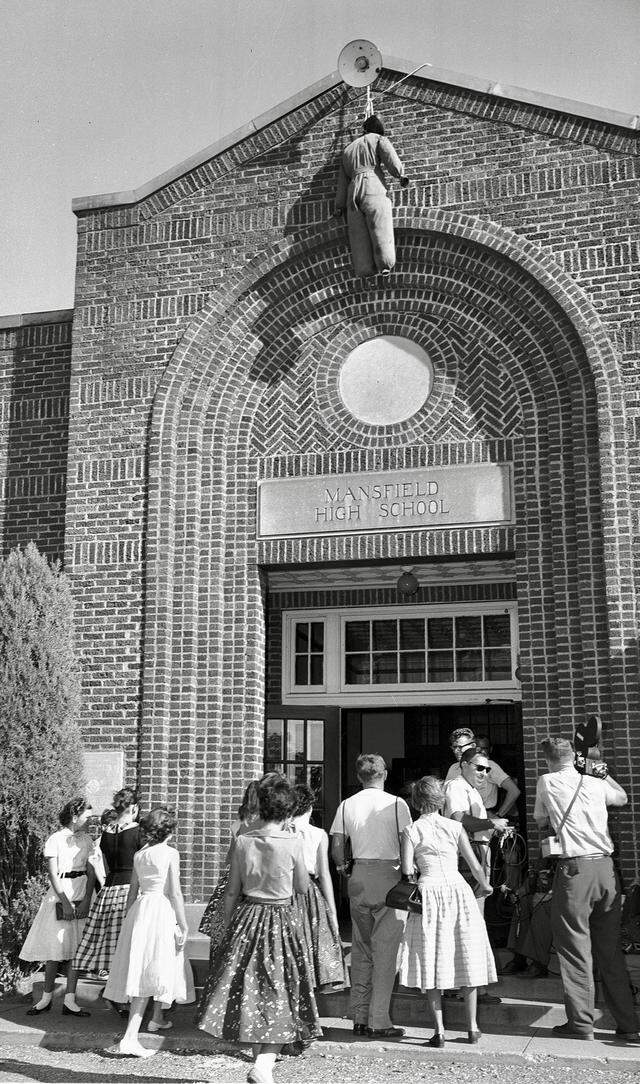 An effigy, the second at the school, was left hanging from the roof over the door of Mansfield High School on Aug. 31, 1956. It hung there for days and only white students enrolled during a school desegregation incident. Fort Worth Star-Telegram Collection Fort Worth Star-Telegram Collection/UT Arlington Special Collections
 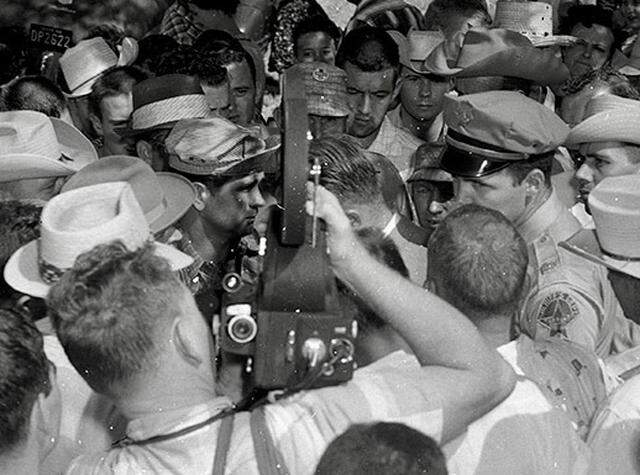 Gordon Yoder, a Dallas camera operator for a national news service, aims his camera at a Tarrant County assistant district attorney, Grady Hight, as angry Mansfield men surround them on Aug. 31, 1956, during the Mansfield school desegregation incident. Seconds later, Yoder’s camera was smashed as he was roughed up. Bob Bain Fort Worth Star-Telegram Collection/UT Arlington Special Collections
 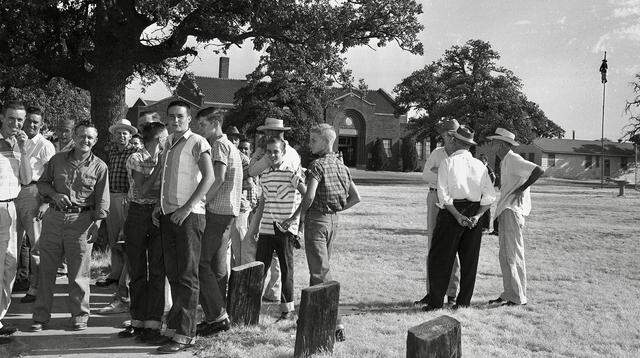 Mansfield High School boys and adults guard the entrance to the school on Aug. 30, 1956, to prevent Black students from registering as an effigy hangs from the flagpole. Fort Worth Star-Telegram Collection Fort Worth Star-Telegram Collection/UT Arlington Special Collections
 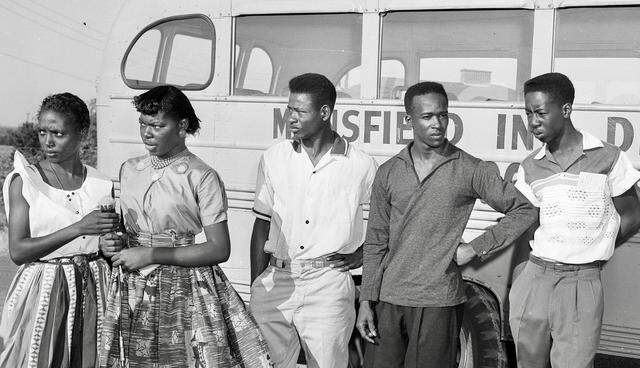 Students Gracie Smith, Hattie Neal, Floyd Moody, John Hicks and Charles Moody were not allowed to enroll at Mansfield High School during the 1956 desegregation incident. Fort Worth Star-Telegram Collection Fort Worth Star-Telegram Collection/UT Arlington Special Collections
This story was originally published March 19, 2026 at 12:26 PM.
Related Stories from Fort Worth Star-Telegram

Bud Kennedy is a Fort Worth Star-Telegram opinion columnist. In a 54-year Texas newspaper career, he has covered two Super Bowls, a presidential inauguration, seven national political conventions and 19 Texas Legislature sessions..
Support my work with a digital subscription