
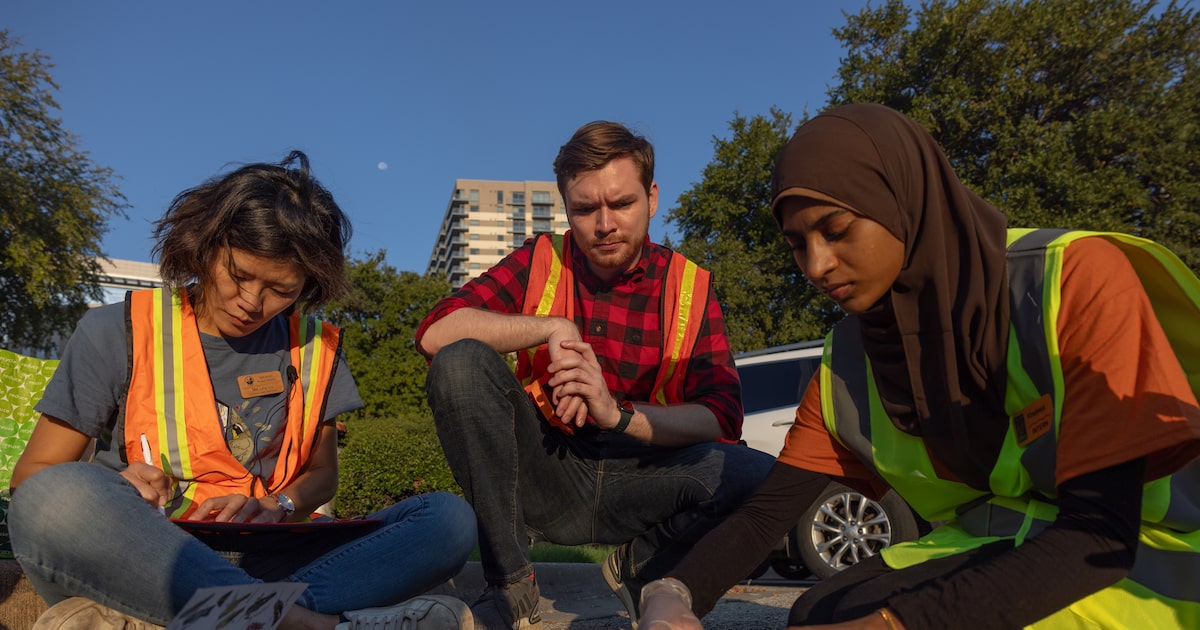
Before sunrise in downtown Dallas, volunteers gather in near silence, scanning sidewalks and glass towers for signs of birds that didn’t survive the night’s migration.
Those early morning walks are part of a coordinated effort led this spring by Lights Out, Dallas! and partner groups to document and reduce bird collisions across North Texas.
The migration surveys, running from March 16 through May 31, invite residents to take part in hands-on conservation work.
Volunteers meet at 6 a.m., Sunday through Friday, at the Perot Museum of Nature and Science parking lot before heading out along designated routes. Their goal is to document injured or dead birds, track collision patterns and contribute to a growing body of data used by researchers and conservationists.
Breaking News
For some, the experience is difficult but necessary, said Mei Ling Liu, community conservation director at the Texas Conservation Alliance, a nonprofit that protects wildlife and natural resources.
“Those who see it firsthand, birds hitting windows over and over again, it’s really powerful,” Liu said. “It changes how people understand what’s happening in the city.”
Birds that are collected are sent to a research facility at Texas A&M Biodiversity Research and Teaching Collection, where they are preserved and studied. Organizers say the specimens help advance scientific understanding of bird populations and migration challenges.
The surveys also serve a broader purpose: building a long-term dataset that can be shared with researchers studying urban wildlife and conservation strategies.
The effort comes as local leaders and institutions take steps to address the risks birds face in cities. The Kay Bailey Hutchison Convention Center plans to incorporate bird-friendly glass, a move aimed at reducing deadly collisions with reflective surfaces.
Even though the work has scientific goals, organizers say the barrier to entry is low. The main requirement is a willingness to wake up early and participate.
“Nobody needs any background about birds,” Liu said. “They can just come out and find out what’s going on.”
Participants walk predetermined routes, record findings and return to log data with survey leaders.
Organizers hope that firsthand exposure, combined with practical solutions, will encourage more residents to take action.
People who cannot participate in the surveys can still contribute by documenting any bird collisions they observe in public places or at home using iNaturalist, an app that allows people to participate from their backyards.
While downtown buildings pose a well-known threat, organizers say many collisions happen closer to home.
“Research shows a lot of collisions happen in residential areas,” Liu said. “People find them right in their backyard.”
To address that, conservation groups are expanding outreach efforts beyond surveys. A new workshop at the Dogwood Canyon Audubon Center will teach residents how to make simple, low-cost solutions to prevent birds from striking windows.
The workshop will take place at 1 p.m. on April 26, and focuses on tools like hanging cords over windows to make glass visible to birds and other options, such as window films. The event is free, but registration is required.
As millions of birds pass through North Texas this spring, conservationists say community involvement will play a key role in reducing preventable deaths.
For more information on volunteering or attending the workshop, visit the Lights Out DFW website.