
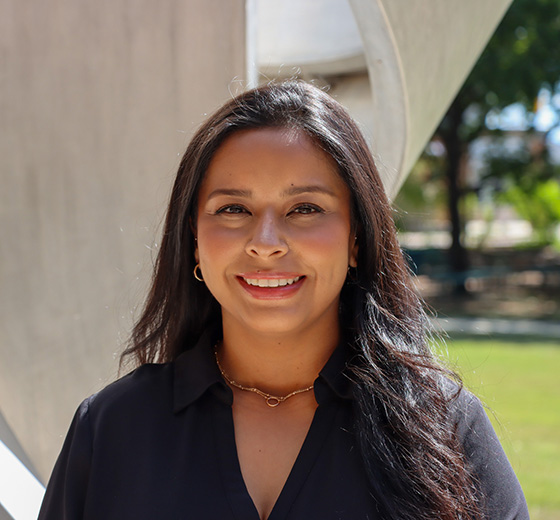
A conversation with Ashley Cuevas, Clinical Director of the Sarabia Family Counseling Center, about student training, community impact and coming full circle.
Q: What is the Sarabia Family Counseling Center (SFCC), and who does it serve?
A: The counseling center is a training clinic located at The UT San Antonio Downtown Campus where our master’s and doctoral-level counseling students provide counseling services. Our counselors-in-training are closely monitored, trained and provided with onsite supervision from site supervisors composed of faculty, staff, and doctoral-level students. We see community members from San Antonio who are dealing with a variety of issues like anxiety, depression, low self-esteem, day-to-day stressors, and relationship issues. Since we are a training clinic, we monitor clients using a pre-screening process to ensure the counseling services are a good fit for both the client and the student counselor. Each semester, we have about 12 students, with each one seeing around three to four clients. That means we are helping about 36 to 48 clients per semester while providing our students with real clinical experience in a supervised setting.
Q: How did your academic and professional journey lead to your role as Clinical Director at the SFCC?
A: I graduated with my master’s in 2014 and PhD in 2017 from The University of Texas at San Antonio and it seemed like a natural fit to continue my journey here. I started as an adjunct professor in early 2018, and in early 2022, I was asked to step into the interim director role. By August 2022, I moved into a full-time position as an Assistant Professor of Practice in the Department of Counseling and the clinical director of the SFCC. What’s special is that I was already familiar with the clinic even during my doctoral program, where I was supervising. When the opportunity to become the Clinical Director came up, it felt like everything had come full circle. I was able to continue my work at my alma mater and contribute to training the next generation of counselors. It was something I had wanted to do, and it naturally landed me in this position.
Q: As Clinical Director, what are your primary responsibilities at the SFCC?
A: In terms of day-to-day operations, I manage student, staff and doctoral supervisor schedules to ensure that students receive both live and direct supervision. This helps create a well-rounded training experience where students are supported academically, clinically and professionally. I oversee any ethical or legal issues that arise, making sure procedures and protocols are followed. I supervise the clinic supervisors and assist them with concerns or questions related to their supervisees. I also assist staff with any operation issues or concerns from printing trouble to student and client questions. When I first stepped into the role, one of the biggest challenges and primary responsibilities was guiding the clinic through the transition back to in-person services after the COVID-19 pandemic. Helping re-establish in-person counseling and rebuilding client engagement was a significant part of my early leadership.
Q: Counseling services at the SFCC are provided by master’s and doctoral-level counseling students under faculty supervision. How does this model help prepare students for their future careers?
A: What’s really helpful is the live feedback and tapescript feedback, which is a transcript of sessions provided by the students that showcases their used skills and offers opportunities to provide alternate skills that highlight the growth and development of the student’s learning. Related to the live feedback it’s beneficial especially if an intervention is needed. With live feedback, the supervisors can address a risk assessment or session concern in the moment, which gives the students hands on training or assistance withrisk or crisis as they unfold. We place a strong focus on helping them build basic counseling skills, especially the ability to connect with clients. All of us — the faculty, staff, doctoral supervisors and peers — have eyes on both the client and the student, creating a well-supported learning environment. The learning comes from experience, starting with basic skills and progressing to more advanced skills such as administering necessary assessment. Many students come in unsure of how to work with clients or what to expect when they’re sitting across from a real person, but over time they begin to feel much more prepared and confident. Sessions are also recorded and monitored, giving students the chance to review their work with supervisors during supervision sessions. Thestudents also get feedback during class time, which is called group supervision. Further feedback comes from a class assignment that requires the student to present a formal case presentation, which offers the instructor and peers more insight into the client’s background, presenting issues, and treatment plan.
Q: Can you tell us about the partnerships the SFCC has with the community, and how both the center and the community benefit from these collaborations?
A: Some of our current partnerships include the Juvenile Justice Partnership, Juror Counseling Program, and more recently, the San Antonio Police Department. Through our Juvenile Justice Partnership, we provide services to at-risk youth and their parents who are required by Municipial Court to attend psychoeducational group sessions. The curriculum focuses on topics such as communication, setting boundaries, understanding the impact of drugs and alcohol, and improving parent-child relationships. Our most recent population that we service are first responders from the San Antonio Police Department (SAPD). This includes front desk personnel, officers, staff, or any SAPD member who may need assistance with anything related to compassion fatigue, communication, boundary setting, emotional support, or day-to-day stressors. These partnerships give the students the chance to expand their comfort zones, apply their skills and gain experience with different populations. The benefit to these collaborations is multi-sided. The students get to apply their learned counseling skills and work through challenges amongst successes with the help of a trained supervisor, the supervisors get to witness the growth and development of the trained counselors, and the clients have access to a safe, nonjudgmental clinical space eager to offer help and guidance.
View this story, along with the rest of the second issue of Somos, by visiting ISSUU. Somos is the annual publication of the College of Education and Human Development at The University of Texas at San Antonio. It is created for students, alumni, faculty, staff and friends of the college. The magazine highlights the achievements, partnerships, and goals of the college.