
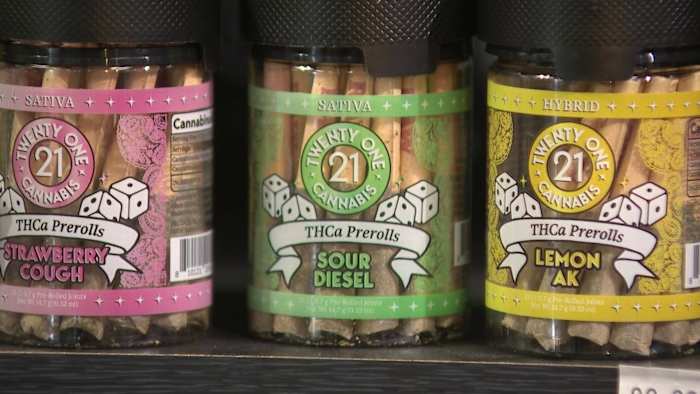
SAN ANTONIO – Texas hemp businesses avoided an outright THC ban during the last legislative session, but San Antonio businesses say a change to how acceptable THC levels are calculated will take a popular class of products off their shelves.
Tetrahydrocannabinol (THC) is the principal psychoactive component of marijuana. While marijuana is still illegal, the legalization of hemp under the 2018 U.S. Farm Bill and a 2019 Texas law inadvertently paved the way for a multibillion-dollar industry of hemp-derived products that give users a “high,” including THCA flower.
THCA on its own isn’t psychoactive, but when heated or smoked, it converts into delta-9 THC. That has led to its popularity in smoke shops, including in San Antonio.
But new state rules announced by the Texas Department of State Health Services are set to take effect March 31, and they require factoring in THCA to calculate whether a consumable hemp product meets acceptable THC levels.
According to the state law library, that effectively bans smokable products.
Jacob Warner, a co-owner of Alamo Bud Co., said 70% of their sales are smokable products. The rest comes from edibles or drinks.
“So March 31st, at the end of the business day, all product would be taken off the shelf and most likely shipped out of state to other suppliers,” he told KSAT.
Jacqueline Walji, who owns Mellow Monkey with her husband, said THCA flower and concentrate make up about half their business.
Going forward will be rough, Walji said, and other businesses specializing in selling flower have told her they’ll be closing.
“I’ve even noticed when I’m driving around that I’ve already seen some of them shut down. So definitely going to take out a lot of the stores around here,” she said.
The new rules also drastically raise the annual licensing fees for hemp businesses. Retailers will pay $5,000 per location, and manufacturers will pay $10,000.
Currently, the state charges them $155 and $258, respectively.
Gov. Greg Abbott vetoed a ban on THC products in the last legislative session but couldn’t convince the Legislature to pass a set of regulations.
Instead, he ordered DSHS in September to begin looking at its rules for possible revision.
The Texas Hemp Business Council wrote on its website it believes “several provisions” of the new rules “exceed the intent of the law” and that it plans to challenge their implementation in court.
Executive Director Mark Bordas told KSAT the licensing costs and new calculation for THC levels were the principal areas with which they had concerns.
“We think in certain instances, the state agency has overstepped its bounds and its authority,” he said. “And … some of the changing of language and things of that nature should be reserved for the Legislature, and not a state regulatory agency.”
Even beyond the state-level fight, a larger threat from the federal government looms on the horizon.
Within the legislation to end the longest-ever government shutdown in November 2025 was language to ban hemp-derived THC products that have anything more than 0.4 milligrams of THC or other cannabinoids that could produce a high per container.
The change is scheduled to become effective Nov. 12.
Read also:
Copyright 2026 by KSAT – All rights reserved.