
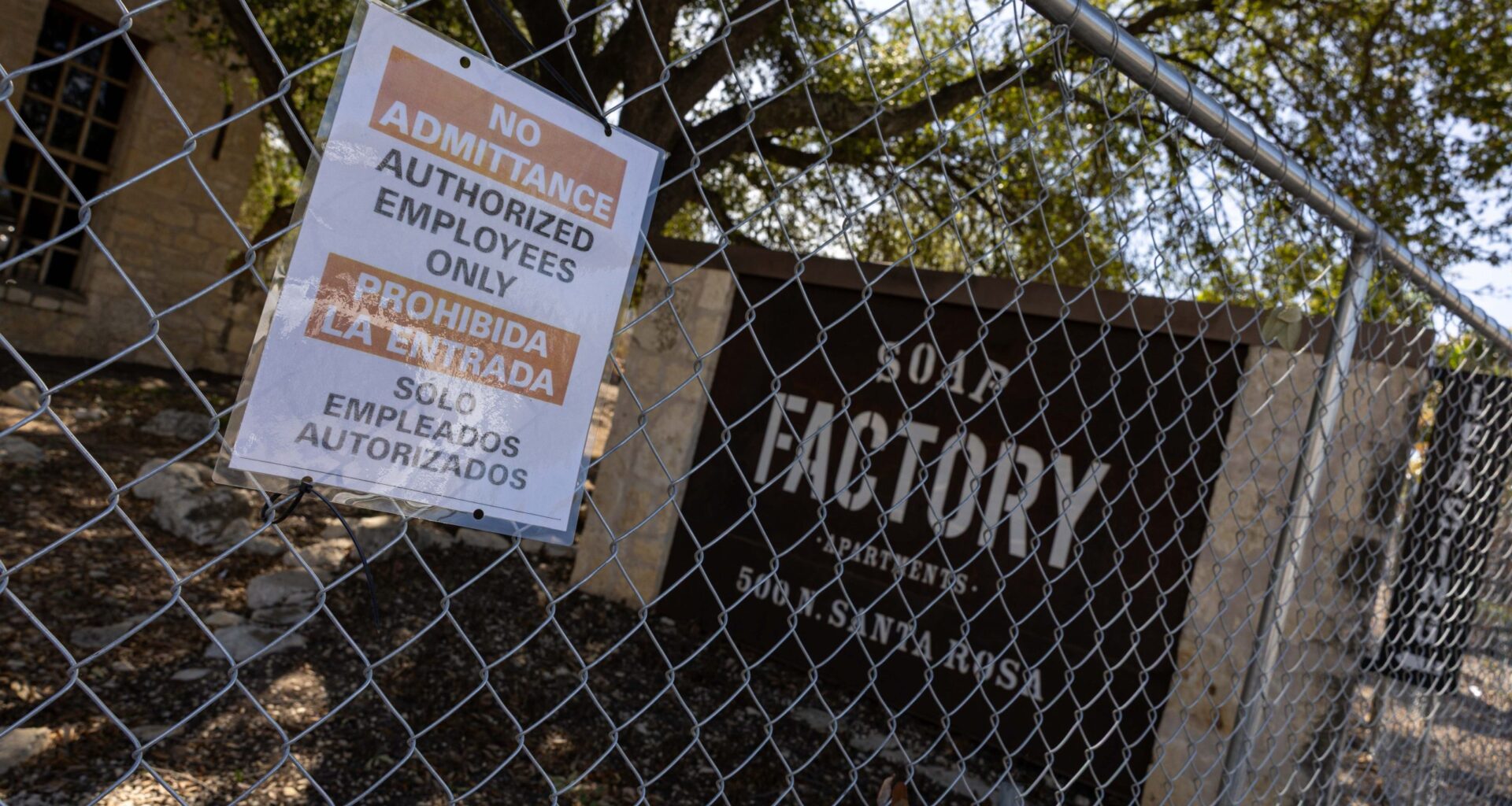
Six months ago, the Soap Factory apartment complex wrapped up its first wave of rehousing to make way for a mixed-use district around a future Missions ballpark.
Now, after a controversial, years-long debate over affordability and displacement, San Antonio City Council members want to take a closer look on how future development projects will impact housing.
City Council unanimously approved updates to its tax increment funding rules on Thursday. The rules now require construction projects to put together a displacement impact assessment for surrounding neighborhoods.
Tax increment funding, or funding from tax increment reinvestment zones, has been earmarked for several large downtown projects, including the new Missions minor league baseball park and a new arena for the San Antonio Spurs.
Previous rules stated that TIF-funded projects could not directly displace residents and required a displacement impact assessment for housing projects, but the council’s new rules expand which projects can be examined for possible displacement and when and where that kind of scrutiny can take place.
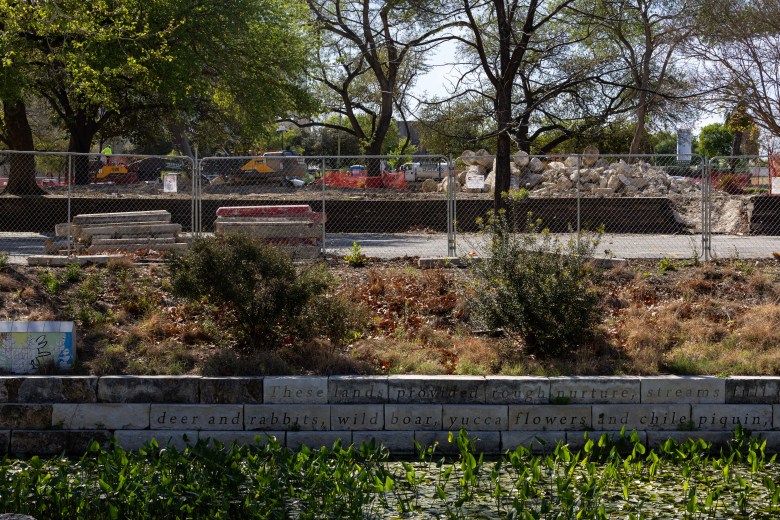 Demolition on the Soap Factory Apartments is underway at the phase one lot on the 500 block of North Santa Rosa and West Martin streets to make way for Urban Weston’s Missions Baseball development seen from San Pedro Creek on March 18, 2026. Credit: Amber Esparza / San Antonio Report
The rules now require an impact assessment for all TIF-funded construction and sets out a specific area of at least a quarter-mile around any project that must be studied. Officials can look at displacement two years before any TIF application, as well as future additions to a project.
“The purpose of the updates were really to ensure that we have residential stability and that we are identifying any potential displacement risk early so we can proactively work with development teams and mitigate any negative impacts to the surrounding neighborhood on this on any projects,” said Veronica Garcia, director of the city’s Neighborhood and Housing Services Department, who laid out the updates at a Housing Commission meeting last week.
If the assessment shows construction displacing residents, the developer must come up with a plan to “mitigate the effects of potential displacement.” Department officials said they would “evaluate projects on a case-by-case basis” and that the new policy only applies to prospective TIF-funded projects after March 19, 2026.
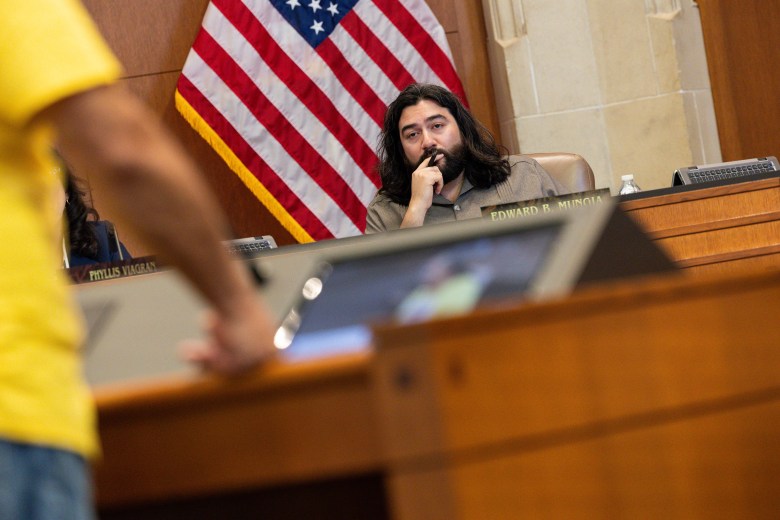 District 4 Councilman Edward Mungia listens to comments from the public during a city council special session meeting discussing the censure of San Antonio Mayor Gina Ortiz Jones on Feb. 27, 2026. Credit: Amber Esparza / San Antonio Report
Councilman Edward Mungia (D4) led the effort to make the changes after seeing the city’s assessment of the Soap Factory Apartments.
“We’re splitting hairs with that,” Mungia replied. “I understand that the actual physical project didn’t displace [anyone], but the plan that encompasses it did.”
At a Jan. 17 council meeting, city officials said the Missions’ new ballpark is not displacing residents because it’s other parts of the project — a mixed-use development around the stadium — that are being built in the Soap Factory footprint.
What happened at Soap Factory?
A total of 189 households needed to move out of the Soap Factory apartments before the first phase of demolition in September, after more than a year of back-and-forth discussions about if and how the buildings should be demolished.
 Credit: Courtesy / City of San Antonio
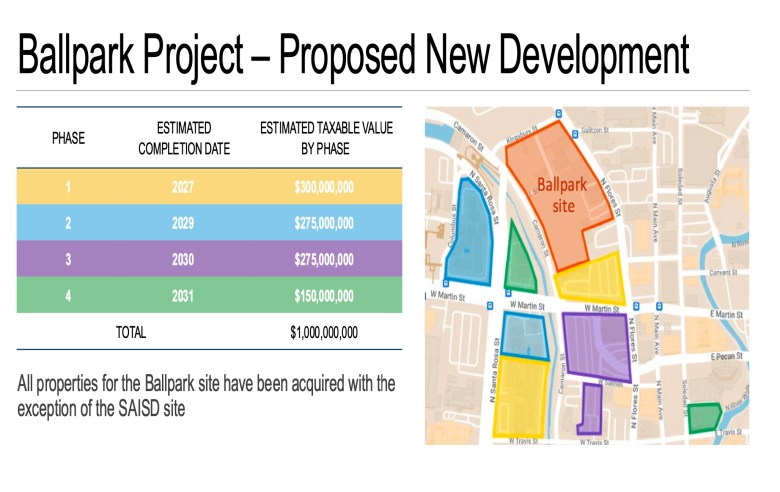
Downtown developer Weston Urban purchased the 381-unit apartment complex in 2023 and announced plans to build a mixed-use district around the stadium in August 2024. This week, those plans were revealed in detail — a 160-key hotel and two residential towers with nearly 700 housing units combined.
The ballpark itself would cost $160 million. The Missions’ ownership group would contribute $34 million upfront and $126 million would come from the Houston Street TIRZ. That’s the same kind of public funding mechanism that got new rules from City Council this week.
Back in August 2024, the city asked Weston Urban to guarantee development — now in the form of its proposed hotel and residential construction — and to rehouse residents of all 381 units at the Soap Factory.
The apartments were some of the last “naturally occurring” affordable housing in downtown. This is because the complex was built in the 1970s and lacked upgraded amenities. Monthly rents averaged $700 for studio apartments and $1,300 for two-bedroom apartments.
The apartments are on the edge of the downtown ZIP code, where apartments tend to be more expensive. According to the National Low-Income Housing Coalition, fair market rent for one-bedroom and two-bedroom apartments a few blocks away are $1,260 and $1,530, respectively.
Rent for units at 300 Main, also owned by Weston Urban, start at $1,600 for a studio.
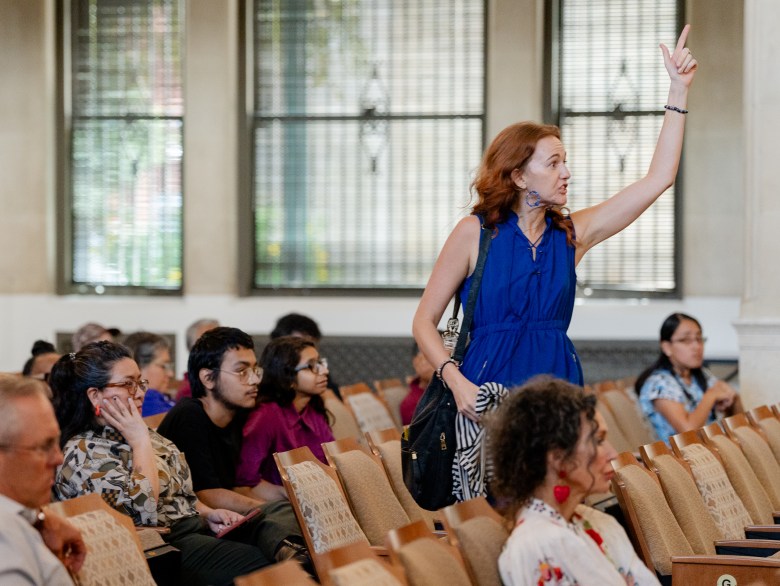 Maureen Galindo, who was a resident of the Soap Factory apartments, storms out of a city council special session as Assistant City Manager Lori Houston talked about the displacement of residents for the development of a Missions baseball stadium downtown on Sept. 29, 2024. Luis Alvarado and his girlfriend Celia Coronado can be seen seated behind Galindo. Credit: Brenda Bazán / San Antonio Report
The developer and the city proposed a novel rehousing plan 18 months ago. Each entity committed $250,000, totaling half a million dollars, in relocation assistance funds to move residents off the property.
Now, after the demolition and move-outs have started, the results of that rehousing program, which Weston Urban called the first of its kind in San Antonio, are clearer.
Soap Factory is being demolished in three phases. The first was in 2025 with subsequent phases planned before 2030.
Weston Urban and the city have since helped 99 affected households find new housing outside Soap Factory, while another 43 households have been temporarily moved to apartments that will be demolished later.
In an October interview, Garcia and Weston Urban CEO Randy Smith shared details about that relocation effort. Because it was entirely new to San Antonio, they said, there was no clear blueprint for how to do it.
“I learned that this can be done at a micro-scale, with a city partner in a way that listens to people and respects people and ultimately achieves the goal that it’s set out,” Smith said.
Weston Urban said it didn’t raise rents and left dozens of apartments open at Soap Factory that wouldn’t be demolished for years.
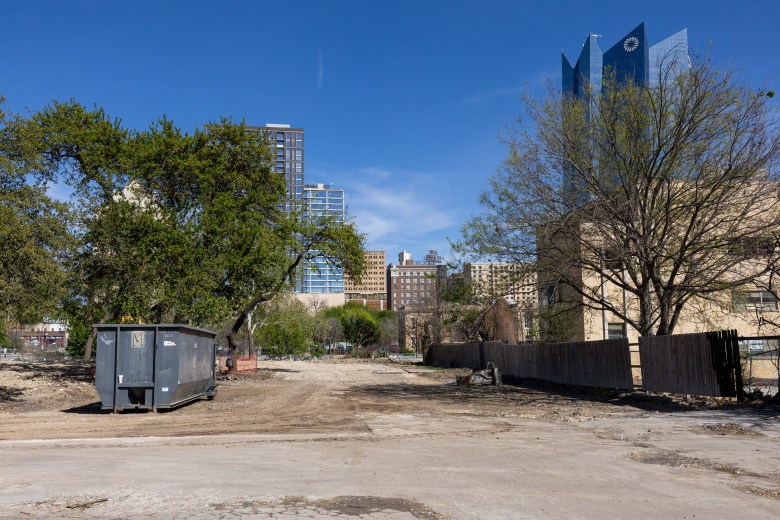 Demolition on the Soap Factory Apartments is underway at the phase one lot on the 500 block of North Santa Rosa and West Martin streets to make way for Urban Weston’s Missions Baseball development seen from the former parking lot entrance on Santa Rosa across from the CHRISTUS Children’s Hospital on March 18, 2026. Credit: Amber Esparza / San Antonio Report
The company tried not to pursue evictions, even when residents were months behind on rent, said David Robinson, the former Weston Urban development manager who helped oversee the rehousing effort.
“No leases were ended prematurely,” Robinson said in October. “We granted extensions month to month. Throughout the last year, they’ve had ultimate flexibility to leave whenever they want, with no payment penalties.”
On Friday, city officials said just over 75% of Soap Factory residents had either been moved into later construction phases or rehoused entirely.
Weston Urban worked with nonprofit Building Better Communities to provide wraparound services when residents moved out. BBC and city staff provided help on a case-by-case basis, helping residents find new homes in their desired neighborhoods and assisting with transportation, job hunting and other needs.
Residents who were current on their rent payments were qualified to receive $2,500 from the relocation fund, but those who were behind on rent did not qualify. City officials said 37 households did not qualify for the assistance and 10 others could not be contacted.
Philip Adcock, a resident, housing advocate and vocal critic of the planned demolition, said some residents were unable to find stable housing in San Antonio. He did not qualify for the relocation assistance and in the fall he moved to Los Angeles.
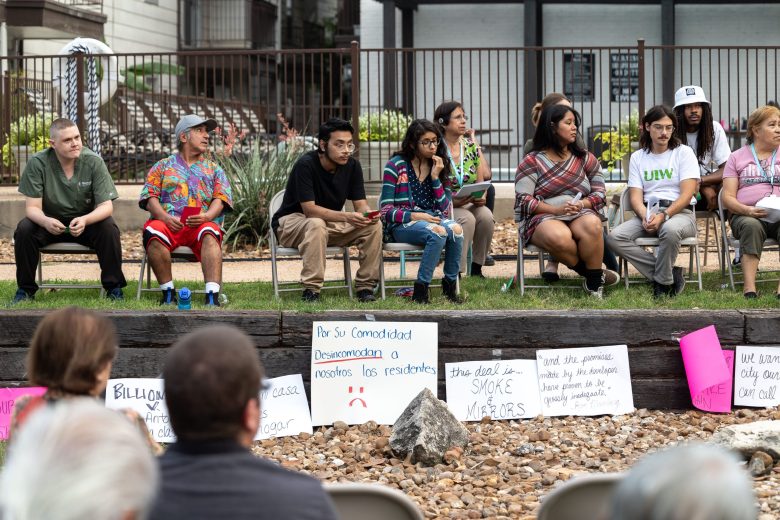 Residents of Soap Factory Apartments take turns addressing community members and housing advocates during a forum outside of the apartment complex at the 500 block of North Santa Rosa Street on Sept. 9, 2024. Luis Alvarado and his girlfriend Celia Coronado can be seen seated center front. Credit: Bria Woods / San Antonio Report
Luis Alvarado and his wife were living in their car before they moved into the Soap Factory in 2024. Alvarado had spent the prior two years without housing.
“I thought we could progress,” he said. “It was very much a foundation we thought we could build on.”
Alvarado said that stability didn’t last. Rehousing was stressful and he lost his job during that time, causing him to fall behind on rent and fail to qualify for assistance.
Other residents who did receive assistance, like Robert Laurence, said communication to residents about what to expect could have been better.
“It was a lot of work on my end to follow up all the time. It seems like I was taking ownership of following up,” Laurence said during an interview in July.
Officials said communication had been a challenge. Building trust with the residents took time. There were gaps between when the relocation program was announced and when it was implemented.
“We learned that it’s going to take longer than the time that you think it’s going to take, and a lot of that is because a lot of our work is continuing to build trust in the community,” Garcia said.
Soap Factory resident Gabriel Garcia moved from Phase I to Phase II in September, which gave him more time. Communication with management had been clear, he said while moving, and he was ready to move when the time came.
But for residents like Alvarado, the process was much rockier. He and his wife are currently staying with a relative, trying to get back to some stability.
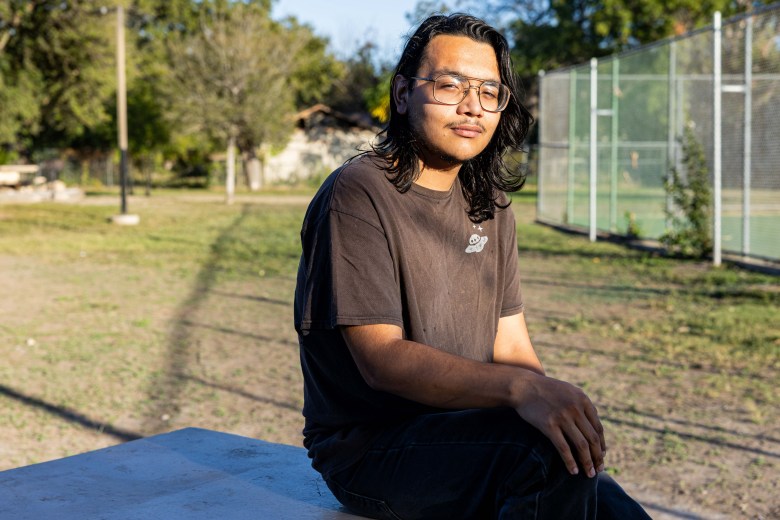 Former Soap Factory Apartments resident Luis Alvarado talked with the San Antonio Report about his housing transition after he was displaced from his unit that was located in phase one the Urban Weston Missions Baseball development on Nov. 11, 2025. Credit: Amber Esparza / San Antonio Report
Alvarado said the experience has eroded his faith in local government. He doesn’t want to rent an apartment again, and added that he’s not even sure he would want to buy a home in San Antonio.
“This isn’t us falling through the cracks, this is you sifting us so we’ll fall through,” he said. “I would like the city to do better.”
More development on the horizon
For Weston Urban, the ballpark project was an opportunity to build denser, more diverse and higher quality housing downtown. The Soap Factory apartments were 50 years old. Residents and landlords agreed the building needed upgrades.
“Absent some sort of major governmental intervention, these type of properties cannot sustain themselves in urban centers,” Smith said in October. “We are in the business of developing and redeveloping downtown … that means a broad range of product types at a broad range of price points.
“Every great American city has a great downtown, we should aspire to be a great American city,” he added later.
Smith said the rehousing program at Soap Factory will continue for the more than 200 units that are in Phases II and III.
The Missions baseball team currently plays at the aging Nelson Wolff Municipal stadium on the West Side and its owners plan to move downtown in 2028.
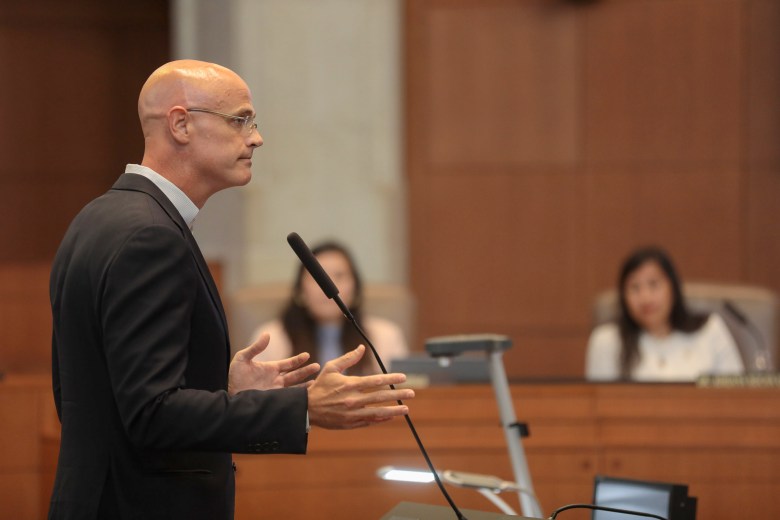 Weston Urban CEO and part owner of the San Antonio Missions Randy Smith appeals to City Council to vote in favor of the development of a downtown ballpark. Credit: Scott Ball / San Antonio Report
Adcock argued it would have been worth upgrading the apartments to keep people housed. Alvarado asked who benefits from future development as the city prepares for a new baseball stadium and basketball arena in the downtown core.
“I’ve definitely lost a lot of faith and there’s a lot of sour in my mouth with anything government,” Alvarado said.
It’s not the first time a major project has affected housing in San Antonio. In the 1960s, a reported 1,600 people were displaced to build Hemisfair, which was part of a larger urban renewal effort that altered the city’s core.
Affordable housing continues to be a broad concern downtown. Nonprofits like COPS/Metro and Esperanza Peace and Justice Center argued against displacement in 2024, when city officials were discussing the plan for a new ballpark.
Mungia was not on council when the funding plan for the new stadium was approved, but he shares those concerns about affordable housing.
“We don’t have a lot of affordable housing for people below 60% of the area median income,” he said on Friday. “We can’t continue to forget that there are a lack of affordable units downtown.”
Mungia said the new rules would give city staff clearer direction when it comes to affordable housing and preventing displacement when evaluating projects.
“Step one is to be more transparent about projects and not say ‘it’s not displacing anybody’ when we have a displacement fund,” he said.